Cycling cadence plays a central role in how efficiently and comfortably you ride.
Your cadence determines how much muscular strain you accumulate, how well you manage your energy, and how effectively you handle different terrains and intensities.
In this guide, you’ll learn what cycling cadence is, what an optimal cadence range looks like, how to train at different pedaling speeds, and how cadence drills and cadence workouts can improve your performance.
You’ll also get practical sessions you can start using today to develop smoother, faster, and more efficient pedaling.
What is Cycling Cadence?
Cycling cadence is the number of pedal revolutions you complete in one minute, measured in revolutions per minute (RPM).It describes how fast you are turning the pedals and is a key metric for controlling your pedaling rhythm, managing fatigue, and improving efficiency on the bike.
A consistent cycling cadence can help you manage your energy output, reduce muscle fatigue, and improve your overall performance.
All you need to measure your cycling cadence is a bike cadence sensor; our guide compares nine, from the Garmin to the budget Magene S314.
Learn this and more definitions in our complete cycling definitions library.
What is a Good Cycling Cadence?
Although several studies have been conducted about cadence, there isn't a science-based magic number to adopt.A “good” or performant cycling cadence is often individualized, as it can vary based on your physiology, bike setup, and riding conditions.
However, for most cyclists, a cadence between 80-100 RPM is considered efficient and sustainable over long distances.
This range strikes a balance between exerting too much force with each pedal stroke—which can lead to rapid fatigue—and pedaling too quickly, which can be inefficient and difficult to maintain.
A higher cadence may benefit you by reducing the strain on your muscles and joints, conserving energy, and possibly preventing injuries.
Conversely, a lower cadence emphasizes power, which might suit certain terrains or building strength.
Incorporating cadence drills into your workouts can enhance your neuromuscular coordination, increase your leg speed, and improve your body’s ability to process lactate, all of which contribute to a more performant cycling experience.
Should I Train At Different Cadences?
Variability in your training regime is key to becoming a well-rounded cyclist.By incorporating different cadences into your workouts, you challenge your body to adapt to various demands, which can improve strength and endurance.
These cadence changes follow the same principles used in interval training, which relies on alternating efforts to improve adaptation and performance.
When you train at a low cadence, you focus on force production and muscle endurance, which is beneficial for conquering steep climbs or riding against strong headwinds. How low you actually go on a climb depends on your gearing as much as your legs, and our gear ratio calculator shows the cadence your chainring and cassette give you at a given power and gradient.
On the other hand, high cycling cadence training emphasizes leg speed and efficiency, which can help you maintain a brisk pace without overtaxing your muscles.
It’s essential to recognize that your muscles and cardiovascular system respond differently to changes in cadence.
Training at a higher cadence can improve cardiovascular fitness, while lower cadence work can increase muscular strength.
This versatility in your pedaling cadence can also prevent overuse injuries by distributing the workload across different muscle groups and joints.
Moreover, by becoming proficient at adjusting your cadence, you’ll be better equipped to handle the unpredictable nature of road conditions and race scenarios, making you a more adaptable and an ‘all-around’ cyclist.
Benefits of High Cadence Training
By pedaling at a higher RPM, you reduce the force required for each stroke, which lessens the stress on your muscles and joints.This approach not only conserves energy but also minimizes the risk of injury, allowing you to ride longer and more comfortably.
Moreover, as your cardiovascular system adapts to the increased demand, you’ll experience improvements in aerobic capacity and endurance.
Incorporating high cadence drills into your routine also hones your neuromuscular coordination, enabling smoother and more synchronized movements between your nervous system and muscles.
This adaptability is invaluable, whether aiming for a personal best in a time trial training plan or seeking to outpace the competition in a sprint finish.
Together, these benefits make high-cadence work one of the most effective ways to improve efficiency without adding excessive training stress.
Cadence Drills to Improve Your Pedaling Technique
Cadence drills are short, focused exercises designed to improve specific elements of your pedaling technique.A drill is not a full workout; instead, it’s a technical block you insert inside a training session to develop skills like leg speed, smoothness, neuromuscular coordination, or strength at different cadences.
These drills typically last only a few minutes and can be repeated multiple times within a workout.
Because they target one skill at a time, they’re one of the most effective ways to build better cadence control and prepare your body to handle changes in pace, terrain, and intensity.
Below you’ll find a set of cadence drills you can integrate into any endurance ride, interval workout, or structured training plan.
High RPM Cadence Drill
This drill focuses on improving leg speed and neuromuscular coordination.Ride in an easy gear and gradually increase your cadence until you reach 100–120 RPM while keeping your upper body stable and avoiding bouncing.
Hold the high cadence for 30 to 60 seconds, then recover at your normal cadence for the same duration. Repeat 4 to 6 times.
High RPM drills help you develop smoother pedal strokes and better efficiency at faster leg speeds.
Low Cadence Strength Drill
A low cadence drill develops muscular strength and torque.Shift into a harder gear and ride at 50–60 RPM while maintaining a steady Zone 3 effort.
Focus on pushing evenly through the entire pedal stroke without rocking your hips.
Hold for 2 to 3 minutes, then spin easily for 2 minutes to recover.
Repeat 3 to 5 times.
These drills build the muscular endurance needed for climbs and accelerations.
Cadence Pyramid Drill
This drill teaches you how to transition smoothly between different pedaling speeds.Start at 80 RPM for 1 minute, then increase to 90 RPM for 1 minute, then 100 RPM for 1 minute.
Once you reach the peak, descend back down: 100 → 90 → 80 RPM, holding each step for 1 minute.
Recover for 2 minutes and repeat 2 to 3 times.
Cadence pyramids improve control, consistency, and your ability to adjust to terrain changes.
Variable Cadence Control Drill
This drill simulates unpredictable pace changes during group rides or races.Alternate between 30 seconds at a high cadence of 100 RPM and 30 seconds at a low cadence of 70 RPM, keeping effort in Zone 2–3.
Continue for 8 to 10 minutes, then recover for 3 minutes. Repeat 2 to 3 sets.
This drill increases your adaptability and teaches your body to switch efficiently between power-focused and speed-focused pedaling.
Cadence Workouts to Improve Cycling Efficiency
A cadence workout is a structured cycling session designed to train specific pedaling speeds, improve neuromuscular coordination, increase leg speed, and optimize efficiency.Below are three effective cadence workouts for cyclists.
Rhythm Revolution Routine (75-minute duration)
This cadence workout is designed to improve leg speed, neuromuscular coordination, and your ability to maintain smooth pedaling at higher RPMs.Each segment uses specific heart rate zones to control intensity while cadence variations shape neuromuscular response.
If you’re not sure what Zone 2 or Zone 3 means in BPM, use this heart rate zones calculator to get your Max HR based ranges.
It includes a structured warm-up, a progressive main set, and a controlled cool-down to help you build a more efficient cadence.
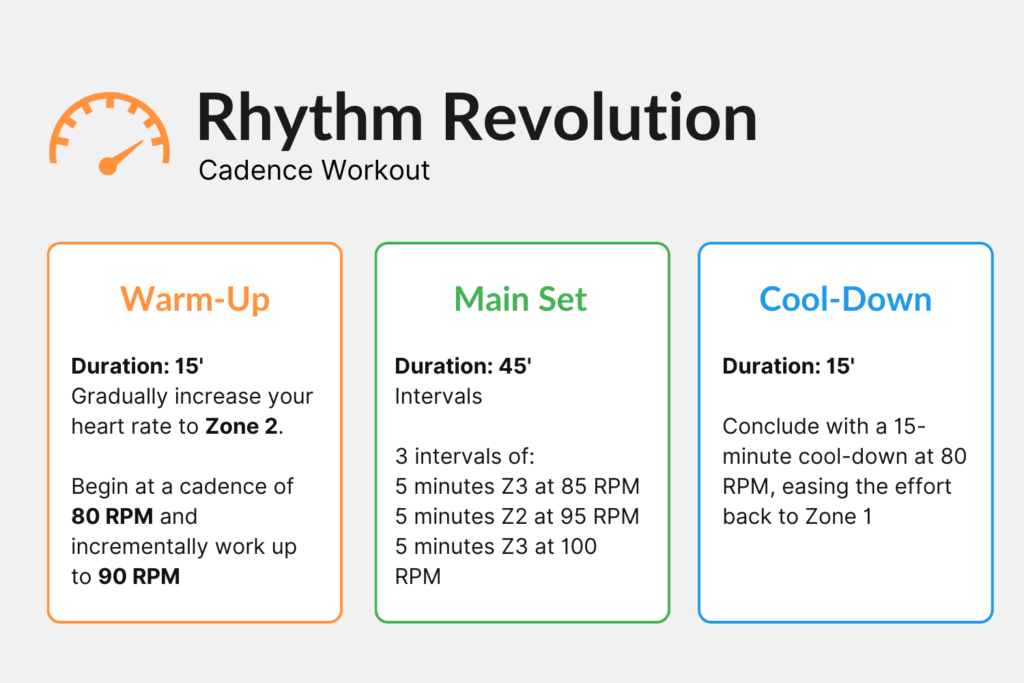
Consistently incorporating this cadence workout into your training will help you sustain higher RPMs with less fatigue, improve pedal smoothness, and increase your efficiency on both flat terrain and climbs.
| Segment | Duration | Intensity Zone | Cadence Target | Description |
|---|---|---|---|---|
| Warm-Up | 15 minutes | Zone 2 | 80 → 90 RPM | Gradually raise your heart rate into Zone 2 while increasing cadence from 80 to 90 RPM to prepare your muscles and cardiovascular system. |
| Main Set – Block 1 | 15 minutes | Z3 → Z2 → Z3 | 85 RPM → 95 RPM → 100 RPM | 5 min at Z3 @ 85 RPM, then 5 min at Z2 @ 95 RPM, finishing with 5 min at Z3 @ 100 RPM. |
| Main Set – Block 2 | 15 minutes | Z3 → Z2 → Z3 | 85 RPM → 95 RPM → 100 RPM | Repeat the 15-minute sequence to reinforce neuromuscular efficiency across varying cadences. |
| Main Set – Block 3 | 15 minutes | Z3 → Z2 → Z3 | 85 RPM → 95 RPM → 100 RPM | Final 15-minute block following the same pattern to enhance leg speed control under fatigue. |
| Cool-Down | 15 minutes | Zone 1 | Down to 80 RPM | Ease effort back to Zone 1 while letting cadence naturally return to around 80 RPM, focusing on relaxed breathing and smooth pedal strokes. |
By consistently integrating the Rhythm Revolution Routine into your training plan, you’ll notice a marked improvement in your ability to sustain a higher cadence over longer durations, which is essential for effective cycling performance.
Cadence Climber Circuit (80-minute duration)
This workout blends climbing-focused intensity with high-cadence recovery, helping you maintain pedal smoothness across changing gradients.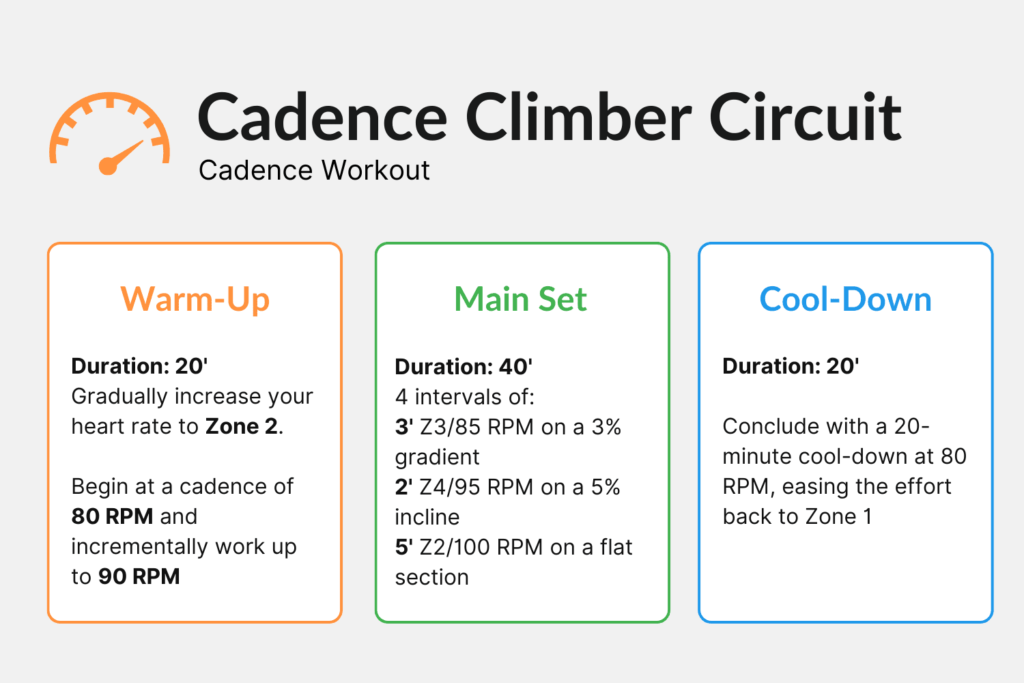
| Segment | Duration | Intensity Zone | Cadence Target | Description |
|---|---|---|---|---|
| Warm-Up | 20 minutes | Zone 1 → Zone 2 | 80 → 90 RPM | Begin at 80 RPM in Zone 1 and gradually increase intensity to Zone 2, reaching 90 RPM to prepare for the variable inclines ahead. |
| Main Set – Block 1 | 10 minutes | Z3 → Z4 → Z2 | 85–90 RPM → 90–95 RPM → 95–100 RPM | 3 min Z3 at 85–90 RPM on a 3–4 percent incline, 2 min Z4 at 90–95 RPM on a 5–6 percent incline, 5 min Z2 at 95–100 RPM on flat or slight downhill. |
| Main Set – Block 2 | 10 minutes | Z3 → Z4 → Z2 | 85–90 RPM → 90–95 RPM → 95–100 RPM | Repeat the sequence to reinforce cadence control and climbing efficiency. |
| Main Set – Block 3 | 10 minutes | Z3 → Z4 → Z2 | 85–90 RPM → 90–95 RPM → 95–100 RPM | Focus on maintaining smooth transitions as fatigue begins to accumulate. |
| Main Set – Block 4 | 10 minutes | Z3 → Z4 → Z2 | 85–90 RPM → 90–95 RPM → 95–100 RPM | Final round of incline variations to strengthen cadence consistency across gradients. |
| Cool-Down | 20 minutes | Zone 1 | Around 80 RPM | Gradually reduce effort back to Zone 1 while maintaining relaxed, smooth pedaling at approximately 80 RPM. |
Incorporating the “Cadence Climber Circuit” into your training schedule will bolster your cadence efficiency on climbs and enhance your overall leg speed and cardiovascular resilience, which are vital for tackling challenging ascents during long rides or competitive events.
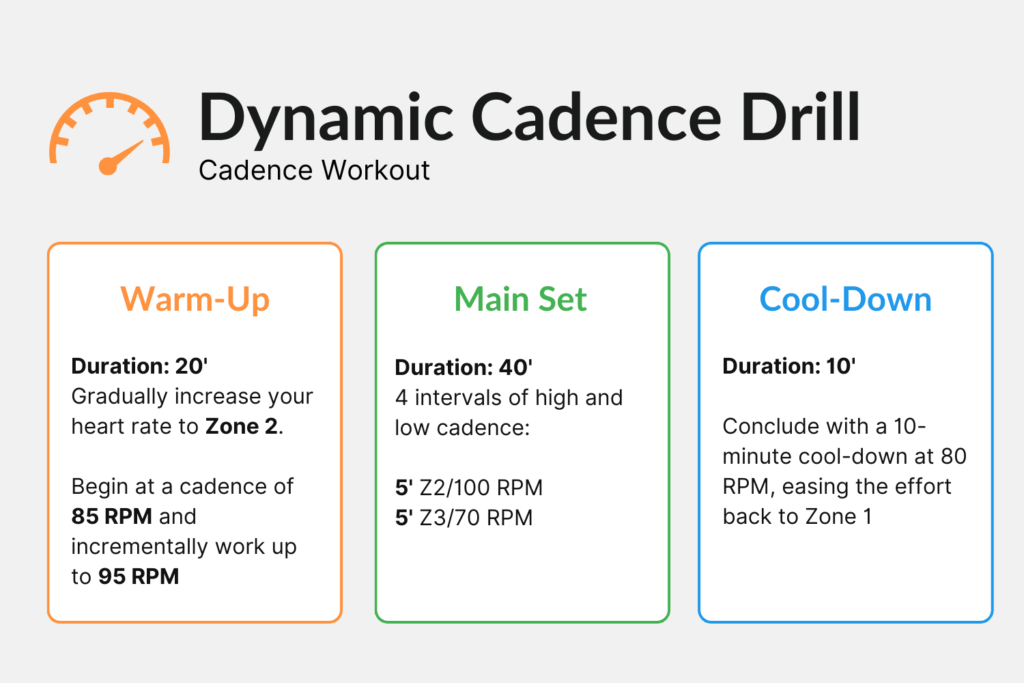
Dynamic Cadence Drill (70-minute duration)
This cadence workout trains your ability to switch rapidly between high and low pedaling speeds while maintaining control, efficiency, and smoothness.It’s ideal for cyclists who want sharper responsiveness and better cadence versatility.
| Segment | Duration | Intensity Zone | Cadence Target | Description |
|---|---|---|---|---|
| Warm-Up | 20 minutes | Zone 1 → Zone 2 | 85 → 95 RPM | Begin at 85 RPM in Zone 1 and gradually increase to 95 RPM in Zone 2 to prepare your muscles and cardiovascular system for changing cadences. |
| Main Set – Interval 1 | 10 minutes | Z2 → Z3 | 100 RPM → 70 RPM | 5 min Z2 at 100 RPM, followed by 5 min Z3 at 70 RPM, focusing on smooth transitions between cadences. |
| Main Set – Interval 2 | 10 minutes | Z2 → Z3 | 100 RPM → 70 RPM | Repeat the sequence to reinforce neuromuscular control and maintain power at low cadence. |
| Main Set – Interval 3 | 10 minutes | Z2 → Z3 | 100 RPM → 70 RPM | Continue alternating between high and low cadence to improve adaptability under moderate fatigue. |
| Main Set – Interval 4 | 10 minutes | Z2 → Z3 | 100 RPM → 70 RPM | Final interval block focusing on keeping technique sharp as intensity accumulates. |
| Cool-Down | 10 minutes | Zone 1 | Around 80 RPM | Reduce effort to Zone 1 and let cadence drift to a relaxed 80 RPM, supporting recovery and lactate clearance. |
Consistently incorporating the Dynamic Cadence Drill into your training strengthens your ability to react to pace changes, maintain efficiency across varied pedal speeds, and transition smoothly between high-RPM leg speed work and low-cadence strength efforts.
This improved cadence adaptability translates directly into better handling of rolling terrain, surges during group rides, and race situations that demand quick shifts in intensity and rhythm.
Because cadence work challenges both neuromuscular control and muscular endurance, recovery plays a major role in how much fitness you actually gain from these sessions.
Understanding post-ride recovery principles can significantly improve your adaptation.
With these drills and workouts integrated into your routine, the next step is understanding how cadence fits into your broader cycling development.
Cycling Cadence – Final Takeaways
In conclusion, mastering your cadence in cycling is a multifaceted endeavor that can significantly improve your efficiency, endurance, and overall cycling performance.Understanding cycling cadence and how it affects riding allows you to tailor your training to suit your needs and goals.
Remember, an optimal cycling cadence is typically between 80-100 RPM, which can vary based on personal physiology and riding conditions.
Training at different cycling cadences is beneficial; it prepares your body to handle various riding scenarios and helps prevent overuse injuries.
High cadence training, in particular, can enhance your cardiovascular fitness and neuromuscular coordination, leading to better performance and stamina.
By incorporating structured workouts like the “Rhythm Revolution Routine,” “Cadence Climber Circuit,” and “Dynamic Cadence Drill” into your regimen, you’ll develop a more effective and adaptable pedaling technique.
Ultimately, the key to cycling cadence training is consistency and mindfulness—paying close attention to how your body responds and adjusting your approach as you progress.
For riders who want their cadence work integrated into a fully adaptive weekly training structure, a personalized cycling training plan is the most effective approach.
With dedication and practice, you’ll find your rhythm and pedal your way to peak performance.