Getting faster on the bike takes more than riding more kilometers.
Without a structured plan, most cyclists plateau quickly. They train at the same intensity, skip the recovery that makes hard efforts worthwhile, and never build the progressive load that actually moves fitness forward.
A cycling training app solves that. It gives you a clear weekly schedule, adapts as your fitness improves, and removes the guesswork from every session, whether you ride indoors, outdoors, or both.
The challenge is not finding a cycling training app. There are more than a dozen solid options. The challenge is finding the right one for how you ride, what equipment you have, and how much time you can realistically commit each week.
This guide compares 15 of the best cycling training apps across training approach, adaptation depth, platform complexity, and pricing. Whether you are picking your first app or re-evaluating what you already use, you will leave with a clear answer.
Who This Guide Is For
This guide is for any cyclist who wants a structured, consistent way to improve, regardless of experience level.It is especially useful if you:
- Are searching for the best cycling training apps and want to understand what each platform actually does before committing
- Have been riding without a plan and want to add structure for the first time
- Use a training app but are not sure it is the right fit for your goals, schedule, or riding style
- Need to compare indoor-first tools with outdoor-friendly coaching systems
- Want one clear place to evaluate TrainerRoad, Zwift, TrainingPeaks, Garmin Coach, JOIN, and 10 more platforms side by side
Our Top Cycling Training App Picks
These recommendations reflect our independent professional opinion. No app paid to appear here and no affiliate relationship influences our picks.
The best for each use case
- Cycling Coach AI for adaptive training, structured training plans & beginners
- Zwift for indoor cycling
- MyWhoosh for low-budget training
- TrainingPeaks for coaches
- Intervals.icu for advanced analytics
- Xert for data-driven training
- Humango for triathlon and multisport
Side-by-Side Comparison of Popular Cycling Training Platforms
We divided the best cycling training apps into three categories to make the comparison easier to navigate:- AI cycling training apps
- Data-driven cycling training apps
- Indoor training apps
- Structured training apps
Each category uses the same evaluation fields so you can compare consistently.
AI Cycling Training Apps
Apps in this category generate personalized training plans and adapt them automatically based on your performance, fatigue, and schedule. They replace or complement a human coach by making ongoing planning decisions for you.
| App | Best for | Pricing | Training approach | Weaknesses |
|---|---|---|---|---|
| Cycling Coach AI | Cyclists who want adaptive coaching depth with practical real-life flexibility. | $149.99/year or $12.50/month, plus 15-day free trial. | Adaptive coaching workflow with personalized planning and clear progression logic. | Requires syncing with connected platforms/devices for execution. |
| NUA Coach | Riders who want AI coaching with training, nutrition, and recovery support. | ~$16.65/mo or ~$124/yr (~$10.35/mo). 14-day trial, no card. | AI cycling coach combining training, nutrition, and recovery with messaging-first access. | Less explicit weekly strategic planning depth in some coaching scenarios. |
| Spoked (closed) | No longer available. It served time-crunched cyclists who wanted simple, mobile-first adaptive AI coaching. | Discontinued. Was GBP 3.99 to GBP 9.99 a month. | Mobile-first adaptive plan generator with a simple post-ride RPE feedback loop. | The service shut down in the summer of 2026. |
| enduco | Triathletes and multi-sport athletes who want one plan across three disciplines. | $14.99/mo or $119.99/yr (Pro); $21.99/mo or $179.99/yr (Pro+). 14-day trial. | AI plans for running, cycling, swimming and triathlon, with an AI coach chat capped by plan. | Cycling depth is shared with the other sports, and the chat has a weekly message limit. |
| Athletica.ai | Athletes who want adaptive AI endurance coaching with dynamic plan adjustments. | $19.90/mo or $189/yr ($15.75/mo). 14-day trial. | AI endurance coaching with dynamically adjusted recommendations. | Can require more interpretation and planning decisions than execution-first adaptive systems. |
| AI Endurance | Athletes comfortable with data-driven coaching and predictive AI recommendations. | $20/mo or $200/yr. 14-day trial, no card. | Scientific, predictive AI endurance coaching. | Can feel technical for cyclists who prefer a simpler coaching-first decision flow. |
| JOIN | Riders who want app-based AI guidance with simple daily execution. | EUR 16.99/mo or EUR 119.99/yr. 7-day trial, no card. | AI-based daily workout guidance with app-first execution. | Can feel lighter on strategic coaching context for long-horizon progression. |
| RestOrTrain | Cyclists who want AI plans pushed straight to a head unit. | Free tier with a limited number of questions a month. Paid price is not published: it is shown inside the app. | AI plans built from full training history, with workouts exported to devices. | Cannot read Strava: the platform states Strava blocked AI apps from reading athlete data. |
| Humango | Triathletes and duathletes juggling swim, bike and run. | Essential $16.99/month and Premium $28.99/month, with a free trial. | Multisport AI coach, Hugo, that adapts to schedule, travel and wearable data. | Breadth across three sports means the cycling week is not the only priority. |
Cycling Coach AI
Read more: Cycling Coach AI.
NUA Coach
Strengths
- Clear AI-coach positioning across training, nutrition, and recovery.
- Convenient access through WhatsApp and Telegram.
- Supports watts, heart rate, and RPE workflows with Garmin, Wahoo, and Strava integrations.
Weaknesses
- Some cyclists still want deeper weekly strategic coaching context.
- Less explicit full-plan weekly restructuring framing compared with coaching-first adaptive systems.
- Messaging-first workflow may feel limited for riders who prefer richer planning interfaces.
NUA Coach is an AI cycling coaching platform built around a conversational delivery model, providing personalized training, nutrition, and recovery guidance through WhatsApp and Telegram. Instead of a traditional dashboard or app, riders receive coaching interactions directly in their messaging app, making it uniquely accessible without changing existing phone habits.
The platform connects with Garmin, Wahoo, and Strava to sync ride data and inform ongoing coaching recommendations. NUA Coach covers watts, heart rate, and RPE-based training across different equipment setups. Training, nutrition timing, and recovery advice are integrated into a single coaching conversation, with post-ride analysis and readiness check-ins handled through the same conversational format.
NUA Coach suits cyclists who find app navigation cumbersome or prefer coaching delivered as a natural conversation. Riders who need richer plan visibility or explicit weekly structural planning may find the messaging interface limits their view of the bigger training picture, which is where a planning surface earns its keep.
Spoked (shut down in 2026)
Spoked is no longer available. The last app release was on 5 June 2026, the website stopped serving shortly after and the iOS listing has been removed. The shutdown date reported at the time was 1 July 2026. We leave the entry here because riders still search for it, and because what it did explains where they should look next.
Spoked was a UK-based AI cycling coaching app: mobile-first, unusually cheap at GBP 3.99 to GBP 9.99 a month, with a 30-day Pro trial. After every session you reported effort, zone compliance, sleep and freshness, and the plan moved. It had no in-app analytics and no web access, but for a rider who wanted structure without coach prices it did the job.
Riders were offered three months of icTrainer as a parting gift. That is a smart-trainer control app for indoor riding, not a coach: it will not write your plan. If you are coming from Spoked and that felt like a downgrade, that is why. Our guide to where its riders ended up covers what happened to your data and what replaces the coaching layer at each budget.
enduco
Strengths
- One plan covering running, cycling, swimming and triathlon.
- AI coach chat you can ask about the week, not just a dashboard.
- Adjusts for missed sessions and illness; imports from watch or head unit and exports workouts back.
Weaknesses
- Not cycling-specific, so the depth on the bike is shared with the other sports.
- The AI chat is capped by plan, starting at 10 messages a week.
- The free trial is for new customers only.
enduco is a German endurance-training app that builds AI plans for running, cycling, swimming and triathlon. It reads your activities from your watch or head unit, integrates with Strava and Garmin, and exports planned sessions back to the device. Pricing is $14.99 a month or $119.99 a year on Pro, with a Pro+ tier at $21.99 a month or $179.99 a year, and a 14-day trial for new customers. Prices checked on 24 September 2026.
The differentiator is the AI coach chat: you can ask why the week looks the way it does. The number of messages is capped by plan, from 10 a week upward, so it works as a periodic consultation rather than an always-on coach.
enduco suits athletes whose season is not decided only on the bike. Cyclists who ride and nothing else will find the cycling depth shared with two other sports, which is the trade-off that disappears when the bike is the only sport on the plan.
Athletica.ai
Strengths
- AI endurance coach positioning with dynamic training recommendations.
- Strong adaptation narrative around evolving load and readiness context.
- Supports multi-sport athletes with broad device/platform interoperability.
Weaknesses
- Can still feel data-heavy for cyclists wanting simpler weekly decision flow.
- Some riders need clearer full-plan weekly restructuring visibility.
- Execution decisions may require more self-interpretation than coaching-first alternatives.
Athletica.ai is an AI-powered endurance coaching platform developed by a team of sport scientists with backgrounds in academic research and professional coaching. The platform centers on dynamic load management, using machine learning to adjust training recommendations based on athlete fitness data, session outcomes, and readiness signals in an ongoing feedback loop.
Plans are created based on goal events, sport type, fitness assessment, and available weekly hours. Athletica supports cycling, triathlon, running, and swimming, making it relevant for multi-sport athletes alongside pure cyclists. Its AI layer processes completed workout data, HRV readings where available, and performance trends to update future recommendations. Integrations with Garmin, Wahoo, Strava, and TrainingPeaks provide broad device and ecosystem compatibility.
Athletica differentiates on the scientific depth of its endurance training methodology. The adaptation model updates recommendations progressively rather than proactively restructuring the full plan each week, so some riders may still need to interpret weekly priorities rather than receiving fully explicit daily coaching decisions. That difference is easier to judge week by week, side by side.
AI Endurance
Strengths
- Strong scientific and predictive AI coaching positioning.
- Broad integrations across key endurance data and execution platforms.
- Solid adaptation narrative with regular model updates.
Weaknesses
- Can feel technical for cyclists who want simpler weekly coaching decisions.
- Some riders need clearer full-plan weekly restructuring guidance.
- Execution choices can still require more user interpretation than coaching-first alternatives.
AI Endurance is a predictive AI coaching platform built for endurance athletes across cycling, triathlon, and running. The platform applies machine learning models trained on training science principles to generate personalized plans and adapt recommendations over time based on completed workout data and ongoing performance signals.
Plans are created from goal events, fitness assessments, available training hours, and sport type, then updated by the platform's predictive model as the training cycle progresses. AI Endurance emphasizes the scientific basis of its coaching approach, positioning its recommendations around research-grounded load management and progressive overload principles. The platform integrates with Garmin, Wahoo, Strava, and other major endurance ecosystems, supporting both indoor and outdoor training workflows.
A free trial period is available before committing to a monthly or annual subscription. AI Endurance suits athletes comfortable with data-driven coaching who can engage with model-based recommendations. Riders who prefer more explicit coaching directions without needing to interpret predictive outputs may find the platform more technically demanding than they need, and the extra interpretation work shows up quickly in a normal training week.
JOIN
Strengths
- Modern app experience with AI-driven workout guidance.
- Good integration coverage for common cycling setups.
- Simple day-to-day training execution.
Weaknesses
- Can feel lighter on strategic weekly coaching context for long-term progression.
- Less explicit full-plan restructuring depth for disrupted weeks.
- Some riders still need more guidance around long-horizon planning decisions.
JOIN Cycling is a European AI-powered training platform designed to deliver personalized, responsive daily workout recommendations through a clean, modern app experience. The platform builds training plans based on goals, fitness level, discipline, and available weekly hours, then refines recommendations dynamically as athletes complete sessions and provide feedback.
JOIN's AI layer processes workout outcomes alongside readiness signals to adjust daily training direction, reducing the need for manual plan revisions. Structured workouts can be executed within the JOIN app, exported to Garmin or Wahoo devices, or synchronized with Strava and Komoot for outdoor ride tracking. The platform supports road, gravel, and indoor training contexts, with integrations spanning Garmin Connect, Wahoo, Apple Health, and Strava.
JOIN appeals to cyclists who want intelligent, low-friction daily guidance without the complexity of data-heavy analytics platforms. Riders who need detailed long-term planning visibility or explicit weekly restructuring around disrupted schedules may find the coaching layer lighter than systems that rebuild the whole week after a missed session.
RestOrTrain
Strengths
- Reads a full training history quickly and turns it into a season-level plan.
- Pushes planned workouts straight to Garmin, Wahoo, Hammerhead, Zwift and Rouvy.
- Lets riders describe their training philosophy and constraints in plain language.
Weaknesses
- Cannot read Strava. The platform states that Strava blocked AI apps from reading athlete data, even with the athlete's permission.
- No WHOOP integration listed, so recovery data has to come from elsewhere.
- Pricing is not published on the site; it is shown inside the app and may vary by region.
RestOrTrain is an AI coaching platform for cyclists that analyses a full training history and builds plans from the season down to individual workouts. It also covers structured running and swimming for multisport athletes.
It connects with Garmin, Wahoo, Hammerhead, Zwift, Rouvy, Intervals.icu, Coros and Apple Health, and exports sessions to the head units among them. Strava is the notable absence, and the platform is explicit about why.
RestOrTrain suits riders whose data already lives in Garmin or Intervals.icu and who want plans delivered to a device. Cyclists whose history sits in Strava will find that part of their riding is invisible to it, and that blind spot compounds across a season.
Humango
Strengths
- Genuine multisport coverage across swim, bike and run in one adaptive plan.
- Hugo, its AI coach, reacts to schedule changes, travel and wearable data.
- Published pricing with two clear tiers and a free trial at the higher level.
Weaknesses
- Cycling shares the week with two other sports, so the bike is rarely the only priority.
- Positioned for athletes, coaches and teams rather than cyclists specifically.
- Riders who only race bikes pay for swim and run structure they will not use.
Humango is an AI training platform for endurance athletes, built around an AI coach called Hugo. It generates adaptive plans across swimming, cycling and running, and adjusts them to availability, performance, travel and wearable data.
Pricing is published on its FAQ: Essential at $16.99 per month and Premium at $28.99 per month, with the free trial matching the Premium feature set. Premium is where multi-goal and multisport planning live.
Humango suits triathletes and duathletes who need three disciplines coordinated in one plan. Cyclists whose season is decided entirely on the bike will get more from a coach that spends every week on the bike.
Data-Driven Cycling Training Apps
These platforms focus on tracking, analyzing, and visualizing your training data. They are most useful for self-coached athletes or those working with a coach who needs deeper visibility into performance trends, load, and readiness.
| App | Best for | Pricing | Training approach | Weaknesses |
|---|---|---|---|---|
| Intervals.icu | Data-driven cyclists who want advanced analytics and high manual control. | Free forever. Optional Supporter tier at $4/mo. | Data-rich endurance analytics with flexible workout planning and broad integrations. | Can require more self-coaching interpretation and manual decision-making. |
| Xert | Cyclists who want advanced training modeling and are comfortable with data-heavy workflows. | $14.99/mo or $99.95/yr ($8.33/mo). 30-day trial. | Advanced modeling-based training with Fitness Signature and breakthrough concepts. | Can present a steeper learning curve for riders seeking simpler coaching guidance. |
| GoldenCheetah | Data-driven cyclists who want deep analysis and are comfortable self-coaching. | Free. Open source, desktop only. | Open-source desktop analysis platform focused on deep endurance data interpretation. | Can require substantial interpretation and manual planning decisions. |
| Final Surge | Athletes and coaches who want a flexible training log and coaching management workflow. | Free for athletes. The paid tier is for coaches. | Training log and coaching platform with athlete, coach, team, and club workflows. | Can require more manual planning interpretation than coaching-first adaptive systems. |
| Today's Plan (closed) | No longer available. It served coaches and teams wanting elite-level analytics and squad management. | Discontinued: the service closed on 12 March 2024. | Deep analytics with athlete and squad management, comparable to TrainingPeaks. | Specialized shut the platform down in March 2024. |
| TrainingPeaks | Data-driven athletes and coach workflows. | Free (Basic). Premium is $19.95/mo or $134.99/yr ($11.25/mo), with a 14-day trial. | Analytics and planning platform with coach-driven plans. | Can be expensive and operationally heavy. |
Intervals.icu
Strengths
- Excellent analytics depth with highly flexible custom charts.
- Broad integrations with key cycling platforms and devices.
- Strong value model with free access and optional supporter plans.
Weaknesses
- Can feel complex for cyclists who want turnkey coaching guidance.
- Execution decisions often require more self-coaching interpretation.
- Less coaching-first structure for riders wanting explicit weekly direction.
Intervals.icu is a free web-based training analytics platform developed by David Tinker as an open project, built for performance-oriented cyclists and endurance athletes who want professional-grade data tools without a subscription cost. The platform syncs with Garmin Connect, Strava, and other popular services to pull in activity data automatically.
Its analytics suite covers fitness and fatigue trends using CTL, ATL, and TSB modeling, power and pace curves, heart rate zone breakdowns, and detailed interval analysis. A built-in calendar allows athletes to plan training blocks, create structured workout sets, and track sessions over time. Custom charts and metrics give advanced users deep flexibility to analyze specific performance dimensions. An optional supporter tier removes advertising and unlocks additional features while keeping the core platform free.
Intervals.icu is best suited to analytically confident athletes who are comfortable making their own training decisions based on data, as the platform provides analytics infrastructure and planning tools rather than prescriptive AI-driven coaching guidance. Pairing that analytical depth with an adaptive plan is the route many riders take once the data outgrows the time they have to read it.
Xert
Strengths
- Advanced training models with Fitness Signature and breakthrough concepts.
- Broad partner integrations across major devices and training platforms.
- Strong analytical depth for self-coached, performance-focused riders.
Weaknesses
- Can feel technical and complex for cyclists wanting a simpler workflow.
- Weekly execution decisions often require more rider-led interpretation.
- Steeper learning curve than coaching-first platforms with clearer default guidance.
Xert is a training platform built around a proprietary performance model called Fitness Signature, which continuously tracks three variables: FTP, High Intensity Energy (HIE), and Peak Power. The signature updates automatically as athletes complete workouts, including non-structured outdoor rides, and refines further through breakthrough efforts where riders push beyond current modeled limits.
The platform's Adaptive Training Advisor uses this fitness model alongside a concept called Training Pairing to generate daily workout recommendations aligned to current form, training phase, and target goals. Xert's Training Status system, displayed as a real-time Strain Score, guides riders on when to train hard, prioritize recovery, or attempt a breakthrough effort. Structured workouts can be pushed to Garmin and Wahoo devices via integrations, and a companion app supports guided execution in real time.
Xert rewards cyclists who invest time understanding its terminology and model logic. Athletes who prefer more explicit coaching directions without interpreting model outputs may find the self-directed aspect more demanding than a platform that states the day's decision outright.
GoldenCheetah
Strengths
- Deep open-source analysis toolkit with broad metrics and modeling options.
- Strong compatibility with many file formats and data workflows.
- Free desktop software for cyclists who want maximum analytical control.
Weaknesses
- Steeper learning curve for cyclists who want simple coaching guidance.
- Weekly progression decisions are typically more self-directed.
- Less coaching-first workflow for day-to-day execution clarity.
GoldenCheetah is a free, open-source desktop training analysis application developed and maintained by a community of volunteer contributors since 2006. It is one of the most analytically powerful tools available to endurance athletes, offering a deep library of metrics, modeling tools, and visualization options that rivals many commercial alternatives.
The software imports training data from Garmin devices, Strava, TrainingPeaks, and a wide range of raw file formats including .fit, .tcx, and .gpx, building a comprehensive local performance library. Its analytical toolkit covers power profiling, Performance Management Charts, Critical Power modeling, W' balance tracking, interval analysis, and dozens of additional custom metrics. GoldenCheetah supports R language integration and custom scripting for athletes who want to build their own analytical models, with cloud sync options available for those who prefer not to rely solely on local storage.
The platform is best suited to analytically minded self-coached athletes and coaches who want maximum data control and are comfortable navigating a steeper learning curve in exchange for unmatched analytical depth. Riders who want that depth without the desktop workflow usually end up weighing it against a hosted setup that reads the data for them.
Final Surge
Strengths
- Strong training log and coach-athlete communication workflow.
- Officially supports broad syncing across popular endurance platforms.
- Attractive model for athletes with free account positioning.
Weaknesses
- Less coaching-first weekly adaptation framing for self-coached cyclists.
- Progression decisions can remain more manual than adaptive alternatives.
- Can feel more like infrastructure than end-to-end adaptive coaching.
Final Surge is a training log and coaching management platform designed primarily for coaches working with athletes across endurance sports, while also offering a capable self-coaching experience for individual athletes. Its core strength lies in the coach-athlete workflow, providing tools for workout assignment, compliance monitoring, messaging, and team management within a shared platform.
For self-coached athletes, Final Surge offers a calendar-based training log with workout creation tools, structured session building, and integration with Garmin, Wahoo, Strava, and other major platforms. Athletes can track training volume, manage blocks, and review historical performance data. A free athlete account tier makes it accessible without upfront cost, and the platform supports cycling, running, triathlon, and swimming.
Final Surge works best as coaching infrastructure rather than an autonomous adaptive coaching system. Self-coached riders who want automatic plan adaptation and AI-driven weekly guidance will need to add those layers manually or through a coach, rather than relying on built-in intelligence that rebuilds the week on its own.
TrainingPeaks
Strengths
- Powerful analytics and coach ecosystem.
- Strong for data-heavy athletes.
- Broad integration compatibility.
Weaknesses
- Can be complex for riders wanting simplicity.
- Personalization depends on external plans/coaches.
- Manual overhead is often high.
TrainingPeaks is a performance analytics and training management platform used by professional athletes, coaches, and serious amateur competitors across cycling, triathlon, and running. It provides a structured environment for planning, tracking, and analyzing training using industry-standard metrics including TSS, CTL, ATL, and TSB.
Coaches use TrainingPeaks to assign structured workouts, design multi-week training blocks, and monitor athlete compliance through a centralized dashboard. Athletes track fitness trends and measure form heading into events using the Performance Management Chart. The platform integrates with virtually all major GPS devices and training apps, including Garmin, Wahoo, Zwift, and Strava. A free tier covers basic logging, while a premium subscription unlocks full planning tools and advanced analytics.
TrainingPeaks delivers the most value when paired with a qualified coach who actively manages the planning layer. Self-coached riders who want automatic weekly guidance without manual overhead may find it operationally demanding compared to a platform that rebuilds the plan after every ride.
Today's Plan (shut down in 2024)
Today's Plan is no longer available. Specialized, which had bought it in 2019, closed the platform on 12 March 2024. Athletes could export their data until the final day of service; anyone who did not export before then cannot recover it now. We keep the entry because riders still search for it.
It launched in Australia in 2014 and spent most of a decade as the main rival to TrainingPeaks among coaches and professional teams, with several WorldTour squads running their programmes on it. Its analytics depth was comparable to TrainingPeaks, including TSS-based load management, historical charting and interval analysis, and its squad-management tools were what set it apart for coaches with multiple athletes.
There is no single replacement, because it served two different users. Coaches managing rosters went to TrainingPeaks, which is the closest structural match. Self-coached riders who mainly wanted the analysis went to Intervals.icu, which is free. Our guide for its former users covers what happened to the data and which option fits which case.
Indoor Training Apps
These platforms are built around the indoor riding experience. They combine virtual worlds, real-route video, or gamified environments with smart trainer control. Training structure is present, but the primary draw is immersion, motivation, and consistency for riders who spend significant time on the trainer.
| App | Best for | Pricing | Training approach | Weaknesses |
|---|---|---|---|---|
| Zwift | Riders prioritizing immersive indoor engagement and community. | $19.99/mo or $199.99/yr (US). 14-day trial on the monthly plan only. | Gamified virtual world with structured workouts, races, and group rides. | Less robust as a complete adaptive coaching system. Requires a smart trainer for full experience. |
| Wahoo SYSTM | Indoor riders who want to be entertained and coached through the session. | $17.99/mo or $179.99/yr, inside the Wahoo Pro tier. 14-day trial. | Video-led structured training built around the 4DP rider profile, plus strength, yoga and mobility. | The plan is fixed once you pick it: a missed week is yours to reorganise. |
| MyWhoosh | Riders wanting a free Zwift alternative with competitive racing. | Free. You need a smart trainer; the app itself costs nothing. | Virtual cycling world with structured workouts, racing, and smart trainer integration. | Smaller route and event library than Zwift. Less mature community outside the Middle East. |
| Rouvy | Cyclists who prefer real-world routes over virtual worlds for indoor riding. | EUR 19.99/mo or EUR 179.99/yr (EUR 15/mo), Single plan. 7-day trial. | Augmented reality video routes with power overlay and structured workout library. | Video quality varies by route. Less social and community depth than Zwift. |
Zwift
Strengths
- Excellent engagement and motivation for indoor riding.
- Strong community and events.
- Wide range of structured workout plans and racing.
Weaknesses
- Not a full adaptive coaching platform.
- Requires significant hardware investment for best experience.
- Monthly cost adds up without a coaching layer.
Zwift is the leading virtual cycling platform, combining indoor training with a gamified 3D world. Riders control an avatar through virtual environments while a smart trainer adjusts resistance to match terrain or workout targets. The platform offers structured training plans, a large library of workouts, group rides, and competitive racing events.
Zwift Training Plans provide progressive structure for events like century rides and racing seasons, but they do not adapt dynamically to individual performance the way AI coaching platforms do. The platform is best understood as a motivation and execution tool rather than a complete coaching system. Athletes who ride primarily indoors and value community, competition, and variety benefit most from Zwift, and adding a coaching layer on top covers the structure it deliberately leaves out. For the indoor choice on its own, we compare it with the video-led alternative.
Wahoo SYSTM
Strengths
- Production-quality video workouts that make an indoor hour pass.
- 4DP profiles four rider strengths instead of a single FTP number.
- Strength, yoga, mobility, running and swimming content in the same subscription.
- Controls any smart trainer over Bluetooth or ANT+; no Wahoo hardware required.
Weaknesses
- The plan is fixed once chosen and does not rewrite itself after each ride.
- It sits in the Wahoo Pro tier: the cheaper Core tier does not include SYSTM.
- Outdoor riding is not where the product puts its effort.
Wahoo SYSTM is the training app inside Wahoo’s subscription. It sits in the Pro tier at $17.99 a month or $179.99 a year, with a 14-day trial that gives full Pro access. The cheaper Core tier, at $4.99 a month, does not include SYSTM, which is the most common mix-up when people quote its price. Checked against Wahoo’s own subscription page on 24 September 2026.
Its signature is 4DP, which profiles four rider strengths rather than reducing you to one FTP number, and a video library with a real production budget. The subscription also covers running, swimming, strength, yoga, mobility and mental training, and it controls any smart trainer over Bluetooth or ANT+ without needing Wahoo hardware.
SYSTM is the better product for the indoor experience itself. What it does not do is change the plan when your week changes: you pick a plan and follow it. Riders who want both are weighing it against the same structure once they ride back outdoors.
MyWhoosh
Strengths
- Completely free to use with smart trainer support.
- Growing race calendar including UCI-sanctioned events.
- Clean interface with structured workout library.
Weaknesses
- Smaller route library and community compared to Zwift.
- Less mature third-party integration ecosystem.
- No adaptive coaching layer.
MyWhoosh is a free virtual cycling platform built around indoor riding, structured workouts, and competitive racing. Developed in the UAE and backed by Abu Dhabi Sports Council, it has grown rapidly and now hosts UCI-sanctioned esport events, giving it a level of competitive legitimacy beyond most free alternatives.
The platform works with ANT+ and Bluetooth smart trainers and offers ERG mode for structured workouts. Route variety is growing but remains smaller than Zwift. For riders primarily interested in free indoor riding with a race focus, MyWhoosh offers serious value. It works best as a training execution environment rather than a coaching platform.
Rouvy
Strengths
- Real-world video routes with accurate elevation and power overlay.
- Access to famous climbs and race routes.
- Structured workout library alongside route riding.
Weaknesses
- Video quality varies significantly between routes.
- Smaller community and fewer live events than Zwift.
- No adaptive coaching or plan personalization.
Rouvy is an augmented reality indoor cycling platform that overlays rider avatars and performance data onto real-world video footage of cycling routes. This gives it a different feel from the purely virtual worlds of Zwift or MyWhoosh, appealing to riders who want to virtually ride iconic roads and climbs like Alpe d'Huez or the Strade Bianche without leaving their home.
The platform includes structured workouts, a training plan library, and smart trainer ERG mode support. Racing and group rides are available but more limited than competing platforms. Rouvy is best suited to riders who are motivated by real scenery and route authenticity over gamification and community racing.
Structured Training Apps
These platforms deliver structured, periodized training plans with clear workout targets. Coaching logic is more defined and less open-ended than AI-adaptive platforms, making them a strong fit for goal-oriented athletes who want a clear progression path without manual planning.
| App | Best for | Pricing | Training approach | Weaknesses |
|---|---|---|---|---|
| Cycling Coach AI | Cyclists who want adaptive coaching depth with practical real-life flexibility. | $149.99/year or $12.50/month, plus 15-day free trial. | Adaptive coaching workflow with personalized planning and clear progression logic. | Requires syncing with connected platforms/devices for execution. |
| TrainerRoad | Riders who want strict structured intervals with indoor focus. | $21.99/mo or $209.99/yr ($17.45/mo). No trial: 30-day money-back guarantee. | Structured, power-based interval training with AI-adjusted workout difficulty. | Can be rigid and indoor-biased. Limited outdoor flexibility. |
| Garmin Coach | Garmin-native riders and event prep basics. | Free, but it needs a compatible Garmin computer or watch plus a heart rate monitor and a power meter. | Garmin Cycling Coach adapts daily; the six prebuilt plans are fixed. Cycling arrived in September 2024. | Limited long-term customization depth. |
| TrainerDay | Cyclists who know what they want to ride and need a cheap way to build and send it. | $4.99/mo or $44.99/yr (~$3.75/mo), plus a free tier. | A very large workout library and the Coach Jack plan builder, with an indoor app that drives the trainer. | It does not coach you: the plan does not change on its own when your week does. |
| FasCat | Cyclists who want an all-in-one training, nutrition, and AI-guided ecosystem. | $34.99/mo or $209.99/yr ($17.50/mo), through its CoachCat app. | Training and nutrition ecosystem with CoachCat guidance and Optimize workflow. | Can require more interpretation and workflow management for riders wanting turnkey coaching simplicity. |
Cycling Coach AI
Read more: Cycling Coach AI.
TrainerRoad
Strengths
- Strong structured interval execution.
- Consistent indoor progression logic.
- Clear workout architecture.
Weaknesses
- Less flexible for variable weekly schedules.
- Limited full-plan adaptation.
- Indoor-centric workflow.
TrainerRoad is a structured, power-based training platform built primarily for indoor cyclists. Launched in 2010, it pioneered interval-based plan delivery through smart trainers, using ERG mode to automatically hold precise power targets throughout each workout.
The platform centers on FTP improvement through periodized plans organized by specialty (road, triathlon, MTB, cyclocross), fitness level, and duration. The Plan Builder feature helps riders sequence training phases leading to a target event, while the Adaptive Training engine adjusts workout difficulty based on completed sessions and post-ride survey responses.
TrainerRoad integrates with Garmin, Wahoo, and other Bluetooth and ANT+ devices, and syncs with Strava and major GPS platforms. The platform is strongest for riders who train primarily indoors and want a metrics-driven, structured progression path. Those who ride mostly outdoors or need frequent schedule flexibility may find its plan revision process more manual than alternatives that reschedule the week for them. We also put it head to head with Zwift, which is the comparison most riders are actually making.
Garmin Coach
Strengths
- Simple, device-native onboarding.
- Accessible for many beginner riders.
- Strong Garmin ecosystem convenience.
Weaknesses
- Template-first approach with limited deep customization.
- Less flexible for multi-discipline progression.
- Limited adaptation depth for complex schedules.
- The free plan needs a compatible Garmin computer or watch, a heart rate monitor and a power meter, so the entry cost is in the hardware.
Garmin Coach is a free adaptive training feature built into compatible Garmin devices and the Garmin Connect app, designed to guide cyclists toward a target event with minimal setup. Plans are generated based on current fitness estimates, goal event type, available weekly hours, and target completion date.
As training progresses, Garmin Coach updates future workouts using completed session data captured directly through Garmin hardware, providing basic responsiveness without requiring a third-party subscription. Workout instructions including target power zones, heart rate ranges, and cadence cues are delivered to compatible Garmin Edge computers and multisport watches during the ride.
The platform is a natural fit for cyclists already using Garmin devices who want structured guidance without additional cost or a separate app. Garmin Coach suits beginner and intermediate riders targeting a specific event. Cyclists who need deeper plan customization, flexible schedule adaptation, or more granular coaching feedback across a full training season will likely outgrow it, and that ceiling tends to appear at a predictable point.
TrainerDay
Strengths
- The cheapest structured training in this guide by a wide margin.
- A library of more than 20,000 prebuilt workouts, plus the Coach Jack plan builder.
- Drives smart trainers over Bluetooth and works with heart rate monitors and power meters.
Weaknesses
- No adaptive coaching layer: rebuilding the plan after a disrupted week is your job.
- The free tier is limited, so the library really opens on the paid plan.
- Interface and workflow assume you already know how to programme your training.
TrainerDay is the low-cost end of structured cycling training: $4.99 a month or $44.99 a year, which works out at about $3.75 a month, with a free tier on top. Prices are the App Store in-app purchases, checked on 24 September 2026. Coach Jack, its plan builder, asks about your event, your hours and your intensity preference and builds a programme from your recent data.
The app drives smart trainers over Bluetooth and pairs with heart rate monitors and power meters, and workouts can be pushed out to other platforms and devices. It holds a 4.8 rating from more than 700 App Store ratings and ships updates regularly.
TrainerDay is the right answer for riders who can programme their own training and want it cheap. Riders who want the plan decided for them, and kept current when the week falls apart, are comparing it against handing the programming over instead of doing it themselves.
FasCat
Strengths
- Combines training plans, nutrition guidance, and AI coaching in one ecosystem.
- CoachCat and Optimize workflow adds practical readiness and post-workout context.
- Strong library depth and broad integration coverage.
Weaknesses
- Can feel feature-heavy for cyclists who want simpler weekly coaching decisions.
- Some riders still need clearer full-plan adaptive structure week to week.
- Execution can require more manual interpretation than coaching-first adaptive systems.
FasCat Coaching is a Colorado-based endurance coaching organization that has built a digital platform combining structured training plans, AI-guided coaching tools, and nutrition support under one ecosystem. Founded by coach Frank Overton, FasCat established its reputation on science-based periodization plans before adding the CoachCat AI assistant and the Optimize platform for ongoing adaptive guidance.
The plan library spans road, mountain bike, gravel, cyclocross, and time trial disciplines, organized by duration, fitness level, and goal event type. Optimize layers AI-driven coaching on top of purchased plans, delivering post-workout feedback, readiness assessment, and training adjustments. FasCat integrates with Garmin, TrainingPeaks, Strava, and Wahoo, and nutrition guidance is woven into the coaching workflow covering fueling strategies across training phases and event types.
The platform suits cyclists who want a structured plan foundation with AI-powered support layered on top. Riders seeking fully automated weekly plan restructuring will still need to make more manual decisions than coaching-first adaptive systems deliver by default.
How to Choose the Right Cycling Training App
Choosing the best cycling training app becomes easier when you prioritize the decision factors that affect consistency and long-term progression.1. How adaptive does your plan need to be?
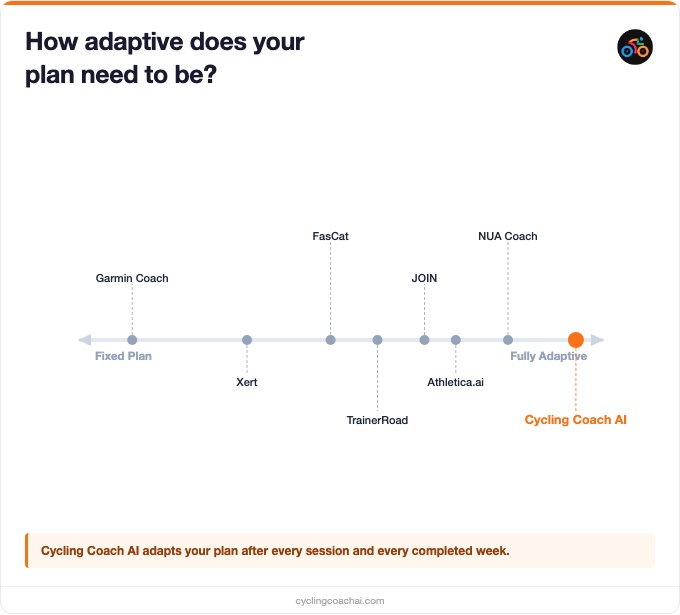
Mostly fixed structure: Garmin Coach
Structured progression with partial adaptation: TrainerRoad, JOIN, NUA Coach, Intervals.icu, Xert, FasCat, Athletica.ai, Final Surge, AI Endurance, GoldenCheetah
Manual + coach-driven adjustments: TrainingPeaks, Today's Plan
Full daily adaptive planning: Cycling Coach AI
2. How much setup complexity can you tolerate?
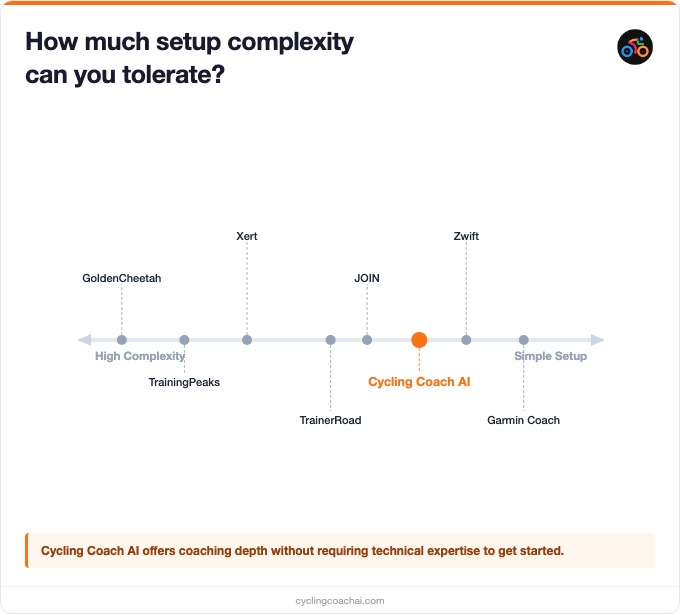
High complexity tolerated: TrainingPeaks, Today's Plan
Moderate to high complexity: TrainerRoad, JOIN, NUA Coach, Intervals.icu, Xert, FasCat, Athletica.ai, Final Surge, AI Endurance, GoldenCheetah
Low-friction workflow: Garmin Coach, Cycling Coach AI
3. What coaching depth do you expect?
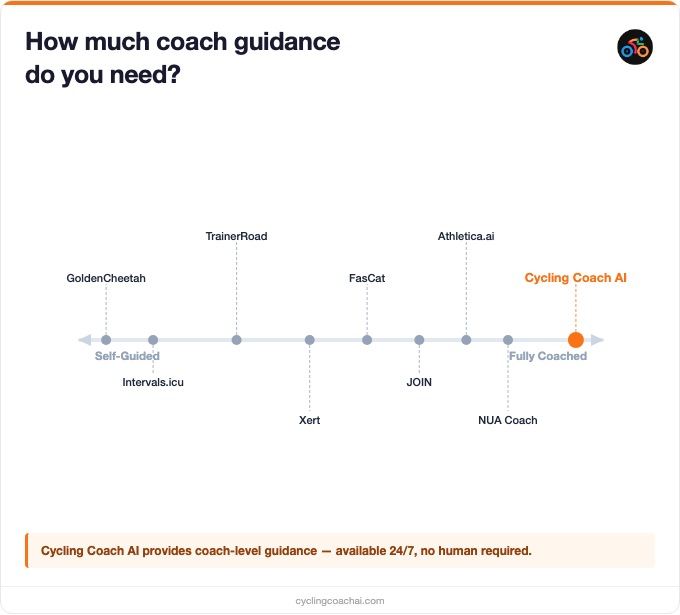
Workout delivery first: Zwift, Garmin Coach
App-centric AI guidance: JOIN, NUA Coach, FasCat, Athletica.ai
Data-first self-coaching workflow: Intervals.icu, Xert, Final Surge, AI Endurance, GoldenCheetah
Adaptive coaching context + weekly decision clarity: Cycling Coach AI
4. What is your budget model preference?
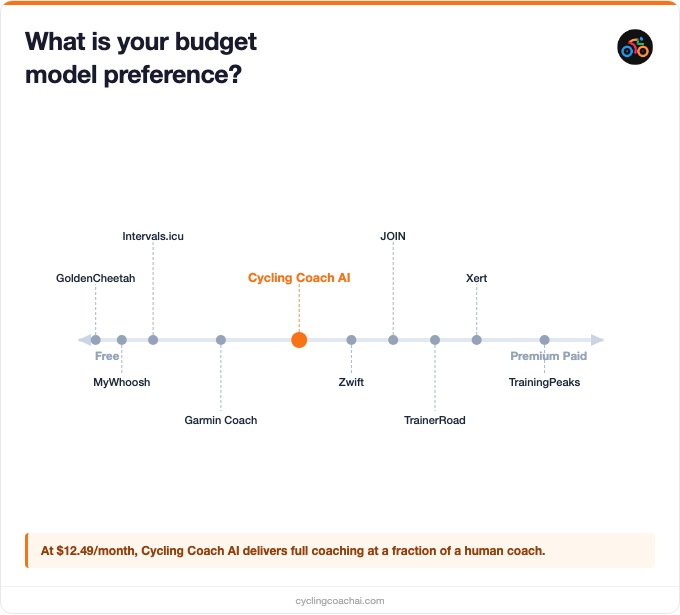
Platform subscription: Zwift, TrainerRoad, JOIN, NUA Coach, Xert, FasCat, Athletica.ai, Final Surge (for coaching accounts), AI Endurance
Free + optional supporter contribution: Intervals.icu
Stacked premium/coach ecosystem: TrainingPeaks
Single-value annual coaching workflow: Cycling Coach AI
When you compare platforms through adaptation depth, execution flexibility, and coaching clarity, the right choice usually becomes obvious.
Why Cycling Coach AI Is the Best Cycling Training App
After comparing the major cycling training platforms, one pattern stands out: most apps excel in one area but fall short as a complete coaching solution. Cycling Coach AI is built differently — it combines deep personalization, continuous adaptation, and full execution flexibility in a single platform that works for real life, not just ideal conditions.
1. Adaptability
Most training apps deliver a fixed plan that stays the same regardless of how your sessions actually go. Cycling Coach AI works differently. After every completed session, the platform re-evaluates your training load, recovery status, and progression curve to determine what comes next. After each week, the coach analyzes whether the cumulative load is producing the expected adaptation or deviating from the target — and adjusts the following week accordingly.
Beyond scheduled check-ins, the platform monitors training load dynamically throughout the week. If a ride was harder than expected, if you skipped a session, or if your fatigue indicators suggest a change is needed, the coach can propose real-time adjustments before the next session rather than waiting for the weekly review. This means your plan is always current, not just a starting point that gets stale.
2. Personalization
Cycling Coach AI connects with Strava, intervals.icu, Garmin and Wahoo to read your actual training history, current fitness level, and performance trends. Rather than asking you to self-report your fitness on a scale, the platform uses real data to understand where you are and where you have room to grow.
From that baseline, it builds a training plan around your specific goal. That goal can be performance-based — improving FTP, raising VO2max, or peaking for a target event — or it can be physical, such as losing weight while maintaining cycling performance. If your target event demands a big single climbing day instead, like La Marmotte's four alpine cols, the plan builds around that specific demand too. The plan adapts as your fitness evolves, so the targets you train toward always match your current level, not the level you had when you signed up.
3. Built for Indoor and Outdoor Training
Cycling Coach AI creates structured workouts that can be exported and executed wherever you prefer to train. Workouts sync directly to Garmin devices and Wahoo head units for outdoor and indoor use. For virtual training environments, the platform supports export to Zwift, MyWhoosh, and Rouvy, so you can complete your intervals in a virtual world without losing the structure your plan requires.
This flexibility means you are not forced into an indoor-only or outdoor-only workflow. You can move between platforms session to session without breaking progression logic or manually adjusting targets.
4. Coach Always Available
Every Cycling Coach AI user has access to an AI coach that is available at any hour. Whether you have a question before a key session, want to understand why a particular workout was scheduled, or need advice after a difficult week, the coach responds immediately — not during business hours. There is no waiting for a human coach to reply, and no question is too basic or too specific to ask.
5. Nutrition Plan
Training load and nutrition are directly connected, and Cycling Coach AI accounts for that. The platform generates a personalized nutrition plan that adapts to your training schedule, specifying what to eat and when based on the demands of each day. Rest days, easy rides, hard interval sessions, and race days each carry different fueling requirements, and the plan reflects that distinction clearly.
The nutrition guidance covers pre-ride fueling, intra-ride intake, and post-ride recovery nutrition — aligned with your training load so that you are fueling for adaptation, not just for energy.
6. Strength Training Plan
Cycling performance is not built on the bike alone. Cycling Coach AI creates a strength training plan designed to work alongside your cycling program, not compete with it. The strength sessions are scheduled around your key cycling workouts to avoid compromising your riding quality, and the exercises target the muscle groups most relevant to cycling: hip extensors, core stability, and single-leg power.
The result is a complete training system — cycling, strength, and nutrition — managed in one platform and optimized toward the same goal.