Find the Cycling Training Plan That Fits Your Goals and Fitness.
Structured training plans for road cycling, gravel, MTB, and more. Choose your level and find the right plan for your next goal.

Why do you need a cycling training plan?
A cycling training plan is the difference between riding with purpose and just putting in miles. Without structure, most cyclists plateau: repeating the same rides at the same effort without meaningful adaptation.
A well-built plan provides direction, ensuring each ride serves a purpose, whether building endurance, increasing speed, or improving technique. It helps you track training volume, maintain motivation, and prevent overtraining by incorporating rest days and recovery periods.
A plan also tailors your routine to your specific needs and target event. It allows you to focus on areas that require improvement, such as climbing, sprinting, or endurance. By following a structured plan, you can efficiently use your time, maximizing gains within your available schedule.
How to choose the right cycling training plan
Choosing the right training plan starts with four questions: what is your goal, what is your current fitness level, how many hours per week can you realistically train, and how many weeks do you have before your target event or deadline.
If you are training for a distance event like a 50-mile sportive or a 100-mile century ride, choose a plan that matches both the distance and your experience level. If your goal is general fitness or weight loss, duration matters more than discipline.
Assess your current fitness level honestly to ensure the plan aligns with your abilities and allows for gradual progression. A plan that is too demanding may lead to burnout, while one that is too easy will not yield results.
If you are also evaluating different tools or apps to help structure your training, our complete guide to the best cycling training apps provides a clear comparison of the most popular platforms cyclists use today.
How long should your training plan last?
The duration of your plan depends on your goals and current fitness level. For beginners new to cycling, a 12-week plan is often recommended to build a solid foundation, allowing time for gradual adaptation.
Intermediate riders benefit from a 16-week plan, providing a longer period to focus on specific areas such as speed or endurance. Advanced riders could consider 20 to 24 weeks, enabling a more detailed approach to peak performance and competitive preparation.
Factor in your personal schedule and commitments. Ensure the plan is realistic and sustainable. Regularly reassess your progress and be prepared to adjust as necessary. The key is consistency and maintaining a balance that keeps you motivated throughout the training period.
How many hours do you have to commit to training?
The training volume you dedicate largely depends on your objectives and current fitness level.
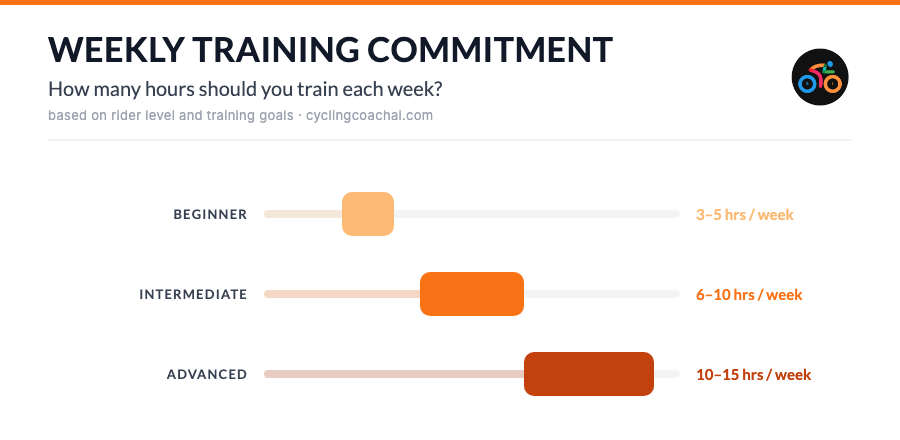
For beginners, starting with 3 to 5 hours per week can effectively build endurance without overwhelming your schedule.
As you progress, increasing to 6 to 10 hours weekly may be necessary to achieve more ambitious targets, such as participating in competitive events. Advanced riders commit 10 to 15 hours of weekly training volume, focusing on fine-tuning performance and preparing for race season.
It is essential to integrate this time commitment seamlessly into your lifestyle to maintain consistency and avoid burnout. Consider your daily routine and responsibilities to ensure your plan is sustainable in the long term.
Key phases of a cycling training plan
Every well-structured cycling training plan follows a periodization model with four phases. Each phase has a specific purpose, and skipping one compromises the others.
Base / Adaptation
Build your aerobic foundation at low to moderate intensity. Your body learns to process oxygen efficiently, burn fat for fuel, and handle time in the saddle. Most cyclists spend 4 to 8 weeks in this phase before progressing.
Build
Introduce intervals, threshold efforts, and discipline-specific workouts. This is where most performance gains happen. Volume and intensity increase progressively week over week.
Peak
The highest quality sessions at race-specific or goal-specific intensity. You reduce total training volume while sharpening fitness. The goal is to arrive at your event at maximum readiness without accumulated fatigue.
Taper
The final 1 to 2 weeks. Volume drops significantly while intensity is maintained. This period of tapering allows your body to fully recover and absorb all the training you have done.
What training zones should your plan be based on?
Every quality cycling training plan is built around training zones: specific intensity ranges that target different physiological systems and produce different adaptations.
Most plans use either power zones (based on your FTP) or heart rate zones (based on your maximum heart rate). Both systems divide training into 5 to 7 levels, from easy Zone 1 recovery efforts to all-out Zone 6 and 7 sprints.
Training in the right zone at the right time is what makes structured plans effective. Zone 2 builds your aerobic base and improves fat oxidation. Zone 4 (threshold) directly raises your FTP. Zone 5 and above target VO2max and anaerobic capacity.
Not sure which zone system suits you best? Our cycling heart rate zones calculator covers everything you need to get started, with or without a power meter.
Which cycling training plan is right for you?
| Level | Weekly hours | Effort system | Best for | Duration |
|---|---|---|---|---|
| Beginner | 3-5h | RPE (perceived effort) | New cyclists building base fitness | 8-20 weeks |
| Intermediate | 6-10h | Power + HR zones | Cyclists targeting events or performance | 12-20 weeks |
| Advanced | 10-15h | Power + HR zones | Competitive cyclists peaking for races | 16-24 weeks |
Common mistakes cyclists make with training plans
Training too hard, too often
Most cyclists ride at moderate intensity all the time. They never go easy enough to recover or hard enough to generate real adaptation. A structured plan fixes this with a deliberate mix of intensities.
Skipping recovery days
Rest is not weakness; it is where fitness is built. Skipping recovery leads to accumulated fatigue, stagnation, and eventually overtraining syndrome.
Never testing your FTP
If your training zones are based on an outdated FTP, every workout is calibrated to the wrong intensity. Retest every 6 to 8 weeks to keep your plan accurate.
Starting with a plan that is too advanced
An ambitious plan you cannot recover from will do more harm than a moderate plan followed consistently. Start at the level that matches your current fitness, not the one you aspire to reach.
Ignoring nutrition and sleep
Training is the stimulus; recovery is where adaptation happens. Without adequate sleep and proper fueling, even the best plan produces limited results.
Abandoning the plan after one missed session
Missing a workout is completely normal. What matters is getting back on track the next day, not trying to compensate for lost sessions.
How to balance training with recovery
Incorporating rest days into your schedule is as crucial as the training itself. These days allow your muscles to repair and strengthen, preventing overuse injuries and burnout. Listen to your body; if you feel unusually fatigued or sore, it might be a signal to ease up.
Implement active recovery sessions, such as light cycling or yoga, to promote blood flow without straining your body. Quality sleep is another cornerstone of effective recovery, as it aids in muscle repair and mental rejuvenation.
Nutrition also plays a pivotal role. Ensure you are consuming adequate protein and carbohydrates to replenish energy stores and support muscle recovery. Hydration is equally important, as it facilitates nutrient transport and waste elimination.
Recovery is not optional. It is when your body adapts to the training load, and skipping it is the fastest way to stall progress or end up injured.
«Sleep extension to 10 hours per night improved reaction time, mood, and overall well-being in athletes, with subjects reporting significant improvements in physical performance.»
Mah CD et al. (2011). The Effects of Sleep Extension on the Athletic Performance of Collegiate Basketball Players. Sleep, 34(7):943-950.
What should you eat to support your cycling training plan?
Prioritize carbohydrates as your primary energy source, especially for long rides. Whole grains, fruits, and vegetables should be staples to ensure sustained energy release. Protein is essential for muscle repair and growth, so include lean meats, fish, or plant-based proteins in your meals.
Healthy fats, like those found in avocados and nuts, support overall energy balance and hormonal function. Hydration cannot be overlooked; drinking water consistently throughout the day and during rides is crucial for maintaining performance.
Consider electrolyte-rich drinks for longer sessions to replenish lost minerals. Timing your meals and snacks around your rides can also enhance energy levels and recovery.
Think of nutrition as the second half of your training. Get it right and your body recovers faster, adapts better, and performs at a higher level.

How to incorporate cross-training and strength training
Integrating cross-training and strength training into your cycling regimen is essential for comprehensive development. Cross-training, such as swimming or running, enhances cardiovascular fitness while reducing the repetitive strain cycling can place on specific muscle groups.
Strength training, focusing on core and leg muscles, is crucial for muscle endurance, improving power output, and cycling efficiency. Exercises like squats, lunges, and planks help build the muscular foundation needed for tackling challenging terrains and maintaining speed over long distances.
Schedule these sessions on lighter cycling days to maintain balance without overexerting yourself. Cyclists who include cross-training and strength work consistently stay healthier and perform better over long seasons.
«Concurrent strength and endurance training can improve cycling economy and time-trial performance beyond what endurance training alone can achieve.»
Ronnestad BR & Mujika I (2014). Optimizing Strength Training for Running and Cycling Endurance Performance. Scandinavian Journal of Medicine & Science in Sports, 24(4):603-612.
What results can you expect from a structured training plan?
Beginners and intermediate riders following a structured plan can typically expect an FTP increase of 5 to 15 percent over a 12 to 16 week block. Advanced riders with years of training history will see smaller but still meaningful gains of 2 to 5 percent.
Within 8 to 12 weeks of consistent base training, most cyclists can noticeably extend the duration they ride comfortably without fatigue. As FTP and power-to-weight ratio improve, climb times drop. Riders often notice this within the first 6 to 8 weeks.
One of the earliest signs of improved fitness is how quickly your heart rate drops between hard intervals. This adapts within just a few weeks of starting structured training.
The most important factor is consistency. A solid plan followed consistently for 12 weeks will always outperform a perfect plan followed inconsistently.
«Training with structured power-based plans and regular FTP testing produces significantly greater improvements in endurance performance compared to unstructured training.»
Coggan AR & Allen H. Training and Racing with a Power Meter. VeloPress.
Free cycling training plans
Every plan on this page is free to access. Browse by level, discipline, goal, or distance and get your full week-by-week training schedule at no cost. If you want a plan that adapts to your actual performance as you train, create your free personalized plan with our AI cycling coach.
Plans by discipline
Pick a structured training plan tailored to the demands of your discipline.
Plans by goal
Training for a specific outcome? Choose a goal-oriented plan designed around measurable results.
Plans by distance
Targeting a specific event distance? Each dedicated plan ships with a free PDF and a structured week-by-week program.
Event-specific training plans
Preparing for a specific race or sportive? These plans are built around the exact demands of each event, including elevation, terrain, and race-day strategy.
Cycling training plans FAQ
Common questions about structured cycling training plans.
If you are new to structured training or have been cycling casually without a plan, start with Beginner. If you train regularly with a heart rate monitor or power meter and want to improve specific metrics, choose Intermediate. If you race competitively and train with power data, Advanced plans are built for you.
Beginners typically train 3 to 5 hours per week across 3 to 4 rides. Intermediate cyclists train 6 to 10 hours, and advanced riders commit 10 to 15 hours per week. Choose a plan that fits your real schedule, not an aspirational one.
Not for beginner plans. All beginner plans use RPE (perceived effort) and the talk test, so no devices are needed. Intermediate and advanced plans use power zones and heart rate zones, which require a power meter and heart rate monitor.
Beginners typically see noticeable endurance improvements within 4 to 6 weeks. Intermediate and advanced cyclists can expect 5 to 15 percent FTP gains over 12 to 16 weeks of consistent training. The most important factor is consistency, not perfection.
Yes. Start with the level that matches your current fitness. If a beginner plan feels too easy after completing it, move to intermediate. Moving up before you are ready usually leads to burnout or injury.
Resume where you left off or repeat the last completed week. Do not try to compress two weeks into one. One missed week will not ruin your fitness. Consistency over months matters far more than any single week.