Strava's training plans look solid on paper: structured workouts, weekly volume targets, progressions, all dropped straight into the calendar you already use. What follows is exactly what you get, and where the gaps are that could limit your progress as a cyclist.
This guide covers what Strava's cycling training plans actually include, how they work in practice, their real strengths, and the one critical limitation that prevents most serious cyclists from seeing the results they're after.
If you are training for a specific distance rather than a generic block, a goal-based plan works better. Our 50-mile bike training plan is built around one target ride and progresses towards it week by week.
What Are Strava's Cycling Training Plans?
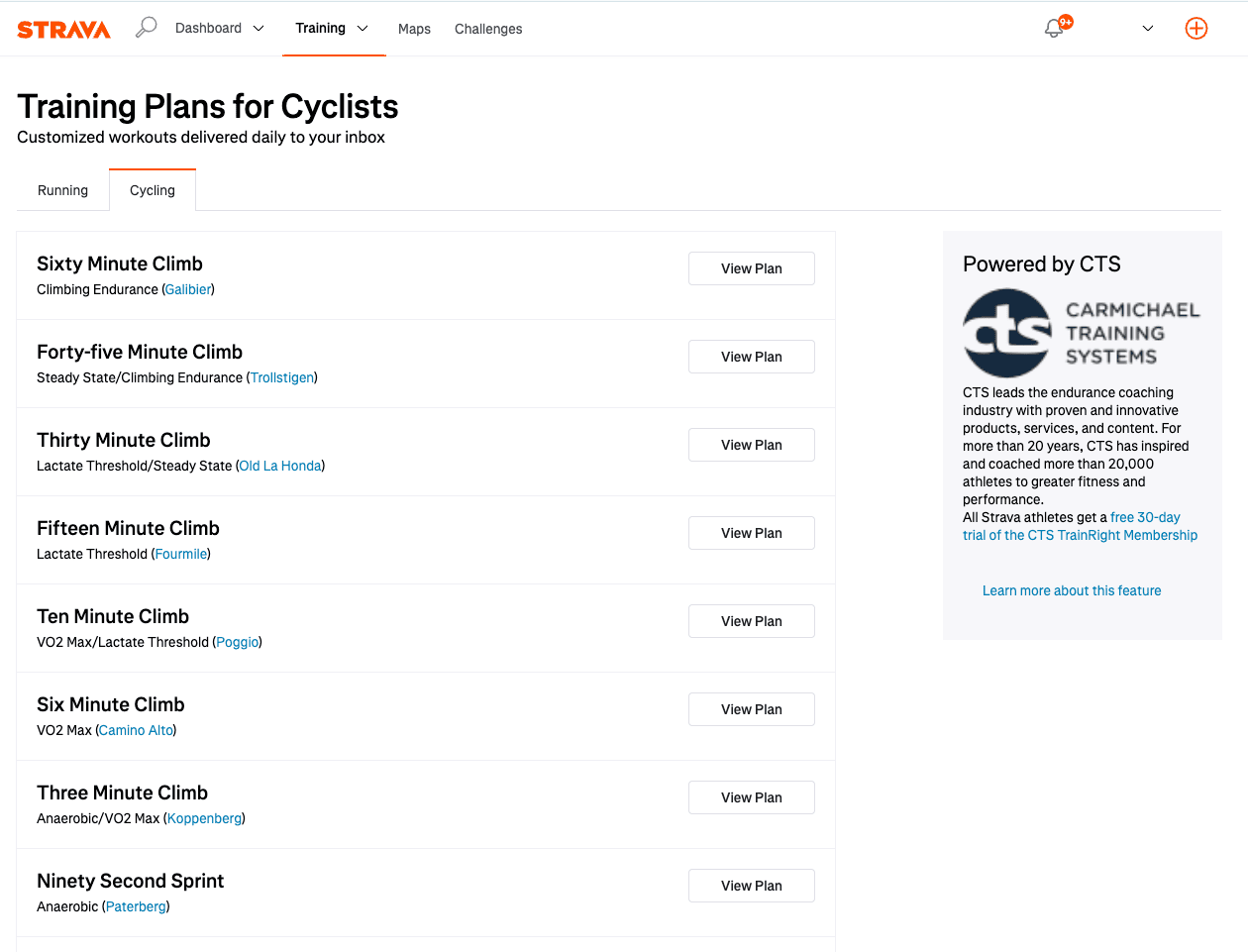
Strava's cycling training plans are structured workout programs designed in partnership with Carmichael Training Systems (CTS) — a well-respected coaching organization founded by Chris Carmichael, Lance Armstrong's longtime coach. These are not generic templates thrown together by a marketing team. They reflect decades of professional cycling coaching methodology.
Access to cycling training plans requires a Strava Premium subscription (currently around $80/year). Once inside, you'll find plans built around specific cycling goals: building endurance, improving lactate threshold, increasing short-burst power, and preparing for events ranging from gran fondos to criteriums.
Each plan runs for 4 weeks, with a focus on one specific energy system or performance goal per block. You can stack blocks together to build a longer training season.
How Strava Cycling Training Plans Work
Once you select a plan, Strava asks you a few basic questions: how many hours per week you can train (typically 5 to 12 hours), your current fitness level, and your primary goal. Based on those inputs, the plan populates your Strava calendar with daily workouts for the next 4 weeks.
Workouts are described with duration, effort level (usually in zones or perceived exertion), and coaching notes explaining the purpose of each session. Some workouts are structured with specific intervals — for example, 3x10 minutes at threshold effort — while others are simple endurance rides with a duration target.
Strava also supports syncing structured workouts to compatible Garmin and Wahoo devices, so you can follow the workout with real-time guidance on your bike computer rather than memorizing the intervals beforehand.
For cyclists new to structured training, this alone is a significant step up from just riding by feel. Having a plan on the calendar, with a clear purpose for each session, changes how you approach your training week.
What Strava Training Plans Do Well
Let's be fair: Strava's cycling training plans have genuine strengths that are worth acknowledging.
They're professionally designed
CTS has trained world-class cyclists for decades. The workout structures — the mix of zone 2 endurance work, threshold intervals, and recovery rides — reflect sound periodization principles that work for most athletes.
They're accessible
For a cyclist who has never followed a structured training plan, a Strava plan offers an easy entry point. The calendar integration, the coaching notes, and the device sync remove most of the friction that usually stops riders from committing to a program.
They introduce structure
Many cyclists ride reactively — they go hard when they feel good, skip rides when they're busy, and repeat the same routes indefinitely. A Strava training plan forces you to think in weeks and blocks, balancing hard days with recovery days. That shift alone can produce real fitness gains for riders who haven't trained systematically before.
They're affordable
Compared to hiring a personal cycling coach ($100–$400/month), getting coaching methodology embedded in your $80/year Strava subscription is genuinely good value.
Where Strava Training Plans Fall Short for Serious Cyclists
Here's the core limitation, stated plainly: a Strava training plan does not know anything about you.
When you select a plan, Strava has no access to:
- Your recent ride history or current fitness level
- Your current FTP or personal power zones
- How long you've been training consistently — or whether you just came back from two weeks off the bike
- Missed sessions, extra fatigue, or breakthrough efforts from the current week
The plan you receive is the same plan any other cyclist with similar hour availability and goal selection would receive. It's a template — a well-designed one, but a template nonetheless.
This creates a few practical problems:
1. Intensity targets are approximate
Strava's plans describe effort in broad zones or perceived exertion, not in watts calibrated to your actual threshold. Without first testing your FTP and establishing your personal power zones, the prescribed intensities are educated guesses at best.
2. The plan doesn't adapt
If you miss two sessions in week two, the plan doesn't adjust week three to account for the lost training load. If you have an unexpectedly strong fitness week and could push harder, the plan keeps you on the same pre-set progression. Static plans don't respond to your actual physiology.
3. Recovery is generic
How much recovery you need depends on your age, fitness level, life stress, sleep quality, and recent training history. Strava assigns the same recovery days to every athlete on the plan, regardless of whether you actually need them.
4. Goal alignment is limited
If your goal is to get faster on a specific local climb, or to be competitive in a specific event, or to build fitness around a demanding work schedule with irregular availability, the pre-built 4-week blocks won't be built around those specifics. Training for a fixed-date climbing goal like the Peaks Challenge Falls Creek is a good example: the climbing volume needs to build toward one specific day, not a generic 4-week cycle.
For recreational cyclists looking to add structure to their riding, these limitations are minor. But for cyclists who want to make meaningful, measurable performance gains — riders tracking watts, monitoring training stress, and working toward specific events — the lack of personalization becomes a real ceiling.
How to Get a Personalized Plan That Still Works With Strava
The good news: you don't have to abandon Strava to solve the personalization problem. Strava excels at what it was built for — tracking rides, recording segments, connecting with other cyclists. That data is valuable.
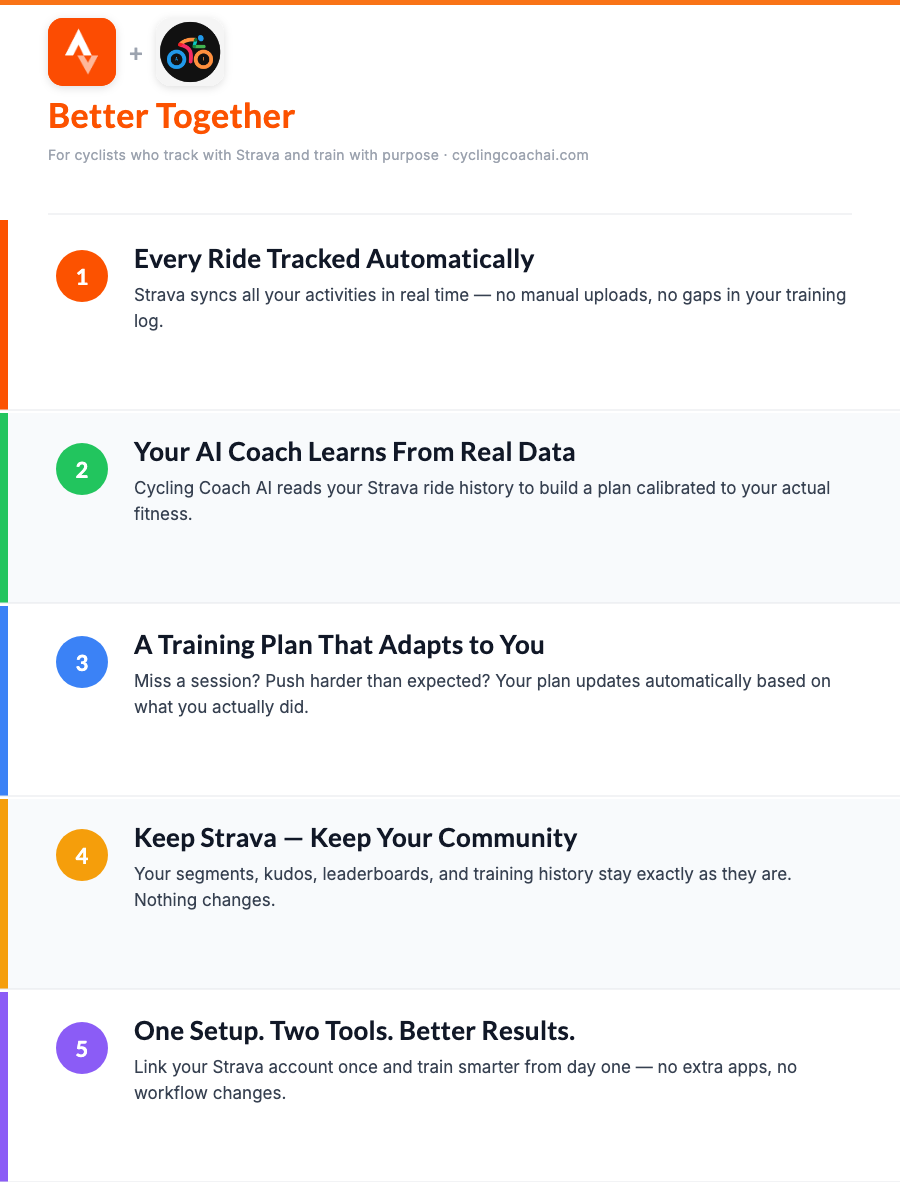
The gap is the coaching layer on top of that data. What Strava's training plans can't do is read your ride history, understand your current fitness trajectory, and build a training plan that's calibrated specifically to you.
That's exactly what Cycling Coach AI is designed to do. It connects with your Strava account, analyzes your past and current rides, and builds a personalized training plan based on your actual fitness data — not a generic questionnaire. When you miss a session or have a breakthrough workout, your plan adapts. When your fitness improves, your training load evolves with it.
If you're already committed to Strava for tracking, you don't have to choose. Strava handles the activity log and community. Cycling Coach AI handles the coaching. They work together.
Strava Training Plan vs. Cycling Coach AI
| Feature | Strava Training Plan | Cycling Coach AI |
|---|---|---|
| Plan design | Generic CTS template — same plan for all athletes with similar inputs. | Built from your actual ride history, fitness, goals, and availability. |
| Intensity targets | Broad effort zones or perceived exertion — not calibrated to your FTP. | Calibrated to your personal FTP and power zones from day one. |
| Adapts to missed sessions | No. The plan continues from where the calendar left off regardless. | Yes — your plan updates automatically when sessions are missed or completed. |
| Accounts for fatigue | No. Recovery days are fixed and identical for every athlete. | Yes — uses training stress and recovery data to adjust load dynamically. |
| Strava integration | Native activity tracking and segment leaderboards. | Connects with Strava to read your rides and refine your training automatically. |
| Goal specificity | Pre-set goal categories only (endurance, threshold, power). | Tailored to your specific event, timeline, discipline, and weekly schedule. |
| Coaching support | No coaching. Riders interpret workouts and effort levels on their own. | 24/7 AI coach available to answer questions and adjust your plan anytime. |
| Weekly feedback | Not included. | AI-generated weekly feedback on progress, effort, and consistency. |
| Price | Included in Strava Premium (~$80/yr). | $149.99/year or $12.50/month. |
| Ideal for | Cyclists new to structured training who want a simple starting point. | Riders who want adaptive, personalized coaching without complexity. |
Who Should Use Strava Training Plans?
Strava training plans make sense if you're a cyclist who has never followed structured training before and wants a low-friction way to introduce weekly workouts with purpose. They're a meaningful step up from riding by feel, and for riders at that stage, the CTS methodology will produce real results.
If you already follow a structured approach — if you know your FTP, track your TSS, and think in training blocks — you'll quickly outgrow what a static 4-week template can offer. At that point, the missing link is a coaching layer that reads your data, responds to your actual fitness, and builds a plan that keeps pace with your progress.
You might also find Strava's plans a useful complement to other training resources. For example, if you're following an indoor cycling training plan through the winter, Strava's outdoor workout structure can help you bridge into the road season. Or if you're working through a beginner cycling training plan, the Strava blocks can add structured progression on top of a foundational base.
The bottom line: Strava training plans are a solid starting point. But they were designed to be accessible to everyone — which means they're not optimized for anyone in particular. For cyclists who want training that genuinely responds to them, that's the gap worth closing.