Complete a 100-Mile Century Ride in 16 Weeks
A structured 16-week century training plan with weekly progression, pacing strategy and nutrition guidance to take you from base fitness to finishing your first 100-mile ride.

This plan assumes
Are you ready for this plan?
- Can ride continuously for 2 hours at a comfortable pace
- Have a power meter and heart rate monitor
- Know your current FTP (tested within the last 6 weeks)
- Can commit to 5 rides per week for 16 weeks
If you cannot ride for 2 hours comfortably or do not have a power meter, start with a beginner plan that uses RPE to guide effort. Start here instead.
Plan overview
Build a deep aerobic foundation with sustained Zone 2 efforts and progressive tempo blocks. Long rides grow from 2h to 3h. The extended base phase develops the endurance platform that supports all later intensity work.
6-8 hours/week
Introduce sweet spot and threshold intervals to raise FTP. Long rides extend to 4.5 hours with century pace sections. A recovery week at week 9 lets your body absorb the training load before the final build push.
8-10 hours/week
Highest quality sessions with race simulations and pacing rehearsals. Volume begins to taper but intensity stays high. Your longest ride approaches target distance with full pacing rehearsal.
8-9 hours/week
Two-week taper with gradually decreasing volume. Week 15 reduces by 30% with some intensity. Week 16 is race week with minimal volume. You should feel restless and eager by race day.
4-6 hours/week
Weekly structure
How long does it take to train for 100 miles
A century ride is any cycling event covering 100 miles, and training for one requires between 12 and 24 weeks depending on your current fitness level and how much time per week you can commit to training. This plan uses a 16-week structure, the sweet spot for most intermediate riders who already ride 2-3 hours comfortably and want to arrive at the start line confident rather than crash-trained.
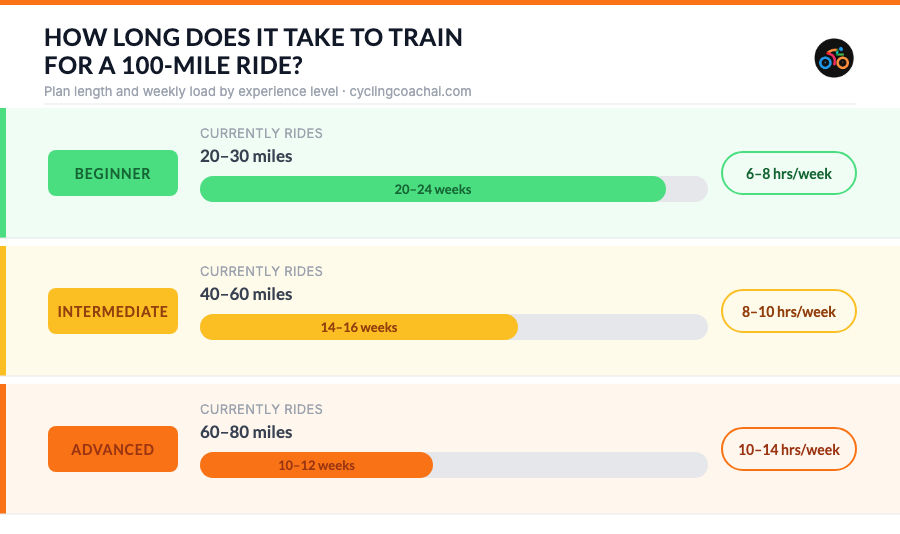
The most common mistake is underestimating the time needed. Starting with 12 weeks when your current long ride is under 40 miles leads to fatigue accumulation and a poor race-day experience. Build your base first, then start the plan. If you have never ridden past 40 miles, the 50-mile bike training plan is the natural stepping stone before attempting a century.
Century ride pacing strategy
Pacing is the single biggest differentiator between a good century ride and a difficult one. Most first-time century riders go out too hard and pay for it after mile 65.
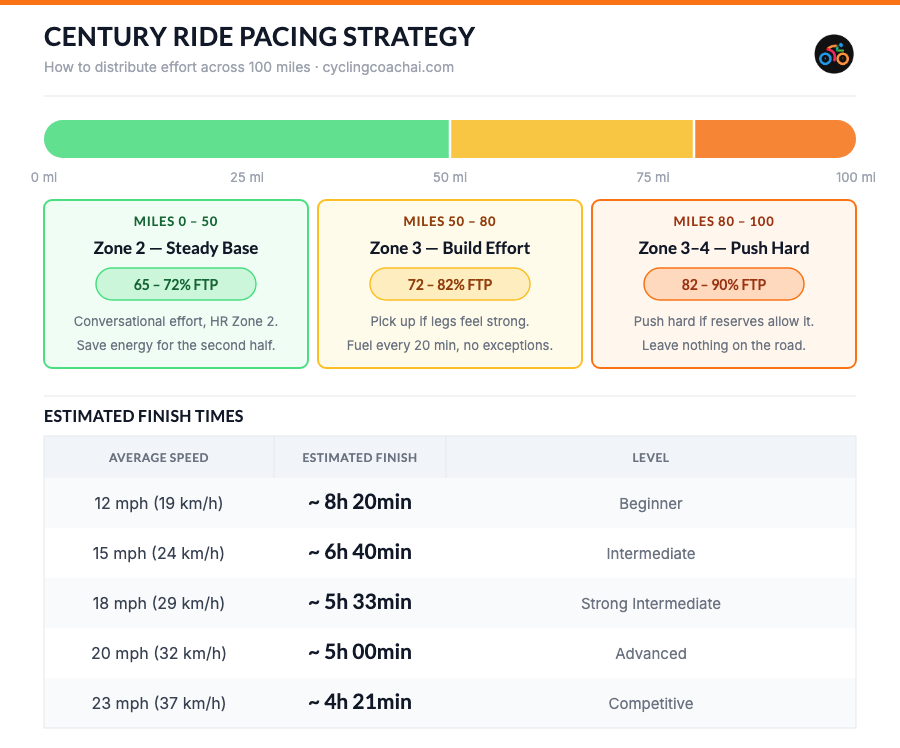
The most reliable approach is to ride the first 50 miles at a conversational effort: 65-72% of your FTP if you train with power, or a heart rate firmly in Zone 2. Reserve a stronger effort for miles 50-80 and only push harder if you have energy reserves after that.
Event-day nutrition and hydration for your 100-mile ride
This section covers what to eat and drink on the day of your 100-mile ride. For day-to-day fueling around training rides (before, during and after each session in the plan), see the Fueling your training section further down.
At 100 miles, nutrition is not optional. Your glycogen stores fuel approximately 90 to 120 minutes of moderate cycling. After that, external fuel is essential to maintain power output and avoid bonking.
Carbohydrates
Consume 60-90g of carbohydrates per hour from mile 30 onward. Use energy bars, gels, bananas or rice cakes. Mix solid food with liquid carbs so flavor fatigue does not become the limiting factor in the second half.
«Ingestion of glucose and fructose in a 2:1 ratio during prolonged cycling can achieve exogenous carbohydrate oxidation rates up to 1.75 g/min, significantly higher than glucose alone, reducing fatigue and improving performance in efforts over two hours.»
Jentjens RLPG & Jeukendrup AE (2005). High Rates of Exogenous Carbohydrate Oxidation from a Mixture of Glucose and Fructose Ingested During Prolonged Cycling Exercise. British Journal of Nutrition, 93(4):485-492.
Hydration
Drink 500-750 ml per hour in cool conditions, up to 1,000 ml per hour in heat. Do not wait until you are thirsty. By the time thirst registers, performance has already dropped.
Electrolytes
Replenish sodium, potassium and magnesium to prevent cramps. Use electrolyte drinks or tabs, especially after the first two hours. Sodium loss is the main driver of late-ride cramps for most riders.
The week before your century ride
Focus on tapering your training to arrive at the start line rested. Reduce mileage by 30-40% in the final week. Prioritize carbohydrate loading in the 48 hours before the event and sleep at least 8 hours per night.
Watch: how to fuel a long endurance ride

Should you include strength training
Yes. Cross-training and strength work reduce injury risk and improve the muscular endurance needed for sustained power on long climbs. Two sessions per week of 30-45 minutes targeting glutes, core and single-leg stability are sufficient during the base phase.
As your plan approaches the event and long ride distances increase, reduce strength training to one session per week to prioritize recovery. The full exercise guide lives in our strength training for cyclists article.
Training zones
This plan uses power zones (% of FTP) and heart rate zones (% of max HR) to guide effort. A power meter and heart rate monitor are required.
Power zones
| Zone | % FTP | RPE | Feel |
|---|---|---|---|
| Z1 Recovery | 0-55% FTP | 1-2 out of 10 | Extremely easy. No sensation of effort. Used only for recovery rides. |
| Z2 Endurance | 56-75% FTP | 3-4 out of 10 | Comfortable, sustainable effort. You are working but could maintain this for hours. |
| Z3 Tempo | 76-90% FTP | 5-6 out of 10 | Moderately hard. Sustainable for 30-60 minutes but requires concentration. |
| Z4 Threshold | 91-105% FTP | 7-8 out of 10 | Hard. You can sustain this for 20-40 minutes with focus. Speaking is difficult. |
| Z5 VO2max | 106-120% FTP | 8-9 out of 10 | Very hard. Maximum sustainable effort for 3-8 minutes. Legs and lungs burn. |
| Z6 Anaerobic Capacity | 121-150% FTP | 9-10 out of 10 | Maximum effort for 30 seconds to 2 minutes. Not sustainable. |
| Z7 Neuromuscular Power | 150%+ FTP | 10 out of 10 | All-out sprint for under 30 seconds. Pure explosive effort. |
Heart rate zones
| Zone | % Max HR | Feel |
|---|---|---|
| Z1 Recovery | 0-59% max HR | Extremely easy. No sensation of effort. Used only for recovery rides. |
| Z2 Endurance | 60-70% max HR | Comfortable, sustainable effort. You are working but could maintain this for hours. |
| Z3 Tempo | 71-80% max HR | Moderately hard. Sustainable for 30-60 minutes but requires concentration. |
| Z4 Threshold | 81-90% max HR | Hard. You can sustain this for 20-40 minutes with focus. Speaking is difficult. |
| Z5 VO2max | 91-100% max HR | Very hard. Maximum sustainable effort for 3-8 minutes. Legs and lungs burn. |
16-Week 100-Mile Bike Training Plan
| Day | Session | Duration |
|---|---|---|
| WEEK 1 | ||
| Mon | Rest | - |
| Tue | Endurance + 3x8min tempo @ 76-90% FTP / 71-80% HR | 70 min |
| Wed | Easy endurance @ 56-75% FTP / 60-70% HR | 55 min |
| Thu | Endurance + 2x8min tempo @ 76-90% FTP / 71-80% HR | 65 min |
| Fri | Rest | - |
| Sat | Long endurance @ 56-75% FTP / 60-70% HR | 2h |
| Sun | Recovery @ 0-55% FTP / 0-59% HR | 45 min |
| WEEK 2 | ||
| Mon | Rest | - |
| Tue | Endurance + 3x10min tempo @ 76-90% FTP / 71-80% HR | 75 min |
| Wed | Easy endurance @ 56-75% FTP / 60-70% HR | 55 min |
| Thu | Endurance + 2x10min tempo @ 76-90% FTP / 71-80% HR | 70 min |
| Fri | Rest | - |
| Sat | Long endurance @ 56-75% FTP / 60-70% HR | 2h 15min |
| Sun | Recovery @ 0-55% FTP / 0-59% HR | 45 min |
| WEEK 3 | ||
| Mon | Rest | - |
| Tue | Endurance + 3x10min tempo @ 76-90% FTP / 71-80% HR | 75 min |
| Wed | Easy endurance @ 56-75% FTP / 60-70% HR | 55 min |
| Thu | Endurance + 2x12min tempo @ 76-90% FTP / 71-80% HR | 75 min |
| Fri | Rest | - |
| Sat | Long endurance @ 56-75% FTP / 60-70% HR | 2h 30min |
| Sun | Recovery @ 0-55% FTP / 0-59% HR | 45 min |
| WEEK 4 | ||
| Mon | Rest | - |
| Tue | Endurance + 2x15min tempo @ 76-90% FTP / 71-80% HR | 75 min |
| Wed | Easy endurance @ 56-75% FTP / 60-70% HR | 55 min |
| Thu | Endurance + 2x15min tempo @ 76-90% FTP / 71-80% HR | 75 min |
| Fri | Rest | - |
| Sat | Long endurance @ 56-75% FTP / 60-70% HR | 2h 45min |
| Sun | Recovery @ 0-55% FTP / 0-59% HR | 45 min |
| WEEK 5 | ||
| Mon | Rest | - |
| Tue | Endurance + 2x15min tempo @ 76-90% FTP / 71-80% HR | 75 min |
| Wed | Easy endurance @ 56-75% FTP / 60-70% HR | 55 min |
| Thu | Endurance + 2x12min sweet spot @ 88-93% FTP / 71-80% HR | 75 min |
| Fri | Rest | - |
| Sat | Long endurance + tempo finish @ 76-90% FTP / 71-80% HR | 3h |
| Sun | Recovery @ 0-55% FTP / 0-59% HR | 50 min |
| WEEK 6 | ||
| Mon | Rest | - |
| Tue | Endurance + 2x15min sweet spot @ 88-93% FTP / 71-80% HR | 80 min |
| Wed | Easy endurance @ 56-75% FTP / 60-70% HR | 60 min |
| Thu | Endurance + 2x12min threshold @ 91-105% FTP / 81-90% HR | 80 min |
| Fri | Rest | - |
| Sat | Long endurance @ 56-75% FTP / 60-70% HR | 3h 15min |
| Sun | Recovery @ 0-55% FTP / 0-59% HR | 50 min |
| WEEK 7 | ||
| Mon | Rest | - |
| Tue | Endurance + 3x12min sweet spot @ 88-93% FTP / 71-80% HR | 85 min |
| Wed | Easy endurance @ 56-75% FTP / 60-70% HR | 60 min |
| Thu | Endurance + 2x15min threshold @ 91-105% FTP / 81-90% HR | 85 min |
| Fri | Rest | - |
| Sat | Long endurance @ 56-75% FTP / 60-70% HR | 3h 30min |
| Sun | Recovery @ 0-55% FTP / 0-59% HR | 50 min |
| WEEK 8 | ||
| Mon | Rest | - |
| Tue | Endurance + 3x15min sweet spot @ 88-93% FTP / 71-80% HR | 90 min |
| Wed | Easy endurance @ 56-75% FTP / 60-70% HR | 60 min |
| Thu | Endurance + 2x15min threshold @ 91-105% FTP / 81-90% HR | 85 min |
| Fri | Rest | - |
| Sat | Long endurance + century pace sections @ 76-85% FTP / 71-80% HR | 3h 30min |
| Sun | Recovery @ 0-55% FTP / 0-59% HR | 50 min |
| WEEK 9 | ||
| Mon | Rest | - |
| Tue | Recovery week: easy endurance @ 56-75% FTP / 60-70% HR | 55 min |
| Wed | Rest | - |
| Thu | Endurance + 2x10min tempo @ 76-90% FTP / 71-80% HR | 65 min |
| Fri | Rest | - |
| Sat | Long endurance @ 56-75% FTP / 60-70% HR | 2h 30min |
| Sun | Recovery @ 0-55% FTP / 0-59% HR | 40 min |
| WEEK 10 | ||
| Mon | Rest | - |
| Tue | Endurance + 3x15min sweet spot @ 88-93% FTP / 71-80% HR | 90 min |
| Wed | Easy endurance @ 56-75% FTP / 60-70% HR | 60 min |
| Thu | Endurance + 2x20min threshold @ 91-105% FTP / 81-90% HR | 90 min |
| Fri | Rest | - |
| Sat | Long endurance + century pace sections @ 76-85% FTP / 71-80% HR | 3h 45min |
| Sun | Recovery @ 0-55% FTP / 0-59% HR | 55 min |
| WEEK 11 | ||
| Mon | Rest | - |
| Tue | Endurance + 3x15min sweet spot @ 88-93% FTP / 71-80% HR | 90 min |
| Wed | Easy endurance @ 56-75% FTP / 60-70% HR | 60 min |
| Thu | Endurance + 2x20min threshold @ 91-105% FTP / 81-90% HR | 90 min |
| Fri | Rest | - |
| Sat | Long endurance + century pace @ 76-85% FTP / 71-80% HR | 4h |
| Sun | Recovery @ 0-55% FTP / 0-59% HR | 55 min |
| WEEK 12 | ||
| Mon | Rest | - |
| Tue | Endurance + 2x20min sweet spot @ 88-93% FTP / 71-80% HR | 90 min |
| Wed | Easy endurance @ 56-75% FTP / 60-70% HR | 60 min |
| Thu | Endurance + 2x20min threshold @ 91-105% FTP / 81-90% HR | 90 min |
| Fri | Rest | - |
| Sat | Long endurance + century pace sections @ 76-85% FTP / 71-80% HR | 4h 15min |
| Sun | Recovery @ 0-55% FTP / 0-59% HR | 55 min |
| WEEK 13 | ||
| Mon | Rest | - |
| Tue | Endurance + 2x20min sweet spot @ 88-93% FTP / 71-80% HR | 90 min |
| Wed | Easy endurance @ 56-75% FTP / 60-70% HR | 55 min |
| Thu | Race simulation: 2x30min @ 76-85% FTP / 71-80% HR | 90 min |
| Fri | Rest | - |
| Sat | Long endurance + century pace rehearsal @ 76-85% FTP / 71-80% HR | 4h 30min |
| Sun | Recovery @ 0-55% FTP / 0-59% HR | 55 min |
| WEEK 14 | ||
| Mon | Rest | - |
| Tue | Endurance + 2x15min threshold @ 91-105% FTP / 81-90% HR | 80 min |
| Wed | Easy endurance @ 56-75% FTP / 60-70% HR | 50 min |
| Thu | Endurance + 2x12min sweet spot @ 88-93% FTP / 71-80% HR | 75 min |
| Fri | Rest | - |
| Sat | Long endurance + pace rehearsal @ 76-85% FTP / 71-80% HR | 3h 30min |
| Sun | Recovery @ 0-55% FTP / 0-59% HR | 50 min |
| WEEK 15 | ||
| Mon | Rest | - |
| Tue | Endurance + 2x10min tempo @ 76-90% FTP / 71-80% HR | 65 min |
| Wed | Easy endurance @ 56-75% FTP / 60-70% HR | 45 min |
| Thu | Endurance + 2x10min sweet spot @ 88-93% FTP / 71-80% HR | 65 min |
| Fri | Rest | - |
| Sat | Long endurance @ 56-75% FTP / 60-70% HR | 2h 30min |
| Sun | Recovery @ 0-55% FTP / 0-59% HR | 40 min |
| WEEK 16 | ||
| Mon | Rest | - |
| Tue | Easy endurance + 2x8min tempo @ 76-90% FTP / 71-80% HR | 55 min |
| Wed | Rest | - |
| Thu | Activation: 2x5min @ 91-105% FTP / 81-90% HR | 45 min |
| Fri | Rest | - |
| Sat | Century Ride Day | 5-7h |
| Sun | Rest | - |
Week-by-week breakdown
Aerobic foundation
Focus: Establish the 5-ride weekly structure and build long ride duration to 2 hours.
Key session: Saturday long ride: 2h at Zone 2 (56-75% FTP). Stay disciplined on power, no surges.
What to feel: Every ride should feel controlled and comfortable. If you finish exhausted, you rode too hard.
Avoid: Pushing tempo efforts above 90% FTP. Tempo means 76-90%, not threshold.
Tempo introduction
Focus: Extend tempo blocks to 10 minutes and grow the long ride to 2h 15min.
Key session: Tuesday: 3x10min tempo at 76-90% FTP with 5 min recovery between. Steady power, no spikes.
What to feel: Tempo should feel moderately hard but sustainable. You should be able to hold it for the full duration without fading.
Avoid: Starting tempo intervals too hard and fading. Aim for the same power in the last interval as the first.
Tempo extension
Focus: Lengthen tempo blocks to 12 minutes. Long ride reaches 2h 30min.
Key session: Saturday long ride: 2h 30min at Zone 2. Practice eating every 30 minutes from the start.
What to feel: The 2h 30min ride should feel like a solid effort but not depleting. If you bonk, your nutrition strategy needs work.
Avoid: Waiting until you feel hungry to eat. On a century, you need to eat from the first 30 minutes.
Tempo volume
Focus: Tempo blocks reach 15 minutes. Long ride grows to 2h 45min.
Key session: Tuesday: 2x15min tempo at 76-90% FTP. Focus on holding perfectly steady power throughout each block.
What to feel: The longer tempo blocks should feel challenging but manageable. Your aerobic base is deepening.
Avoid: Rushing into sweet spot work. The extra base weeks in a 16-week plan are a feature, not a limitation.
Sweet spot introduction
Focus: First sweet spot intervals at 88-93% FTP. Long ride includes a tempo finish and reaches 3 hours.
Key session: Thursday: 2x12min sweet spot at 88-93% FTP. This is the upper end of what feels sustainable. Breathing is heavy but controlled.
What to feel: Sweet spot should feel like the hardest effort you could sustain for 30 minutes. Not all-out, but genuinely hard.
Avoid: Confusing sweet spot with threshold. Sweet spot is 88-93% FTP, not 95-105%.
Threshold work begins
Focus: First threshold intervals at 91-105% FTP. Sweet spot extends to 15 minutes. Long ride reaches 3h 15min.
Key session: Thursday: 2x12min threshold at 91-105% FTP. This is your FTP ceiling, the hardest sustained effort the plan asks for.
What to feel: Threshold should feel hard. Speaking is difficult. You can sustain this for 20-40 minutes but it requires full concentration.
Avoid: Going above 105% FTP during threshold intervals. That crosses into VO2max territory and changes the adaptation.
Threshold extension
Focus: Threshold intervals extend to 15 minutes. Sweet spot at 12 minutes with 3 reps. Long ride reaches 3h 30min.
Key session: Thursday: 2x15min threshold at 91-105% FTP with 8min recovery. Hold perfectly even power.
What to feel: The 15-minute threshold intervals are a significant step up. Focus on consistent output from start to finish.
Avoid: Surging at the start of threshold intervals. Start at the lower end of the zone and build slightly.
Century pace introduction
Focus: Long ride includes century pace sections at 76-85% FTP. Threshold stays at 15 minutes. Sweet spot at 15 minutes.
Key session: Saturday: 3h 30min with 3x15min at century pace (76-85% FTP). This is the effort you will hold for 100 miles.
What to feel: Century pace should feel like controlled tempo. Sustainable for the full distance if nutrition is on point.
Avoid: Riding century pace sections above 85% FTP. That is threshold, not century pace. You will bonk before mile 70.
Recovery week
Focus: Reduce volume by 40%. Easy rides only with a short tempo session Thursday. Let your body absorb 8 weeks of training.
Key session: Thursday: easy ride with 2x10min tempo. Just enough to stay sharp without adding fatigue.
What to feel: Fresh, motivated, and slightly restless by Saturday. If you still feel tired, take an extra rest day.
Avoid: Panicking about losing fitness during recovery week. You are not losing fitness. You are absorbing it.
Post-recovery build
Focus: Return to high volume with threshold at 20 minutes. Sweet spot at 15 minutes. Long ride with century pace sections at 3h 45min.
Key session: Saturday: 3h 45min with 4x15min at century pace. You should feel strong after the recovery week.
What to feel: Strong and confident. The century pace sections should feel easier than they did in week 8.
Avoid: Going harder than century pace because you feel strong after recovery week. Save the extra energy for race day.
Volume building
Focus: Long ride hits 4 hours with century pace blocks. Midweek intensity stays at peak levels.
Key session: Saturday long ride: 4 hours with century pace sections. Simulate race conditions: eat 60-90g carbs per hour.
What to feel: This is a big week. Fatigue is expected by Thursday but you should rally for Saturday.
Avoid: Not practicing century nutrition. Every long ride over 3 hours should rehearse your race-day fueling plan.
Volume peak
Focus: Highest volume week. Long ride reaches 4h 15min. All interval sessions at their longest duration.
Key session: Saturday: 4h 15min with sustained century pace sections. This is the toughest week of the plan.
What to feel: Deep fatigue is expected. This is the peak demand. Trust that the taper will absorb the fatigue.
Avoid: Trying to ride the full 100 miles in training. The peak ride is 4h 15min, not 5-7h. The taper and adrenaline cover the gap.
Race simulation
Focus: Race simulation: 2x30min at century pace. Longest ride of the plan at 4h 30min with full pacing rehearsal.
Key session: Thursday: race simulation, 2x30min at 76-85% FTP with 10min recovery. Hold perfectly even power for both blocks.
What to feel: The race simulation should feel hard but doable. If you can hold power for both 30-minute blocks, you are ready.
Avoid: Treating the race simulation as a time trial. It is a pacing exercise, not a max effort.
Sharpening
Focus: Volume drops but intensity stays. Shorter threshold intervals keep the engine sharp. Long ride at 3h 30min with pace rehearsal.
Key session: Saturday: 3h 30min with the last 45min at century pace. Your final long effort before taper.
What to feel: Sharp, fast, and efficient. Rides feel easier at the same power. This means the taper is working.
Avoid: Adding extra intensity because you feel good. The taper makes you feel strong. Channel that energy into race day.
Pre-race week
Focus: Volume reduces by 30%. Short tempo and sweet spot sessions maintain sharpness. Long ride is an easy 2h 30min.
Key session: Saturday: 2h 30min easy endurance. The last long ride of the plan. Keep it comfortable and enjoy it.
What to feel: Energized and eager to race. You should feel like you are holding back, which is exactly the point.
Avoid: Adding extra rides because you feel undertrained. The taper is working. Trust it.
Race week
Focus: Two short rides to stay loose. Tuesday easy tempo, Thursday activation. Saturday is race day.
Key session: Saturday: Century ride day. Start at Zone 2, build to century pace by mile 20, eat every 30 minutes, and enjoy the ride.
What to feel: Restless, eager, and slightly nervous. If you feel like you are losing fitness, that is the taper talking. Trust the 15 weeks of work behind you.
Avoid: Going out too fast in the first 20 miles. Century pacing is everything. Start conservative, finish strong.
Fueling your training
Century nutrition is not optional. At intermediate intensity, you burn 600-900 calories per hour and your glycogen stores last approximately 90 minutes. Without a fueling strategy, you will bonk.
🍌 Before rides
Eat a carb-rich meal 3 hours before longer rides. Aim for 100-150g of carbohydrates: rice, oatmeal, toast with honey, or pasta. For early morning rides, a smaller meal of 60-80g carbs 90 minutes before is sufficient. Avoid high-fat and high-fiber foods that slow digestion.
⚡ During rides
For rides under 90 minutes, water and electrolytes are sufficient. For rides over 90 minutes, aim for 60-90 grams of carbohydrates per hour from gels, bars, chews, or real food like rice cakes and dates. Start eating at minute 20, not when you feel hungry. Practice your race-day nutrition on every long ride.
🥛 After rides
Within 30 minutes of finishing, consume 1.2g of carbohydrates per kilogram of body weight plus 20-30g of protein. Good options: recovery shake, rice with chicken, chocolate milk, or yogurt with granola and fruit. This window is critical for glycogen replenishment.
💧 Hydration
Drink 500-750ml per hour depending on temperature and sweat rate. Use electrolyte mix in your bottles, not plain water, for rides over 90 minutes. Weigh yourself before and after long rides to calibrate your personal sweat rate. Every kilogram lost is roughly one liter of fluid deficit.
🏁 Race day
Eat your pre-ride meal 3 hours before start. Carry enough nutrition for the full century: plan for 5-7 hours and budget 60-90g carbs per hour. Know where the aid stations are and what they serve. Carry backup nutrition in case aid stations are sparse. Never try new food on race day.
Gear checklist
Essential
Nice to have
5 mistakes that derail 100 mile training plans
Going out too fast in the first 20 miles
Century pacing is about negative splitting. If your average power in the first hour exceeds your plan, you will pay for it after mile 60. The adrenaline of race day makes the first miles feel effortless.
✅ Fix: Set a power ceiling for the first 30 minutes: stay at or below 75% FTP regardless of how easy it feels.
Not practicing nutrition during training
Your race-day nutrition strategy should be rehearsed on every long ride over 3 hours. Gut tolerance is a trainable skill that takes weeks to develop.
✅ Fix: Eat the same foods, at the same intervals, on every long training ride. By race day, your stomach should handle 60-90g carbs per hour without issues.
Training at sweet spot or threshold on easy days
Easy endurance rides are Zone 2 (56-75% FTP), not 80% FTP. Riding too hard on recovery days accumulates fatigue and compromises your next interval session.
✅ Fix: Cap your power at 75% FTP on all easy and recovery rides. If you cannot stay below 75%, your FTP may need retesting.
Skipping the recovery week
Week 9 is a recovery week for a reason. Skipping it means arriving at the final build phase already fatigued, which defeats the purpose of the entire block.
✅ Fix: Follow the recovery week exactly as written. You will come out of it stronger and sharper for the final build.
Losing motivation during the long base phase
Five weeks of mostly aerobic riding can feel slow and boring. But the deep aerobic base built in weeks 1-5 is what allows you to absorb the intensity in the build phase without breaking down.
✅ Fix: Trust the process. Ride with friends on long rides, explore new routes, and remember that the base phase is where century endurance is built.
Ride day tips
Pace by power, not by feel or speed
Set your cycling computer to display 3-second average power and stay within your century pace range (76-85% FTP) for the first two thirds of the race. Speed is irrelevant; it changes with wind, terrain, and drafting. Power is the only constant.
Eat early and eat often
Start eating at minute 20. Set a timer on your cycling computer for every 20 minutes as a reminder. By the time you feel hungry on a century, you are already 20-30 minutes behind on fuel and catching up is nearly impossible.
Use the draft whenever possible
Drafting behind other riders saves 20-30% of your energy. In a century event, sit in a group when you can. The energy savings over 100 miles are equivalent to riding 70-80 miles solo. This is free speed.
Use the long timeline to your advantage
Sixteen weeks gives you time to experiment with nutrition, try different pacing strategies on long rides, and build habits. Use the base phase to dial in your fueling and equipment choices so the build phase is focused entirely on fitness.
Why a personalized plan outperforms this one
This plan provides a solid framework for century preparation. But a plan built from your actual power data, recovery metrics, and weekly schedule adapts to you instead of asking you to adapt to it.
| Aspect | This plan | Personalized plan |
|---|---|---|
| Power targets | All intervals based on generic % FTP ranges. Without a recent FTP test, targets may not match your actual fitness. | ✓ Intervals calibrated to your tested FTP, updated after every test and performance breakthrough. |
| Weekly volume | Fixed at 8 hours per week for every rider. | ✓ Adjusted to your real available hours, which can change week to week based on life and work. |
| Recovery timing | Recovery week fixed at week 9 regardless of fatigue. | ✓ Reads your HRV, sleep quality, and training load to prescribe recovery when your body needs it. |
| Missed sessions | Plan does not adjust. You fall behind or skip ahead. | ✓ Plan recalibrates the following week based on what you actually completed. |
| Race-specific preparation | Generic century pacing for a flat course. | ✓ Adjusts interval profiles and long ride structure based on your specific race course profile. |
Start Free · Pay Nothing Today · Cancel Anytime
100-Mile Century training plan FAQ
Common questions about training for a 100-mile century.
In the weeks leading up to your 100-mile event, gradually increase your weekly mileage. Beginners start around 30-50 miles per week and add 10-15% per week. Intermediate riders begin at 60-80 miles per week and build toward a peak week of 120-140 miles in the final block before taper.
A road bike is typically the best choice due to its lightweight frame and aerodynamic design. Ensure it is properly fitted to your body dimensions to prevent discomfort and potential injuries during long rides. If you anticipate rougher paths, a gravel bike offers the versatility needed.
It is not advisable. Attempting 100 miles without preparation significantly increases your risk of injury, exhaustion and a poor experience. A structured plan lets you arrive at the start line confident and physically ready.
Start by maintaining a steady, moderate effort that you can sustain for the duration. Avoid the temptation to push hard in the early miles. Aim to keep your effort level at 65-72% of FTP or Zone 2 heart rate for the first 50 miles, using a heart rate monitor or power meter to guide you.
Prioritize rest, hydration and a carbohydrate-protein meal within 30-60 minutes of finishing. Active recovery such as gentle walking or a very easy spin in the following days helps flush the legs. Sleep is the most powerful recovery tool available.
Yes. All sessions in this plan can be completed on Zwift or any other virtual cycling platform. Cycling Coach AI integrates directly with Zwift, Rouvy and MyWhoosh alongside Garmin and Wahoo devices.
Ensure your bike is properly fitted to your body — a professional bike fit can adjust your saddle height and angle. Invest in quality padded cycling shorts and apply chamois cream to minimize chafing. Gradually increase your ride distances during the plan so your body adapts.
A 16-week plan gives you the most gradual progression, the deepest aerobic base, and the most time to practice century-specific skills like nutrition and pacing. It is ideal if you want maximum preparation or if your current fitness needs more development before high intensity.
There is no minimum FTP for a century. What matters is your power-to-weight ratio and your ability to sustain a comfortable pace for 5-7 hours. The plan teaches you to pace at 76-85% of whatever your FTP is.
Yes. Test before starting the plan and again after week 9 (recovery week). With 16 weeks of training, your FTP will likely improve, and updating your zones ensures accurate intensity targets for the peak phase.
Yes for weekday sessions, but do at least 4-5 long rides outdoors in the build and peak phases. Indoor training cannot replicate the sustained posture, road vibration, nutrition logistics, and mental demands of 5-7 hours on the road.
Aim for 60-90 grams of carbohydrates per hour, which translates to approximately 240-360 calories from carbs. Start at 60g/hour and increase as your gut tolerance allows during training. Most experienced century riders settle around 70-80g per hour.
No. Research shows that fitness is maintained for 2-3 weeks of reduced volume as long as some intensity is preserved. The two-week taper allows full recovery while keeping your engine sharp for race day.