It works because it is repeatable, not because it is hard. At this intensity your body gets better at burning fat for fuel and at delivering oxygen to the muscles, and it recovers fast enough that you can ride again the next day. That is what makes it the foundation under every harder session in your cycling workout schedule.
The difficult part is not the effort, it is the discipline of staying slow. Whether you follow an advanced cycling training plan or are starting with a beginner cycling training plan, what follows covers what Zone 2 does to your body, how to find your own numbers, and how to hold them on the road and indoors.
What is Zone 2?
This exercise intensity is characterized by an average heart rate that hovers between 60-70% of your maximum BPM, a sweet spot for enhancing aerobic endurance capacity without overtaxing your system. In physiological terms, it sits just below the aerobic threshold — the point at which lactate begins to accumulate in the blood.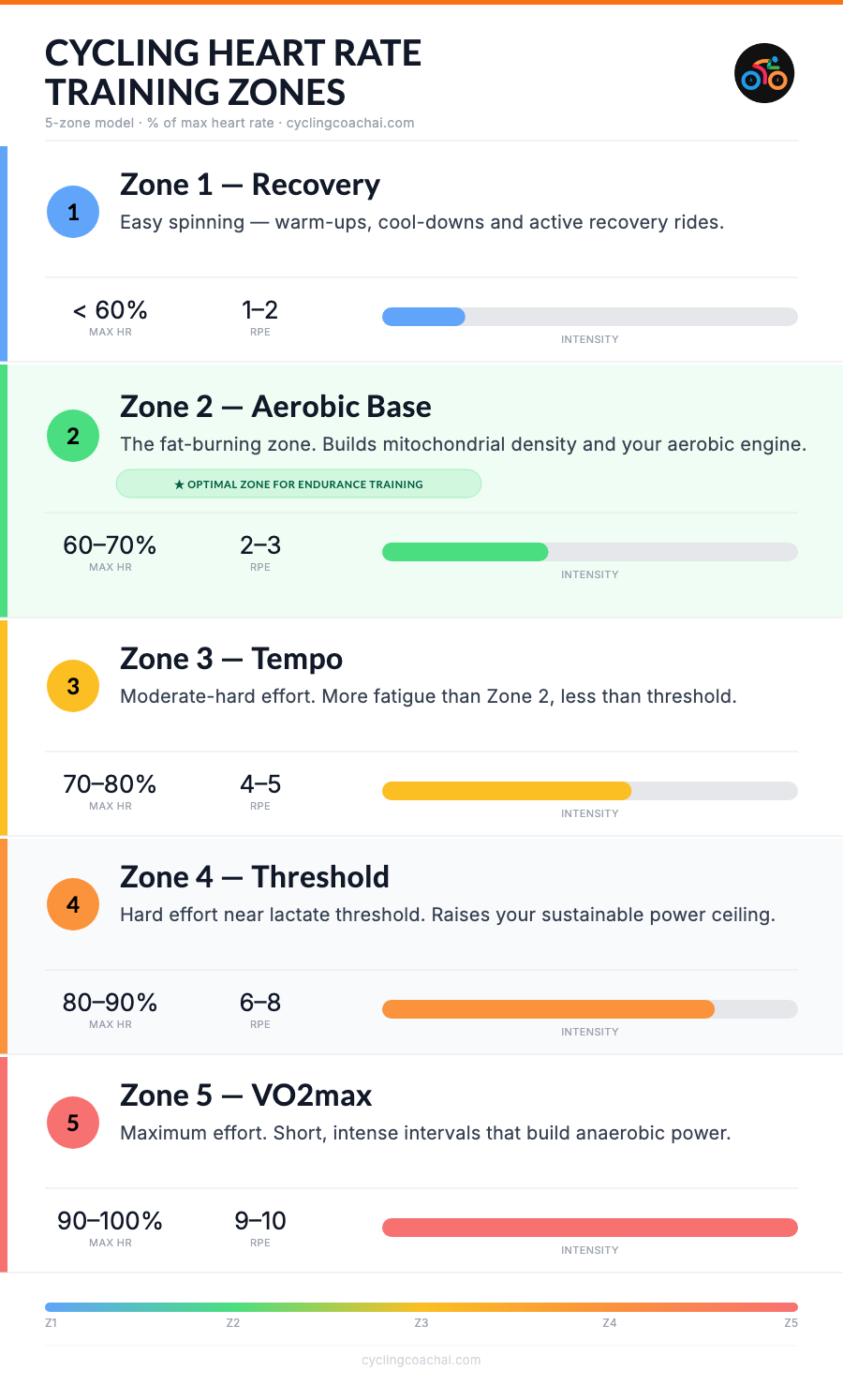
As you maintain this moderate effort, you’ll find yourself able to sustain longer rides with ease. If fat loss is your primary goal, a structured cycling for weight loss plan will show you how to combine Zone 2 rides and HIIT sessions into an effective weekly training block.
The focus here is not on speed but on building a robust aerobic endurance base and stimulating slow twitch muscle fibers.
This foundational work is crucial for your cycling development, as it improves your body’s ability to transport and utilize oxygen, leading to better overall stamina and performance.
By committing to training in this zone, you’re also promoting cardiovascular health.
The consistent, moderate heart rate encourages blood flow and strengthens the heart muscle, all while keeping stress on the body to a minimum.
This type of training is a cornerstone for cyclists looking to enhance long-term endurance and set the stage for more intense workouts in the future.
What are the benefits of Zone 2 training?
Embrace the transformative power of cycling in lower zones as it enhances your cycling endurance and overall health.By committing to this level of effort, you are not only improving your stamina for longer rides but also fostering numerous health benefits, including burning fat.
This training intensity is gentle on the body, reducing the risk of injuries that can occur with high-impact or high intensity efforts.
It allows for more frequent training sessions due to its lower stress on your muscles and joints, promoting consistency in your exercise routine.
The advantages of training in this zone extend to the efficiency of your body’s energy systems.
As you spend time in this endurance training zone, your body becomes more adept at utilizing fat as a fuel source, sparing glycogen reserves for when you need to increase the intensity.
«Zone 2 is the intensity at which mitochondrial fat oxidation is maximized. It is the highest exercise intensity at which the body can still rely primarily on fat as a fuel source while keeping lactate production stable.»
San-Millán I & Brooks GA (2018). Assessment of Metabolic Flexibility by Means of Measuring Blood Lactate, Fat, and Carbohydrate Oxidation During an Incremental Exercise Test. Sports Medicine, 48(Suppl 1).
This metabolic adaptation is crucial for long-distance cycling, where energy management is the key to success.
Furthermore, the consistent, moderate effort required aids in developing a stronger cardiovascular system, which can lead to a healthier heart and reduced risk of chronic diseases.
Training in zone 2 also plays a critical role in recovery.
After hard sessions, this type of ride can help clear metabolic waste from your muscles, facilitating faster recovery and preparing you for your next cycling interval training session.
This balance between exertion and recovery is fundamental to a well-rounded cycling training plan, ensuring you build endurance while allowing your body to heal and strengthen.
When should you include it in your plan?
To optimize your performance and build a solid aerobic endurance foundation, it is advisable to integrate this type of training early in your cycling season.During this period, the focus is on developing endurance and efficiency, which are best achieved through consistent, moderate-intensity rides.
As you progress through different phases of your training plan, these rides should still feature prominently, especially after demanding workouts, to aid in recovery and maintain aerobic fitness.
Including sessions in your weekly training allows for recovery after cycling, like recovery rides, ensuring that your body can recuperate from high-intensity sessions without losing fitness.
This approach helps to prevent overtraining and fatigue, which can derail your training progress.
Moreover, these endurance rides can serve as a tool for gauging improvements in your fitness level, as a decreasing heart rate at a given power output indicates enhanced aerobic endurance capacity.
As you tailor your cycling regimen, recognize that cycling in lower zones is not just a preparatory step but a continuous requirement for maintaining endurance.
Even during peak training periods or competitive seasons, it is beneficial to return to these rides to ensure ongoing cardiovascular health and endurance.
By doing so, you preserve the gains you have made and set the stage for further improvement in your performance.
How much zone 2 training should be in your plan?
Understanding the appropriate amount of Zone 2 to include in your cycling plan is pivotal for achieving optimal endurance benefits.During the base phase and build phase of your training, which typically occurs in the off-season or early season, a significant portion of your training time should be dedicated to endurance rides.
These longer, steady endurance rides are instrumental in developing your aerobic endurance.
As a general guideline, around 70-80% of your total training time during this phase might be allocated to Zone 2 efforts.
As your training progresses towards more specific and high intensity trainings, the proportion of cycling in lower zones will naturally decrease.
However, it remains an essential component of your weekly training to facilitate recovery and maintain aerobic fitness.
It’s not uncommon for experienced cyclists to maintain 1-2 Zone 2 rides per week even during the taper phase.
These rides not only offer recovery benefits but also sustain the aerobic endurance gains achieved during the base phase.
Balance is key in your training approach.
While there is no one-size-fits-all answer, a well-structured training plan will typically include a mix of intensities, with training in lower zones complementing higher-intensity workouts.
Your personal goals, fitness level, and response to training will dictate the precise volume of Zone 2 riding.
Monitoring your body’s response and adapting your training plan accordingly will help you maintain the right amount of training in lowere zones to support your cycling ambitions.
How to actually stay in zone 2?
Maintaining a consistent presence in Zone 2 during your cycling rides demands discipline and attentiveness to your body's cues.It’s imperative to equip yourself with a reliable heart rate monitor, which acts as your guide, ensuring you stay within the correct average heart rate parameters. If you haven’t set your zones yet, use our free heart rate zones calculator to find your exact Zone 2 BPM range.
If you don’t have access to a reliable heart rate monitor, you can use the ‘talk test’: your breathing rate should be ‘conversational’. This means that in Zone 2, you have to be able to speak full sentences, although you should still be able to tell from your breathing that you’re working a bit.
Begin each ride with a warm-up, gradually elevating your heart rate to the desired training zone range.
Once there, focus on maintaining a steady pace that feels manageable over time, one where breathing is controlled and conversational.
It is also important to pay attention to external factors such as terrain and wind resistance, which can inadvertently increase your effort level.
On uphill sections, resist the urge to power through; instead, maintain a steady effort, even if this means reducing speed.
During windy conditions, draft behind other riders or adjust your effort to keep your heart rate anchored in Zone 2.
Consistency in your effort is more beneficial than fluctuating intensity.
Understanding that training in zone 2 is a long-term strategy is crucial.
The temptation to push harder for the sake of variety or immediate satisfaction can be strong, but it’s vital to resist these impulses.
Trust in the process and allow your body the time it needs to adapt and improve.
With dedication and regular monitoring of your heart rate, staying in Zone 2 will become a more intuitive part of your cycling routine, fostering endurance and efficiency that will pay dividends in the long run.
Should you include sprints/intervals in your endurance rides?
While training in the endurance zone is centered on steady-state cardio, it is natural to wonder if incorporating sprints, cycling intervals, or 'sweet spot' training could enhance the efficacy of your rides.However, the primary objective of this type of training is to improve aerobic endurance by maintaining a consistent heart rate that promotes fat oxidation and energy production at a sustainable level.
Adding sprints, intervals or sweet spot training would elevate your heart rate, pushing you out of the Zone 2 and into zones closer to your lactate threshold.
It is essential to understand that the benefits of aerobic training for base building are cumulative and require patience and consistency.
Introducing high-intensity bursts disrupts the steady effort that characterizes Zone 2 and can impede the specific adaptations you are aiming to achieve, such as increased capillary density and mitochondrial efficiency.
These physiological changes are best stimulated by prolonged periods of low-intensity exercise and keeping yourself away from lactate threshold efforts.
If your goal is to enhance your aerobic endurance, it is advisable to focus on maintaining the correct training intensity throughout your endurance rides.
Reserve sprints, intervals and sweet spot training for separate interval training sessions dedicated to improving anaerobic capacity or speed.
By compartmentalizing your training efforts, you ensure that each session targets aerobic energy system and contributes optimally to your overall performance.
Remember, the key to success is the consistent application of moderate effort over time, not the sporadic inclusion of high-intensity work.
Zone 2 vs Sweet Spot Training
Sweet spot training sits at roughly 85–92% of your maximum heart rate — or an RPE of 6–7 out of 10 — uncomfortable enough to hurt, but sustainable for 20–40 minutes. It delivers fitness gains per hour faster than Zone 2, which is why it’s popular for time-crunched riders.

But there’s a cost. Sweet spot generates meaningful lactate accumulation, which means you need more recovery between sessions. Stack too many sweet spot rides in a week and fatigue builds faster than fitness.
Zone 2, by contrast, keeps lactate low enough that your body clears it in real time. You can train in Zone 2 more days per week without the accumulated fatigue that forces cutbacks. That’s why elite endurance athletes skew heavily toward Zone 2 — it allows a higher total training load. Most coaches recommend Zone 2 as 70–80% of volume, with sweet spot reserved for 1–2 targeted sessions per week.
Zone 2 vs Tempo Rides
Tempo training sits in Zone 3 — roughly 80–85% of your maximum heart rate, or an RPE of 5–6 out of 10. The problem: tempo is also the zone most cyclists accidentally end up in when they think they’re doing Zone 2.
In tempo, lactate production exceeds Zone 2’s clearance capacity, pushing you into a more glycolytic (sugar-burning) state. You fatigue faster and need more recovery without gaining the full mitochondrial benefits of true Zone 2.
This is the “grey zone” problem: too hard for recovery, not hard enough for interval quality — the least efficient place to spend training time. If you want to stay in Zone 2, slow down on climbs, ease back into headwinds, and keep checking your heart rate. Your legs might feel comfortable while your heart has already drifted into Zone 3.
When can you expect to see results from Zone 2 training?
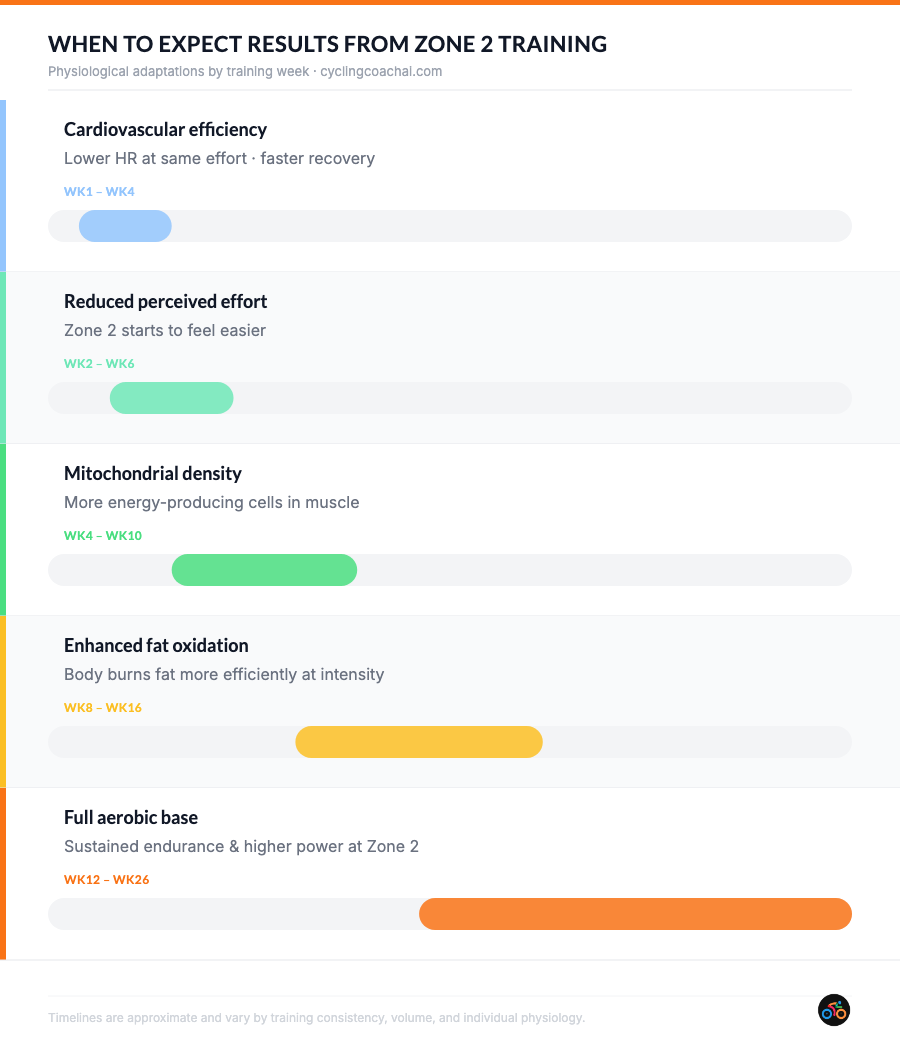
Patience is your ally when embarking on training in lower zones.The adaptations your body undergoes during this type of exercise are gradual and require consistent effort over time.
Typically, you may begin to notice improvements in your endurance and ability to sustain longer rides at a consistent pace after several weeks of dedicated Zone 2 training.
However, significant physiological changes, such as increased mitochondrial density, enhanced fat oxidation, and meaningful VO2max gains, can take several months to develop fully.
Your progression in Zone 2 training is not always linear, and it’s important to measure your improvements in various ways. One of them is your aerobic ceiling, which you can estimate from your FTP or your resting and maximum heart rates and check again a few months later.
You might find that your heart rate at a given power output decreases, indicating enhanced aerobic efficiency, or that you can cycle longer distances with less perceived effort.
These subtle yet meaningful signs of progress serve as motivation and confirmation that your training is effective.
Consistency is crucial for reaping the benefits of Zone 2 training.
By integrating these sessions into your weekly routine and adhering to the correct lower intensity, you create the conditions for continuous improvement.
It’s important to remember that the body adapts during recovery periods, so ensuring adequate rest and nutrition is as vital as the training itself.
By monitoring your fitness and adjusting your training plan as needed, you’ll set yourself up for success in achieving your cycling goals.
Common Zone 2 Training Mistakes
1. Riding Too Fast — The Grey Zone Trap
The most common Zone 2 mistake is drifting into Zone 3 (tempo) without realizing it. It feels sustainable and productive, but it doesn't deliver the aerobic base stimulus you're targeting — and it generates enough fatigue to slow recovery. Use a heart rate monitor with zone alerts. If you're creeping above your upper Zone 2 limit, slow down — even if it feels embarrassingly easy.
2. Sessions Too Short to Matter
Zone 2 adaptations — increased mitochondrial density, improved fat oxidation, capillary growth — require sustained aerobic effort. Sessions under 45 minutes provide minimal stimulus. Aim for at least 60 minutes per session, and ideally 90 minutes or longer. The longer you sustain Zone 2, the stronger the aerobic signal you send to your body.
3. Skipping the Heart Rate Monitor
Riding by feel in Zone 2 almost always leads to drift. You feel comfortable, so you push a little harder. Then harder again. Without a number to anchor your effort, you'll spend most of your "Zone 2" ride in Zone 3. A basic heart rate monitor is the most important tool for honest Zone 2 training — you don't need a power meter.
4. Stacking Zone 2 Immediately After Hard Intervals
Zone 2 is often called a "recovery ride," but that's misleading. A proper 90-minute Zone 2 session is still a meaningful aerobic training stimulus, not passive rest. Doing one the day after a hard interval session can blunt recovery rather than support it. On true recovery days, keep rides short (under 45 minutes) at genuine Zone 1 effort — or simply rest.
5. Expecting Results Too Soon
Mitochondrial biogenesis, capillary density improvements, enhanced fat oxidation — these adaptations unfold over weeks and months, not days. Most cyclists notice improved endurance after 6–8 weeks of consistent Zone 2 training. Significant aerobic base improvements typically take a full training season. The patience required isn't a flaw in the protocol; it's part of it.
6. Treating Every Ride as Zone 2
Zone 2 builds your aerobic base, but a diet of exclusively Zone 2 riding will plateau your performance. Elite cyclists follow a polarized model: roughly 80% of training volume in Zone 2, and 20% at high intensity (Zone 4–5 intervals). The high-intensity sessions sharpen speed and power. Without them, Zone 2 alone will develop endurance but won't raise your performance ceiling. Ride easy when it's easy — and hard when it's time to go hard.
Key Takeaways
In summary, training in zone 2 is essential to a well-rounded endurance regimen.By maintaining your heart rate between 60-70% of its maximum, you encourage a multitude of physiological adaptations that bolster your aerobic capacity and efficiency.
This moderate level of effort not only conditions your body to utilize fat as fuel better, thereby enhancing energy production for prolonged periods, but it also fosters cardiovascular health by promoting blood flow and strengthening the heart muscle without imposing undue stress.
As you integrate this training into your cycling routine, remember that consistency is the key to unlocking its full potential.
Whether you are in the early stages of building your aerobic base or looking to maintain endurance during peak training, this rides should be a staple.
They serve not only as a tool for active recovery but also as a means of gauging and sustaining fitness improvements.
To stay within this zone effectively, equip yourself with a heart rate monitor and be mindful of your pace, especially when external conditions like terrain, wind, or other riding groups could push you beyond the intended lower intensity.
Refrain from integrating sprints or intervals into these endurance rides, as they can disrupt the steady effort this zone requires.
Expect to see results from this training approach after several weeks, with significant gains unfolding over months of dedicated practice.
Cycling in zone 2 is far from a waste of time; it is a strategic investment in your endurance and long-term performance.
By adhering to the principles outlined, you can ensure that each pedal stroke takes you closer to your cycling goals.