This plan assumes
Are you ready for this plan?
- Can ride off-road for 2 hours at a comfortable pace
- Have a power meter and heart rate monitor
- Know your current FTP (tested within the last 6 weeks)
- Comfortable with intermediate-level singletrack
- Can commit to 5 rides per week for 12 weeks
Plan overview
Base
Weeks 1-4Build a deep aerobic base with Zone 2 trail rides and progressive tempo climbing. Skills sessions cover fundamentals: cornering, braking, body position, and steep terrain.
6-7 hours/weekBuild
Weeks 5-9Introduce threshold intervals and extend trail endurance. Skills sessions progress to intermediate techniques: drops, rock gardens, jumps, and flow. Recovery week at week 8.
7-9 hours/weekPeak
Weeks 10-11Highest quality fitness sessions and advanced skills work. All elements come together: fitness, technique, and confidence.
7-8 hours/weekTaper
Weeks 12Reduced volume with fun skills and a reward ride. Celebrate 11 weeks of progress on your favorite trails.
5-6 hours/weekWeekly structure
What makes mountain bike training different
Off-road cycling training rarely allows a steady, controlled pace. Short climbs, sharp accelerations, technical sections, and constant changes in terrain force repeated bursts of effort followed by incomplete recovery. A proper mountain bike training program must prepare you to handle these frequent intensity spikes without accumulating excessive fatigue.
Variable intensity and repeated efforts
Unlike road cycling, where long steady efforts dominate, MTB riding demands the ability to repeatedly move above threshold and recover quickly. Training should include structured sessions that develop both high-intensity capacity and the ability to sustain performance across multiple efforts within the same ride.
Climbing strength and muscular endurance
Steep off-road climbs demand sustained force production, not just aerobic capacity. Steep gradients, low cadence efforts, and uneven traction place a high load on the legs. A mountain bike training program must develop muscular endurance alongside cardiovascular fitness.
Technical terrain and handling demands
Roots, rocks, drops, and tight corners require active body positioning, rapid decision-making, and precise bike control. These demands increase the physical and mental cost of every ride compared to road cycling.
XC, trail, and enduro: how discipline shapes your training
Cross-country racing focuses on sustained aerobic output, climbing efficiency, and the ability to maintain high power over 60-90 minutes. Sessions emphasize endurance rides, threshold intervals, and cadence work.
Trail riding demands a broader fitness base with equal emphasis on climbing endurance and technical descending confidence. Plans balance structured fitness work with dedicated skills sessions.
Enduro training prioritizes repeated high-intensity efforts with recovery between timed downhill stages. Upper body strength, descending technique under fatigue, and the mental endurance to stay sharp on the final stage of a long race day are key differentiators.
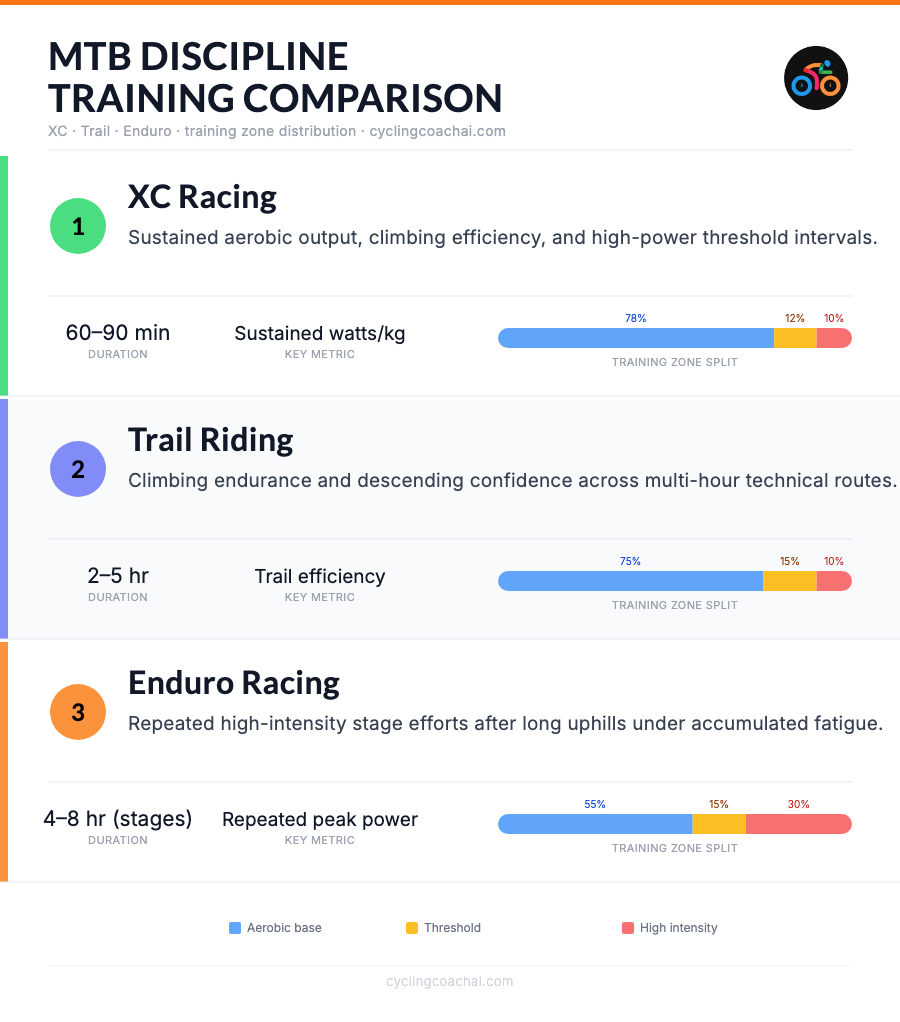
These plans are grouped by discipline so you can choose the training stimulus that matches your riding. Whether you need an XC training plan focused on sustained threshold output, an enduro training plan built around repeated stage efforts, or a broader MTB fitness plan for mountain bike race training, each category below matches its specific demands.
Key components of a mountain bike training plan
A mountain bike training program or structured mountain bike workout plan only works when all its components are balanced and purpose-driven.
1. Endurance base
Long rides at controlled intensity build the aerobic foundation needed to handle extended time on the trails. This base supports recovery between repeated efforts and improves overall efficiency.
«Elite endurance athletes allocate approximately 80% of training volume to low-intensity sessions, forming the aerobic base that supports high-intensity performance.»
Seiler & Kjerland (2006). Quantifying training intensity distribution in elite endurance athletes: is there evidence for an optimal distribution? Scandinavian Journal of Medicine & Science in Sports, 16(1), 49-56.
2. High-intensity efforts
Short, hard efforts are a defining feature of mountain biking. Training must include structured intervals that develop the ability to surge above threshold and recover repeatedly.
3. Muscular strength and torque
Low-cadence efforts and steep terrain demand high force output. Strength-focused work improves torque production and resistance to localized muscular fatigue.
4. Recovery and load management
Progress happens during recovery, not during training. Structured rest and load management prevent the accumulated fatigue that leads to stagnation.
5. Skills and technique practice
Technical proficiency determines how efficiently you use your fitness on the trail. Dedicated skills work is a performance tool, not something you pick up over time.
Skills and technique training
Improving your fitness alone will not automatically make you faster on the trails. How you apply power, choose lines, and manage your body position directly impacts how hard each ride feels.
Watch: mountain bike beginner skills

Climbing technique
How you climb matters as much as how strong you are. Poor cadence control, excessive upper body tension, and bad line choice increase fatigue on every ascent. Working on seated climbing, cadence variability, and weight distribution helps you maintain traction and apply power more efficiently.
Descending and control
Technical descents place high physical and mental demands on you, even if power output is low. Braking control, body positioning, and vision all influence how much stress you accumulate. Better technique allows you to recover while descending instead of fighting the bike.
Cadence and power application
Mountain biking rarely rewards a single cadence. Being able to shift smoothly between low-cadence torque and higher-cadence spinning improves efficiency across changing terrain.
Integrating skills into your training plan
Skills practice should not be a separate activity from your fitness training. The most effective approach is to incorporate technical work into your regular rides. During endurance rides, pick a technical section of trail and repeat it two or three times at low intensity, focusing on line choice and body position rather than speed. Dedicate 15 to 20 minutes of your warm-up to specific skills drills: track stands, slow-speed maneuvers, or cornering practice on a flat section of trail. This turns every ride into both a fitness session and a skills session without adding extra time to your week.
Combining indoor training with trail sessions
Not every rider has year-round access to trails, and some weeks simply do not allow enough time for outdoor rides. Indoor training fills this gap effectively when used with purpose.
Build the engine indoors
A smart trainer is ideal for structured aerobic and interval work. Sessions are consistent, measurable, and unaffected by weather or trail conditions. Endurance rides, threshold intervals, and cadence drills all transfer directly to trail performance. A 45-minute indoor session with structured intervals often delivers more fitness stimulus than a 90-minute unstructured outdoor ride.
Transfer skills on the trail
What you cannot replicate indoors is technical skill: cornering under braking, descending steep terrain, and handling loose surfaces. These require trail time. When trails are accessible, prioritize rides that include technical sections rather than fire-road-only routes.
Seasonal strategy
Many riders use a heavier indoor block during winter to build their aerobic base, then shift to trail-focused training in spring and summer. This approach keeps fitness progressing even when conditions limit outdoor riding. Specific indoor interval formats map well to MTB demands: short-short intervals replicate trail punches, over-under efforts simulate XC climbing, and longer threshold blocks build sustained power for enduro stages. Consistent use of indoor sessions keeps your MTB training program on track when trail access or schedules make outdoor riding impractical.
What a mountain bike training week looks like
The structure of your MTB training program changes significantly between levels. Understanding the differences helps you choose the right starting point.
Beginner: 3 days on-bike + 1 strength
| Day | Session | RPE |
|---|---|---|
| Tuesday | Easy trail ride (60 min) | 2-3 |
| Wednesday | Strength: full body | - |
| Saturday | Endurance trail ride (75-90 min) | 3 |
| Other days | Rest or light activity | - |
Intermediate: 4 on-bike + 1-2 strength
| Day | Session | RPE |
|---|---|---|
| Tuesday | Endurance ride (60-75 min) | 3 |
| Wednesday | Strength: lower body + core | - |
| Thursday | Climb efforts (60 min) | 5-6 |
| Saturday | Long endurance ride (90-120 min) | 3 |
| Sunday | Recovery ride (45 min) | 2 |
Advanced: 5-6 on-bike + 2 strength
| Day | Session | RPE |
|---|---|---|
| Monday | Recovery ride (45 min) | 2 |
| Tuesday | Climb intervals (75 min) | 7-8 |
| Wednesday | Strength: lower body + core | - |
| Thursday | Endurance ride (90 min) | 3 |
| Friday | Recovery ride (45 min) | 2 |
| Saturday | Long endurance ride (2-3 hours) | 3 |
| Sunday | Skills session or strength | 2-3 |
These are representative weeks from the early phase of each plan. Volume and intensity progress across the full training block. Choose your level below to see the complete week-by-week schedule.
How your mountain bike fitness builds over time
Mountain bike training combines aerobic fitness with technical skill, and both must progress together. The timeline and training focus differ by level:
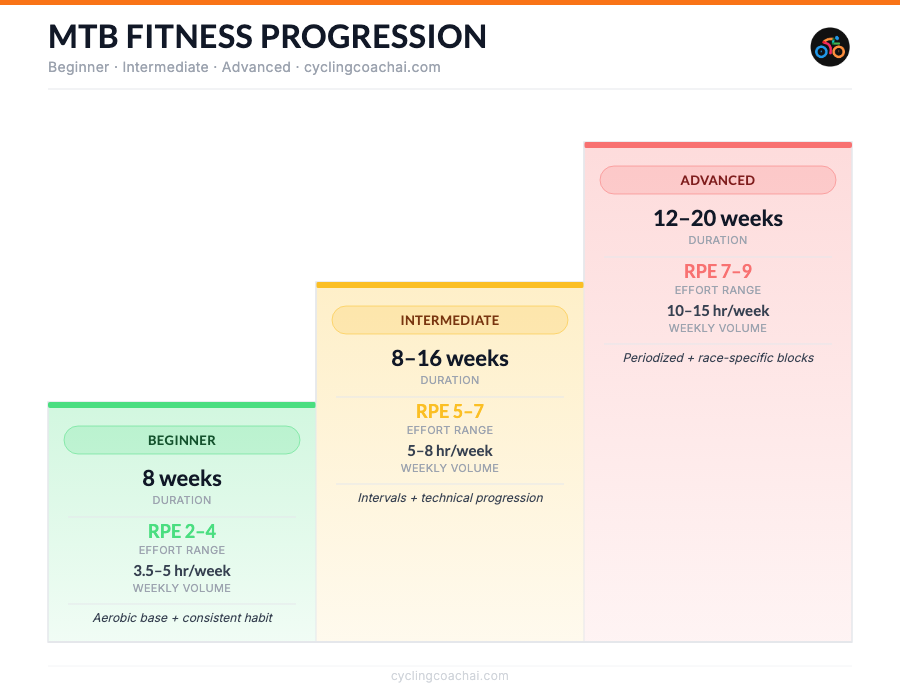
Beginner (8 weeks)
The priority is building a consistent riding habit and a basic aerobic foundation. Rides are short to moderate, effort stays at RPE 2-4, and strength work introduces fundamental movement patterns. By week 8, a beginner rider should be able to complete a 90-minute trail ride at a controlled effort.
Intermediate (8-16 weeks)
Structured intervals enter the plan: climbing efforts, short high-intensity repeats, and cadence work. Effort ranges widen to RPE 5-7 during key sessions. Technical progression becomes intentional, with specific skills practiced alongside fitness work. Strength training advances to heavier loads and more targeted exercises.
Advanced (12-20 weeks)
Training becomes race-specific and periodized. Blocks target different capacities: endurance, threshold, high-intensity repeats, and tapering. Key sessions reach RPE 7-9. Double days appear in high-volume weeks. Strength work peaks in early blocks and transitions to maintenance as event preparation increases. The final weeks include a structured taper to arrive at events fresh and sharp.
Across all levels, the principle is the same: build the base first, then add intensity. Riders who jump to high-intensity work without an aerobic foundation plateau faster and recover slower.
Strength training for mountain biking
Strength training is not optional if you ride mountain bikes regularly. Off-road terrain, repeated climbs, and long technical descents place constant stress on your muscles, joints, and stabilizing structures. If you lack strength, endurance and intensity gains start to break down as fatigue builds.
«Concurrent strength and endurance training improved cycling economy by 4.8% and increased time to exhaustion at maximal aerobic power.»
Rønnestad et al. (2010). Effects of in-season strength maintenance training on thigh muscle cross-sectional area, strength, cycling performance, and body composition in cyclists. Journal of Strength and Conditioning Research, 24(6).
Every MTB training program below integrates strength work as part of the weekly structure. You do not add strength work on top of riding. You train it alongside your bike sessions to support climbing power, stability, and fatigue resistance.
Key exercises for mountain bikers
Focus on compound movements that transfer directly to trail performance. For climbing power: back squats, split squats, and single-leg press (3-4 sets of 6-10 reps). For core stability and bike control: planks, pallof press, and dead bugs (3 sets of 30-60 seconds or 10-15 reps). For upper body endurance on technical terrain: bent-over rows, push-ups, and face pulls (3 sets of 10-15 reps).
Programming guidance
Beginners benefit from one full-body strength session per week. Intermediate and advanced riders should aim for two sessions: one lower body-focused and one upper body and core session. Schedule strength work on easy or rest days, not after high-intensity rides. Reduce strength volume during the final 1-2 weeks of a training block to allow full recovery before events.
Strength and stability beyond the bike
Core stability, upper body strength, and postural control play a major role in maintaining efficiency on technical terrain. Long descents and rough trails place sustained stress on the arms, shoulders, and lower back. Riders who neglect off-bike strength work often develop performance plateaus and recurring discomfort on longer or more technical rides. Integrating stability exercises like single-leg balance work, hip-hinge patterns, and thoracic mobility drills helps maintain better form late in rides and reduces the risk of overuse injuries.
Training zones
This plan uses power zones (% of FTP) and heart rate zones (% of max HR) to guide effort. A power meter and heart rate monitor are required.
Power zones
| Zone | % FTP | RPE | Feel |
|---|---|---|---|
| Z1 Recovery | 0-55% FTP | 1-2 out of 10 | Extremely easy. No sensation of effort. Used only for recovery rides. |
| Z2 Endurance | 56-75% FTP | 3-4 out of 10 | Comfortable, sustainable effort. You are working but could maintain this for hours on easy trails. |
| Z3 Tempo | 76-90% FTP | 5-6 out of 10 | Moderately hard. Sustainable for 30-60 minutes but requires concentration. |
| Z4 Threshold | 91-105% FTP | 7-8 out of 10 | Hard. You can sustain this for 20-40 minutes with focus. Speaking is difficult. |
| Z5 VO2max | 106-120% FTP | 8-9 out of 10 | Very hard. Maximum sustainable effort for 3-8 minutes. Legs and lungs burn. |
| Z6 Anaerobic Capacity | 121-150% FTP | 9-10 out of 10 | Maximum effort for 30 seconds to 2 minutes. Not sustainable. |
| Z7 Neuromuscular Power | 150%+ FTP | 10 out of 10 | All-out sprint for under 30 seconds. Pure explosive effort. |
Heart rate zones
| Zone | % Max HR | Feel |
|---|---|---|
| Z1 Recovery | 0-59% max HR | Extremely easy. No sensation of effort. Used only for recovery rides. |
| Z2 Endurance | 60-70% max HR | Comfortable, sustainable effort. You are working but could maintain this for hours on easy trails. |
| Z3 Tempo | 71-80% max HR | Moderately hard. Sustainable for 30-60 minutes but requires concentration. |
| Z4 Threshold | 81-90% max HR | Hard. You can sustain this for 20-40 minutes with focus. Speaking is difficult. |
| Z5 VO2max | 91-100% max HR | Very hard. Maximum sustainable effort for 3-8 minutes. Legs and lungs burn. |
12-Week Mountain Bike Training Plan
| Day | Session | Duration |
|---|
MTB fueling: in-ride nutrition strategy
Trail riding nutrition supports both fitness and skills development. Long trail rides require consistent fueling, while skills sessions need enough energy for focus and reaction time.
Mountain biking creates fueling challenges that road cyclists rarely face: limited access to water, the difficulty of eating while navigating technical terrain, and the variable intensity of trail riding. A hydration pack is more practical than bottles on rough terrain and frees your hands for bike control. Eat and drink on easier sections of trail, not during technical features.
Before rides
Eat a carb-rich meal 3 hours before longer rides. Aim for 100-150g of carbohydrates. For skills sessions, a lighter snack 60-90 minutes before is sufficient.
During rides
For trail rides over 90 minutes, aim for 60-90 grams of carbohydrates per hour from gels, chews, or trail-friendly snacks. A hydration pack makes fueling on technical trails easier. Start eating at minute 20.
After rides
Within 30 minutes of finishing, consume 1.2g of carbohydrates per kilogram of body weight plus 20-30g of protein. Recovery shake, rice with chicken, or chocolate milk are all good options.
Hydration
Drink 500-750ml per hour depending on temperature. Use electrolyte mix. Trail riding often takes you far from water sources, so carry enough for the full ride.
Long ride days
For Saturday long trail rides, eat a full pre-ride meal, carry enough fuel for the duration, and plan refill points if possible.
MTB Gear Checklist
Essential
Power meter
Essential for pacing climbs and tracking interval intensity on fire road sessions.
Heart rate monitor (chest strap)
Secondary effort reference for trail rides where power fluctuates constantly.
Trail bike (full suspension, 130-160mm travel)
A full suspension trail bike handles the variety of terrain in this plan. It climbs, descends, and handles technical features with versatility.
Dropper seatpost
Essential for trail riding. Lower your saddle for descents and skills sessions, raise it for climbs.
Knee pads (lightweight trail pads)
Protect your knees during skills sessions and descents. Lightweight trail pads are comfortable for all-day riding.
Hydration pack
Carries water, tools, and snacks for long trail rides. More practical than bottles on technical terrain.
Nice to have
Cycling computer with trail mapping
Displays power and heart rate data. Trail mapping helps navigate new trail systems.
Tubeless tire setup
Reduces puncture risk and allows lower pressures for better grip.
Full-face helmet (convertible)
Extra protection for skills sessions involving drops and jumps.
5 mistakes that derail mountain bike training plans
Skipping the weekly skills session
Skills sessions are what differentiate this plan from a pure fitness plan. Technical ability determines how much you enjoy trail riding and how safely you can push your limits.
Fix: Treat Wednesday skills sessions as non-negotiable. They are the most trail-specific work in the plan.
Treating skills sessions as high-intensity workouts
Skills sessions should be at RPE 3-5. Technique breaks down at high intensity, and you reinforce bad habits instead of building good ones.
Fix: Keep skills sessions slow and deliberate. Speed comes from technique, not effort.
Only riding the same trails
Technical skills improve fastest with variety. Different trails expose different weaknesses.
Fix: Ride at least 3-4 different trail systems during the 12 weeks.
Training at threshold on easy days
Trail endurance rides are Zone 2 (56-75% FTP). Riding too hard on easy days compromises your interval sessions.
Fix: Cap your power at 75% FTP on endurance and recovery rides.
Ignoring upper body and core strength
Trail riding demands upper body endurance for bike control on descents. Weak arms lead to arm pump and poor technique.
Fix: Add push-ups, planks, and pull-ups on rest days. Even 10 minutes makes a noticeable difference.
MTB ride day tips
Climb by power, descend by feel
Use your power meter for climbing intensity. On descents, focus on the trail, not the screen. Body position, line selection, and flow are what matter going downhill.
Film yourself on skills sessions
Recording reveals technique issues you cannot feel. Compare your body position to skilled riders and adjust.
Ride with better riders when possible
Following a more skilled rider teaches lines, pacing, and technique through observation. One ride with a better rider can teach more than a week of solo practice.
Use the 12-week timeline to explore new trails
With 12 weeks, you have time to visit trail systems you have not ridden before. New trails build adaptability and expose skill gaps you did not know you had.
Why a personalized plan outperforms this one
This plan provides a solid framework for trail riding improvement. But a plan built from your actual data and skill assessment adapts to you instead of asking you to adapt to it.
Start Free · Pay Nothing Today · Cancel Anytime