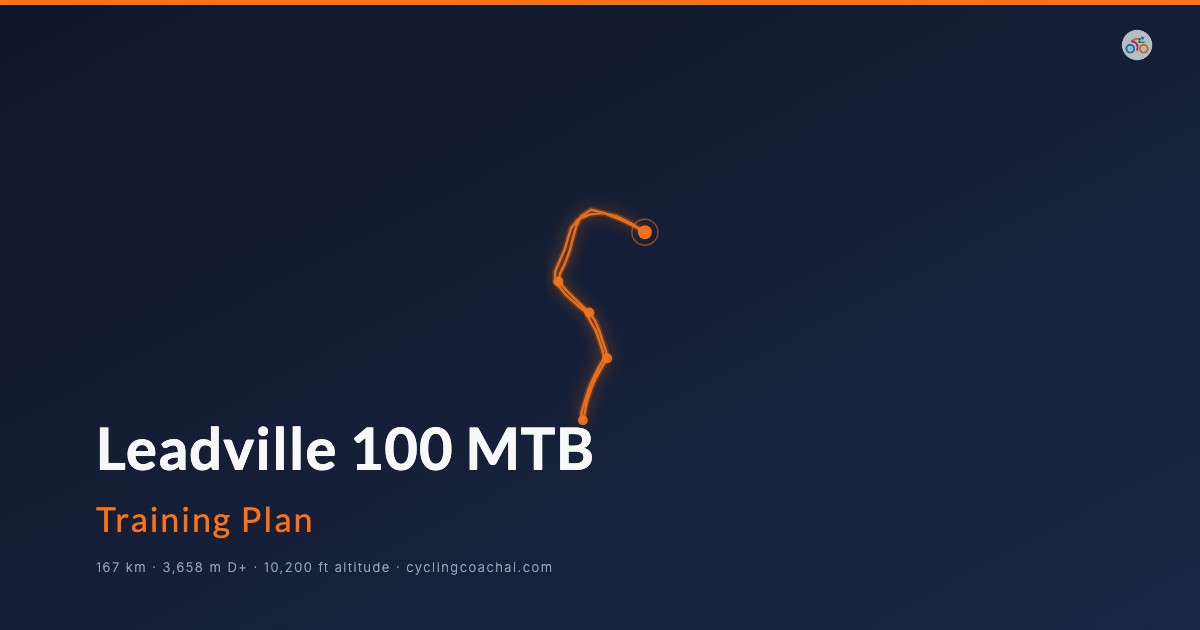
You have signed up for 167 kilometres at 10,200 feet above sea level, 3,658 metres of climbing to a 12,600-foot summit, and a 12-hour cut-off that turns back nearly half the field every August in Colorado.
The Leadville 100 MTB is not the most technically demanding race in the world. What makes it exceptional is altitude. Every rider on the course is operating at 80-90% of their sea-level capacity before the first pedal stroke. The athletes who finish, and especially those who break nine hours for the Big Buckle, have trained their aerobic engines to sustain power under conditions that punish anyone who ignored the elevation on their training plans. If you have not yet built a structured base, a general mountain bike training plan is the foundation to start from before specialising for Leadville.
This guide gives you a complete Leadville 100 MTB training plan: race overview, the physiological demands of altitude racing, how to build the aerobic capacity and muscular endurance to reach Columbine Mine and return, and full week-by-week plans for 12, 16, 20, and 24 weeks. Follow it and you will arrive in Leadville with the fitness, the pacing strategy, and the nutritional habits to hear the finish line announcement at the end of Sixth Street.
Leadville 100 MTB Race Overview
Race day is 14 August 2027, and the lottery closes long before you start training for it. It runs from 1 to 15 December 2026 with results on 6 January 2027. Over 5,000 people enter for about 1,800 places, and the alternative route in is a qualifier race. If you are reading this in the autumn, entering is the action; the 24-week plan below starts in March.
| Race detail | |
|---|---|
| 📍 Location | Leadville, Lake County, Colorado, USA |
| 📅 Next edition | 14 August 2027 |
| 🌐 Official website | leadvilleraceseries.com |
| 📏 Distance | ~167 km (104 miles — GPS-verified) |
| ⛰️ Elevation gain | 3,658 m (12,000 ft) |
| 🏔️ Highest point | Columbine Mine, 3,840 m (12,600 ft) |
| 🛣️ Surface | ~80% doubletrack and forest road, ~15% singletrack, ~5% paved |
| ⏱️ Cut-off times | Course cut-off 12h15 · Big Buckle sub-8h15 · Small Buckle sub-11h15 (2026 figures; the organisers list 2027 buckle times as subject to change) |
| 👥 Participants | ~1,800 starters (5,000+ apply via lottery) |
| 🎟️ Entry method | Lottery, open 1 to 15 December 2026 with results on 6 January 2027, plus entry through a qualifier race |
| 📁 GPX route | RideWithGPS route |
Estimated Finish Times
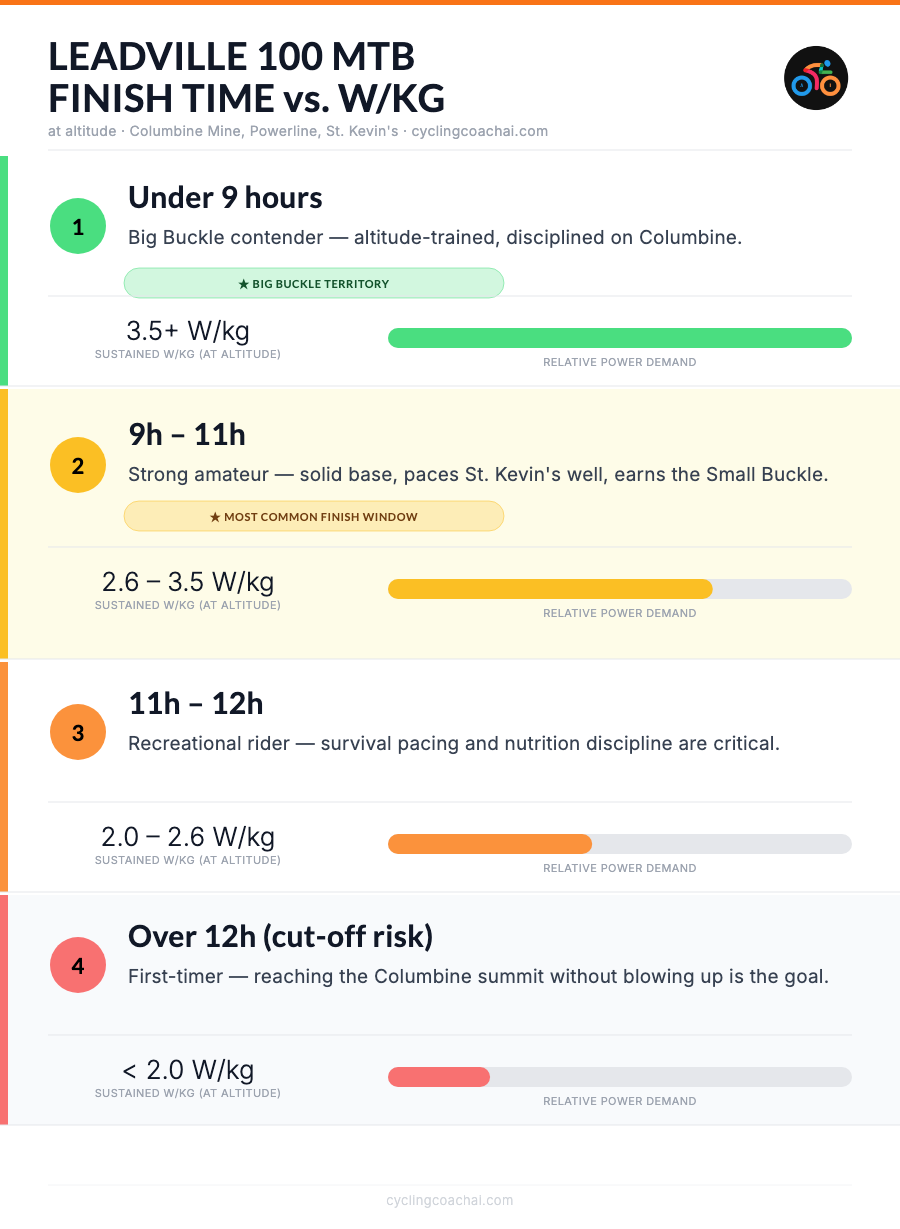
| Estimated finish time | Approximate W/kg needed (at altitude) |
|---|---|
| Under 9 hours (Big Buckle) | 3.5+ W/kg |
| 9h – 11h | 2.6 – 3.5 W/kg |
| 11h – 12h | 2.0 – 2.6 W/kg |
| Over 12h (cut-off risk) | < 2.0 W/kg |
Based on sustained power at 10,200 ft. Sea-level FTP is approximately 15-20% higher than effective altitude FTP. Neutral conditions, no mechanical issues.
Your Leadville 100 MTB Finish Target
The W/kg values above are expressed at altitude, not at sea level. A rider with a sea-level FTP of 4.0 W/kg may arrive in Leadville capable of sustaining only 3.3-3.4 W/kg on the climbs — a 15-18% reduction — if they have not acclimatised. This is why finish-time predictions built on sea-level testing consistently overestimate performance at Leadville.
What Makes Leadville 100 MTB Unique
The Leadville 100 begins at 10,200 feet. Before the first effort of the day, every rider is already working with a reduced aerobic ceiling. The haemoglobin in your blood carries less oxygen at altitude, and your cardiovascular system cannot compensate by simply working harder — pushing above threshold at elevation incurs a lactate debt that is slower and more costly to clear than at sea level. The practical result: riders who attempt to ride Leadville like a sea-level century pay for it severely on Columbine Mine outbound and on Powerline inbound.
Columbine Mine is the defining effort of the race. From Twin Lakes at around mile 40, the course climbs 3,000 feet over 10 miles to 12,600 feet above sea level. The first half is rideable at a disciplined pace; the upper section, above 12,000 feet, tests everyone. Many riders who have trained well still walk portions of the final pitch. The summit marks the halfway point and the emotional centre of the event — the moment when every rider knows the second half is coming.
Powerline, at miles 79-82 on the return leg, is where the race is decided. A 1,500-foot climb on loose, rocky singletrack and doubletrack, arriving when your legs have already covered 80 miles at altitude, Powerline turns well-paced riders into heroes and poorly-paced riders into sufferers. Finish time at Leadville is largely determined by how much you have left when you reach the bottom of Powerline on the way home.
Physiological Demands of the Leadville 100 MTB
Dominant energy system
Aerobic Endurance
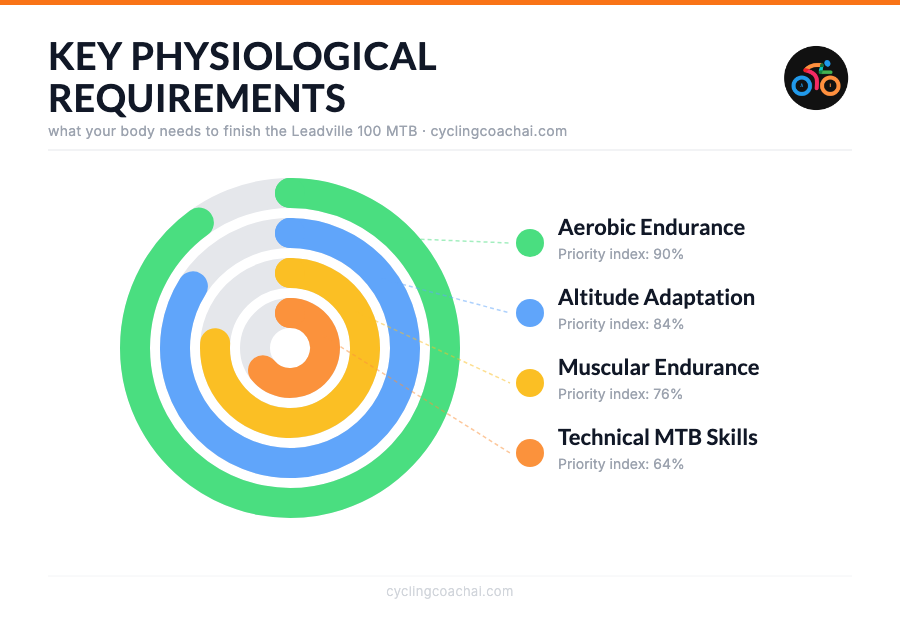
85-90% of Leadville is aerobic oxidative work. The race demands 4,500-6,000 kJ of sustained output across 9-12 hours, with altitude reducing your effective aerobic ceiling by 10-18%. Training your aerobic engine, not your peak power, is the primary preparation goal for this event.
Altitude adaptation earns its place as the second physiological priority because it is the variable that most surprises well-trained sea-level athletes. VO2max drops approximately 1% per 300 metres of elevation gain above 1,500 metres. At Leadville's start elevation of 3,109 metres, unacclimatised riders are operating at roughly 80-85% of their sea-level aerobic capacity before the race begins. Arriving 10 or more days before race day, or using altitude tents at 2,500+ metres for 6 weeks before the event, partially reverses this reduction by stimulating red blood cell production.
Muscular endurance matters here for a different reason than on a road gran fondo. The rough surface of Leadville's doubletrack and singletrack forces constant micro-adjustments, adding 10-15% more metabolic cost per kilometre compared to road cycling at the same speed. After eight hours of this, the legs and lower back accumulate fatigue that no training ride on a smooth road can fully replicate. Regular long rides on gravel and MTB terrain are not optional preparation — they are the preparation.
Technical MTB skills have an outsized effect on finish time at Leadville relative to most other hundred-mile events. Powerline's loose rock and steep pitch rewards bike handlers who can stay seated and pedal through the rough sections. Riders who walk large sections of the descent or struggle with the singletrack on Pipeline lose 10-20 minutes that cannot be recovered through fitness alone. Two MTB skill rides per week throughout preparation are built into every plan below.
Leadville 100 MTB Training Plan: Full Schedule
Four complete plans based on your available preparation time and current fitness. Select the one that matches your situation. Recovery weeks reduce volume by 30-40% while preserving one quality session. The final two weeks in every plan are a taper: volume drops sharply while intensity is preserved to arrive fresh.
| Day | Session | Duration |
|---|
Key Workouts for Leadville 100 MTB
1. The Columbine Simulation
Session: 3×20 minutes at 88-95% of FTP, with 8 minutes of easy spinning between efforts. Progress to 2×30 minutes in the final build phase.
Why it works: Columbine Mine requires sustained threshold-adjacent power for up to 90 minutes depending on your fitness. This session teaches your aerobic system to sustain output at the top end of Zone 3 and bottom of Zone 4 without accumulating lactate faster than you can clear it. At altitude, the effective intensity of this session is higher than the wattage suggests — if you use altitude tents, perform this session at sea-level power and note the increased respiratory rate and perceived effort. On a smart trainer, set the gradient at 6-8% and focus on staying in the saddle for the full duration. As fitness builds, extend the intervals and reduce rest periods.
When to use it: Every 10-12 days from mid-base phase through race prep.
2. The Powerline Preparation Block
Session: 8×3 minutes at high force, low cadence (50-60 rpm), in a gear that makes the effort feel heavy rather than fast. Full recovery between efforts. On a climb if available, or large gear on flat terrain.
Why it works: Powerline on the return leg is steep, loose, and arrives when your legs are already depleted. This session trains the slow-twitch and fast-twitch muscle fibres to generate torque at low speeds under fatigued conditions — the exact demand Powerline makes on every rider above mile 79. The low cadence creates neuromuscular adaptation that transfers directly to the rocky pitch sections where maintaining momentum matters more than speed. Do this session after a 2-3 hour endurance ride, never on fresh legs, to simulate Powerline's late-race conditions.
When to use it: Every 2 weeks in the build phase.
3. The Back-to-Back Long Ride Block
Session: Saturday 5-6 hours at Zone 2 to low Zone 3, on MTB terrain wherever possible. Sunday 2.5-3.5 hours at the same intensity.
Why it works: The return leg of Leadville, from Twin Lakes back to Leadville, is ridden on already-fatigued legs. A single long ride each week does not develop the specific resistance to second-day fatigue that makes the difference between a strong Powerline and a suffering one. Back-to-back long rides train your body to access fat oxidation efficiently when glycogen stores are partially depleted, which is exactly the metabolic state of a Leadville rider at mile 60 onward. The Sunday ride is deliberately easier — the goal is to practice maintaining form and pacing discipline under accumulated fatigue, not to add more training stress.
When to use it: Every week in the build phase and race prep weeks 1-3.
Nutrition Strategy for Leadville 100 MTB
Leadville creates a nutritional problem that most riders underestimate: altitude suppresses appetite. At 10,000+ feet, the hormones that normally drive hunger are blunted, and the digestive system slows. The rider who feels no appetite on the Columbine climb and skips feeding will reach Twin Lakes on the return with a deficit that is impossible to recover from in the remaining 60 miles. Gut training at altitude — or in conditions that replicate its suppressive effects — is preparation that must begin in the first weeks of the plan, not the week before the race.
Target carbohydrate intake: 60-90g per hour. At 9-12 hours of effort, total carbohydrate requirements for a Leadville finisher range from 540g to 1,080g. The body cannot absorb more than approximately 90g per hour without training, and at altitude this ceiling is lower for most athletes until their gut adapts. Build up intake on every long ride from 40-50g per hour in the early weeks to 80-90g per hour in the final build phase. Use real foods alongside gels: rice cakes, boiled potatoes, and bananas are staples at crew-accessible aid stations because they sit better than gels for most athletes in the later hours.
The crew point at Twin Lakes is critical. Twin Lakes aid station, at approximately miles 40 and 60 of the course, is the primary crew access point for most riders. Plan your refuel strategy around this stop: a fresh bottle, solid food if you can eat it, and a fast transition. Every minute spent at Twin Lakes is a minute not moving. Practice your crew exchange in training — verbally walk your crew through exactly what you need, in what order, at each stop.
Hydration at altitude is different. Altitude increases respiratory water loss significantly: you breathe harder and each breath is dryer at elevation. Thirst is also blunted by the same mechanisms that suppress appetite. Riders commonly arrive at the finish chronically under-hydrated after 9-12 hours at altitude, with consequences for both performance and recovery. Drink to a schedule, not to thirst. At minimum, 500-750ml per hour in cooler conditions, more on warm August days. Electrolytes matter: sodium loss through sweat at high intensity is unchanged by altitude, and hyponatremia (low sodium from overdrinking water without salt) is a real risk in races of this length.
Race Week Logistics
Leadville is a three-day commitment before you turn a pedal, and one part of it is compulsory. The pattern below is the one the organisers have run for years; exact times are published in the athlete guide for each edition.
- Thursday. Race Across the Sky expo and packet pickup, 13:00 to 19:00. Photo ID required, and packets are collected in person only: they are not mailed and nobody can collect yours for you.
- Friday. A mandatory athlete meeting at 10:00, held outdoors at the Lake County High School football field. This is not optional and it is not streamed. Packet pickup continues 11:00 to 17:00.
- Saturday, race day. Corrals open 05:00 to 06:15 at the corner of 6th and Harrison. The gun goes at 06:30 for the Gold and Silver corrals, then every two and a half minutes down the corrals to the last White wave at 06:50.
- Your corral. Confirmed within a week of the event, based on your qualifying results. You cannot pick it.
Two things that catch people out
All course cut-offs run on gun time, not your own. If you start in the last White wave at 06:50, the twenty minutes between you and the Gold corral come out of your day. They are not given back.
The Friday meeting decides your travel. Combined with the altitude advice elsewhere on this page, arriving Thursday is the minimum and it is already too late for acclimatisation. If you are treating the altitude seriously, you are in Leadville ten to fourteen days out, and the expo and meeting are a detail inside a much longer stay.
Common Mistakes When Preparing for Leadville 100 MTB
Treating it as a sea-level event
Fitness built at sea level does not transfer fully to Leadville. Riders who look at their sea-level FTP, calculate their expected finish time, and arrive unprepared for an 18% capacity reduction frequently DNF or miss cut-offs. Factor altitude into every finish-time projection, and ideally complete at least some long rides at altitude or with altitude tents if accessible.
Arriving too close to race day
Flying in the day or two before the race gives no altitude adaptation. Arriving two days before is worse than arriving two weeks before because the initial phase of altitude exposure causes disrupted sleep, headaches, and reduced performance — and this phase lasts 48-72 hours before adaptation begins. The best strategies: arrive 10-14 days before the race, or arrive the day before, race before full adaptation hits, and accept the altitude penalty. The middle ground, arriving 3-7 days before, produces the worst results for most athletes.
Going out too fast on St. Kevin's
The first climb of the race feels manageable on fresh legs at 6am with race adrenaline. Going even 10% above your planned power on St. Kevin's creates a lactate load that you will carry all the way to Columbine and beyond. The riders who pace St. Kevin's conservatively and feel slightly underdone at the top of the first climb are the ones who have a strong second half. This is the single most common controllable mistake at Leadville.
Skipping long rides in favour of intervals
Leadville requires 4,500-6,000 kJ of sustained output. Five to seven hour rides at Zone 2 build the fat oxidation capacity and muscular durability that threshold intervals cannot replicate. Riders who have built their fitness on high-intensity blocks without proportional long-ride volume hit a wall around mile 60 that feels like a sudden fitness failure. It is not — it is a fuelling failure that could have been prevented by more long rides in preparation.
Insufficient MTB-specific training
Road cyclists who enter on road fitness and have not spent time on their actual race bike frequently suffer on Powerline and the Pipeline singletrack sections. Forearm pump, inefficient bike handling, and walking technical sections costs 15-30 minutes over the course of the race. Start your preparation on your race bike. Every long ride in the plan should be on MTB terrain where possible.
Wrong gearing for Powerline
Riders targeting sub-11 hours need a cassette or chainring combination that allows a genuinely easy gear on steep, loose terrain at mile 80. The riders who grind Powerline in too large a gear on tired legs arrive at the top with knee strain that follows them to the finish. Install your race gearing before the first long climb session in your training plan, not the week before the event.
Adaptive Training for Leadville 100 MTB
A static training plan cannot account for how your body responds to altitude, how your schedule shifts in the weeks before August, or whether Columbine finally gives you the breakthrough effort you needed in week 14. If you are ready to prepare with a plan that adjusts week by week to your actual fitness and available time, create your personalised Leadville 100 MTB training plan and arrive at the start line in Leadville knowing your preparation was built for your body, not a template.