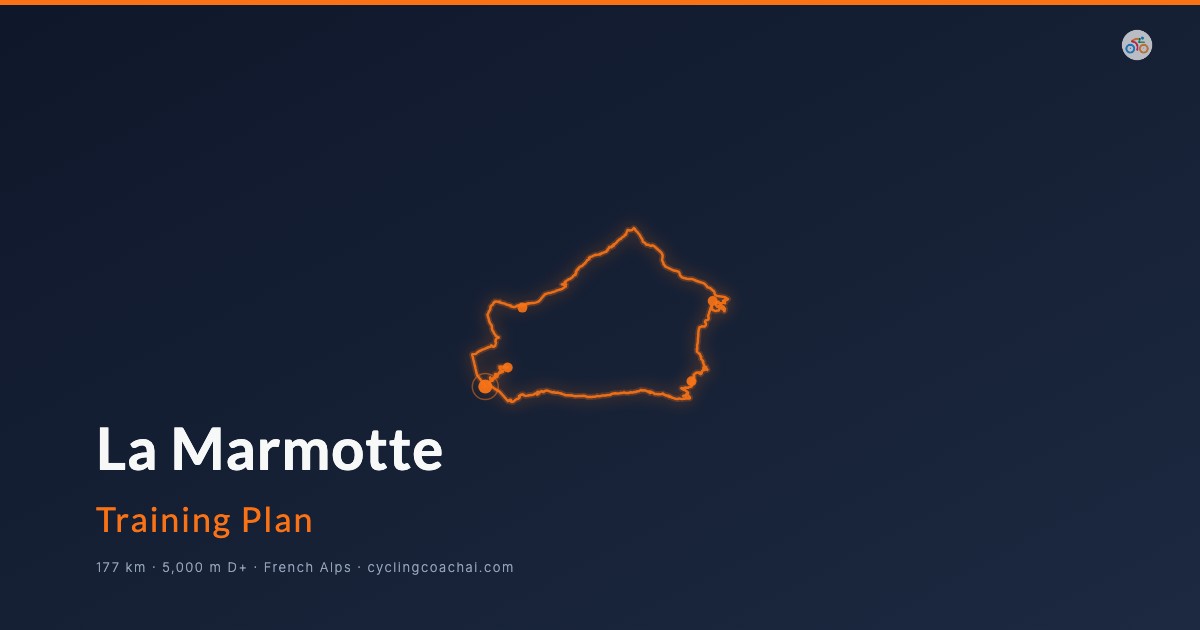
You have signed up for 177 kilometres through the French Alps, 5,000 metres of climbing, and four legendary cols in a single day: the Glandon, the Télégraphe, the Galibier, and Alpe d'Huez. The Galibier summit at 2,642 metres arrives after 130 kilometres already in your legs. Alpe d'Huez, the finish line, is the reward for surviving it.
La Marmotte is not decided by who is fastest on any one climb. It is decided by who manages their energy well enough across the first three cols to still have legs for Alpe d'Huez. Riders who go too hard on the Glandon find themselves counting switchbacks on the Galibier in survival mode, with 21 more switchbacks of Alpe d'Huez still to come. The race is a masterclass in sustained pacing, and it punishes impatience with a brutality that few European gran fondos match.
This guide gives you a complete La Marmotte training plan: race overview, the physiological demands of riding four alpine cols in a single day, how to build the sustained climbing power and pacing discipline to finish within your target time, and full week-by-week plans for 12, 16, 20, and 24 weeks.
La Marmotte Race Overview
| Race detail | |
|---|---|
| 📍 Location | Bourg d'Oisans, Isère, France |
| 📅 Next edition | 28 June 2026 (held annually since 1982) |
| 🌐 Official website | marmottegranfondoalpes.com |
| 📏 Distance | 177 km |
| ⛰️ Elevation gain | 5,000 m D+ |
| 🏔️ Key cols | Col du Glandon (1,924 m), Col du Télégraphe (1,566 m), Col du Galibier (2,642 m), Alpe d'Huez (1,860 m) |
| 🛣️ Surface | 100% tarmac |
| ⏱️ Cut-off time | Approximately 15 hours |
| 👥 Participants | ~7,000 starters |
| 🎟️ Entry method | Online registration via Chronorace platform |
| 📁 GPX route | Download GPX file (2026 edition) |
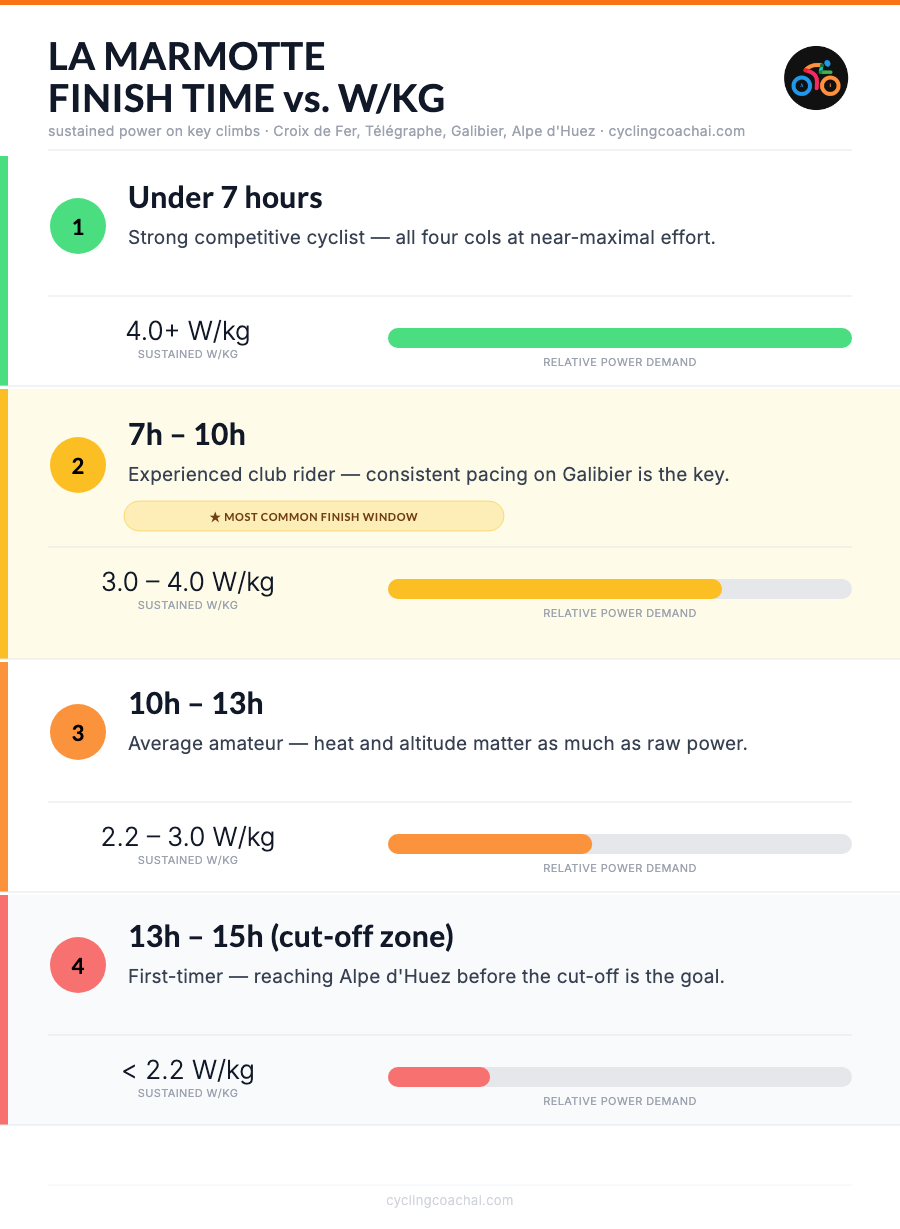
Estimated Finish Times
| Estimated finish time | Approximate sustained W/kg |
|---|---|
| Under 7 hours | 4.0+ W/kg |
| 7h – 10h | 3.0 – 4.0 W/kg |
| 10h – 13h | 2.2 – 3.0 W/kg |
| 13h – 15h (cut-off zone) | < 2.2 W/kg |
Based on sustained power on key climbs in neutral conditions. Altitude effects on the Galibier (2,642 m), heat in the valley sections, and pacing errors on the Glandon significantly affect these projections.
Your La Marmotte Finish Target
The W/kg values above reflect sustained climbing power across all four cols, not a single fresh effort. A rider whose power to weight ratio is 3.5 W/kg for 20 minutes on a ramp test may sustain only 2.8–3.0 W/kg on the Galibier after 130 kilometres and two major cols already in their legs. The gap between tested fitness and late-race performance is large at La Marmotte, and it grows significantly for riders who overcook the Glandon in the morning.
What Makes La Marmotte Unique
Most gran fondos have one defining climb. La Marmotte has four. The Glandon is 22 kilometres long and arrives first, when riders are fresh and enthusiastic — which makes it the most dangerous col on the route. The Télégraphe is shorter and easier, but it is immediately followed by the Galibier, meaning the two climbs function as a single extended effort of nearly 40 kilometres. The Galibier at 2,642 metres is the highest point of the entire route, and it is here, in the thin air above the snowfields, that the race is often irretrievably lost for underprepared riders.
Alpe d'Huez is the finish, not a climax. Its 21 switchbacks and 8.1% average gradient are well-known from the Tour de France, but arriving at its foot after 153 kilometres with 4,300 metres already climbed transforms a famous climb into a survival exercise. Riders who have paced themselves well across the first three cols find Alpe d'Huez hard but manageable, and the right gearing helps: our bike gear calculator shows the cadence your cassette leaves you on its 8.1% at the power you can hold that late in the day. Those who went out too hard in the morning find themselves walking switchbacks or abandoning in sight of the finish banner.
The route also passes through some of the most exposed terrain in the Alps. The descent from the Galibier to the Col du Lautaret regularly sees temperatures of 5-8°C in early July, while the valley around Bourg d'Oisans can reach 30°C or above. Managing clothing, hydration, and fuelling across a 20°C temperature swing over a 9–15 hour day is a skill that requires deliberate practice, not just fitness.
La Marmotte was founded in 1982 and is one of the original European gran fondos. Its history is documented by the race organisation, and it remains one of the most sought-after gran fondo entries in the world, with the ballot oversubscribed every year.
Physiological Demands of La Marmotte
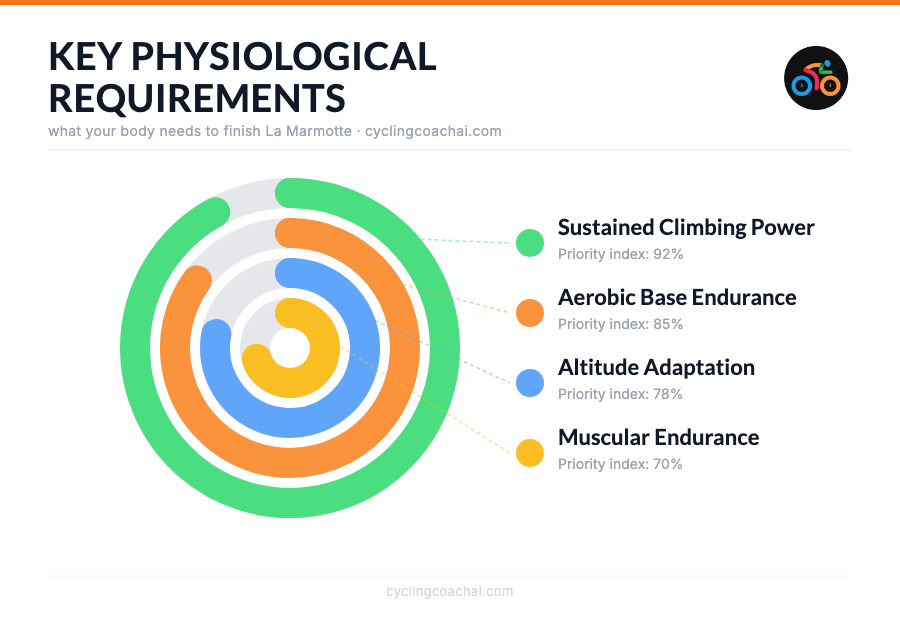
Dominant energy system
Sustained Climbing Power
La Marmotte demands four prolonged threshold-adjacent efforts across 177 kilometres. Every major section of the race is uphill. Training your ability to sustain 85–95% of your FTP for 45–90 minutes repeatedly, with incomplete recovery between efforts, is the central task of La Marmotte preparation.
Sustained climbing power is the non-negotiable requirement at La Marmotte. The event offers almost no flat terrain and no genuine recovery between the four major cols. Unlike a race with one big climb preceded by long valley sections, La Marmotte keeps accumulating elevation gain from the first kilometres. This places unique demands on aerobic threshold capacity: you need to be able to sustain prolonged sub-threshold efforts for hours, not just peak for a single 20-minute effort.
Altitude adaptation is a physiological factor that many first-time participants underestimate. The Galibier summit is at 2,642 metres, where oxygen availability is approximately 14% lower than at sea level. Riders who live at or train near sea level and arrive in Bourg d'Oisans without altitude exposure will experience reduced VO2max, higher heart rate at the same power output, and faster glycogen depletion on the Galibier than their flat-land fitness would predict. The typical penalty for an unacclimatised rider is 6–10% power reduction at altitude, which at race pace can add 30–60 minutes to the finish time.
Muscular endurance, distinct from cardiovascular capacity, determines whether your legs can produce force on the Galibier after the Glandon has already depleted them. The 22-kilometre Glandon climb pre-fatigues the quads, glutes, and hip flexors in a way that makes subsequent climbing feel disproportionately difficult. Training that replicates this pattern — long climbs followed by additional climbing on fatigued legs — is the specific adaptation that separates prepared La Marmotte finishers from those who struggle at the Galibier base.
La Marmotte Training Plan: Full Schedule
Four complete plans based on your available preparation time and current fitness. Every plan includes progressive climbing-specific intervals built around the Galibier and Alpe d'Huez profiles, multi-col back-to-back weekend rides to simulate the fatigue accumulation of race day, and a taper that preserves intensity while reducing volume in the final two weeks.
| Day | Session | Duration |
|---|
Key Workouts for La Marmotte
1. The Galibier Simulation
Session: 4×15 minutes at 92–95% of FTP with 8 minutes of easy spinning between intervals. Progress to 3×20 minutes at 88–90% of FTP in the final build phase.
Why it works: The Galibier is a sustained 35-kilometre climb that arrives after 130 kilometres of riding. The correct simulation is not a single 45-minute maximal effort from fresh — it is a series of sub-maximal intervals done on pre-fatigued legs. Doing this session after 2–3 hours of Zone 2 riding is significantly more race-specific than doing it fresh. On an indoor trainer, set 6–7% gradient and hold target power for the full interval without standing. The goal is not to see how high your power can go, but to train the ability to hold a specific power output while the muscles are already depleted.
When to use it: Every 10 days from early build phase through race prep.
2. The Multi-Col Day
Session: Saturday: 5–6 hours with at least 2,500 metres of climbing at Zone 2 to Zone 3. Sunday: 3–4 hours beginning with 60–90 minutes of climbing before allowing the pace to drop. The Sunday ride starts with climbing to replicate the neurological state of arriving at Alpe d'Huez base after a full day in the saddle.
Why it works: La Marmotte requires four prolonged climbing efforts in a single day with no real recovery between them. No single training ride can replicate this, but back-to-back long rides with significant climbing on both days create the specific fatigue profile that makes Alpe d'Huez manageable on race day. Riders who train exclusively on single long rides, regardless of duration or elevation, consistently find that the Galibier and Alpe d'Huez feel worse than their fitness should predict because they have not trained the specific recovery pattern between multi-hour climbing efforts.
When to use it: Every week in the build phase and the first three weeks of race prep.
3. The Alpe d'Huez Simulation
Session: 45 minutes at 88–93% of FTP on a sustained climb or indoor trainer set at 7–8% gradient. This session is done in isolation but always placed after at least 2 hours of Zone 2 riding to simulate the fatigue state at which you will actually ride the Alpe d'Huez on race day.
Why it works: Alpe d'Huez in La Marmotte is not the same climb that Tour de France riders race. It is a 45-minute threshold effort that begins after 153 kilometres and 4,300 metres of climbing. The session teaches pacing discipline: the first 10 minutes will feel easy, the middle 15 will feel controlled, and the final 20 will reveal whether your base training was sufficient. Riders who have done this session regularly on tired legs arrive at the foot of Alpe d'Huez knowing exactly what pace they can hold and never make the mistake of going out too hard on the first hairpin.
When to use it: Once per week in the build phase, replacing one Galibier simulation every other week.
Nutrition Strategy for La Marmotte
La Marmotte is a 9–15 hour event. The nutrition strategy is not about what to eat in the hour before the race — it is about maintaining glycogen availability across four major climbs separated by brief descents. The Glandon climb is 2–3 hours long at race pace for most riders. Arriving at the Télégraphe base with inadequate glycogen makes the subsequent Galibier ascent effectively impossible at target pace.
The target is 60–90 grams of carbohydrate per hour during climbing sections, depending on body weight and intensity. On descents and flat valley sections, the rate can drop slightly, but many riders make the mistake of stopping eating on descents and arriving at the next climb with glycogen already depleted. The Galibier base — around the Col du Lautaret — is the last major aid station before the final two climbs. Whatever you eat there determines the quality of your Galibier and Alpe d'Huez ascents.
Salt and electrolyte management matters more at La Marmotte than at most gran fondos because the temperature differential between the valley and the Galibier summit is extreme. Sweat rate in the valley sections at 28–30°C is high, and the sudden cooling at altitude means many riders do not register how much fluid they have lost. Arriving at the Galibier dehydrated reduces power output and accelerates the perception of fatigue on every subsequent effort.
Practice your nutrition strategy on every multi-col training weekend. The goal is not just to know what works, but to have your gut trained to absorb carbohydrates at race intensity for 9–15 hours. Cycling nutrition during a ride is a trainable skill, and La Marmotte demands it be fully developed before race day.
Common Mistakes When Preparing for La Marmotte
Starting the Glandon too fast
Col du Glandon is the first major climb and one of the longest. It is also the one where excitement, fresh legs, and cool morning air conspire to push most riders significantly above sustainable race pace. A correct Glandon effort is 80–87% of FTP. It should feel easy in the first 10 kilometres. Every watt above sustainable pace on the Glandon is borrowed from the Galibier and Alpe d'Huez — and the interest rate is punishing.
Treating the Télégraphe as a warmup for the Galibier
The Télégraphe arrives after the Glandon descent and before the Galibier. Many riders relax on the Télégraphe because it is the shortest of the four climbs. But the Télégraphe immediately connects to the Galibier at Valloire, making the effective combined climb 40 kilometres long. Pacing correctly on the Télégraphe, even if it means riding conservatively, protects your Galibier.
Underestimating altitude on the Galibier
For riders who live and train below 500 metres, the Galibier summit at 2,642 metres will reduce power output relative to heart rate in ways that feel alarming in the moment. Heart rate climbs faster, breathing feels laboured at moderate effort, and the familiar relationship between power and perceived exertion breaks down. Training with altitude-simulation tools or arriving in Bourg d'Oisans 3–4 days early for acclimatisation meaningfully reduces this penalty.
Insufficient climbing volume in training
La Marmotte requires four sustained climbs of 30–90 minutes at near-threshold intensity. Riders who train predominantly on flat terrain without compensating with indoor gradient simulation consistently struggle on the specific muscular demands of prolonged seated climbing. Every Galibier simulation in this plan must be done on a genuine climb or at 6–8% gradient on a smart trainer. Flat intervals at the same power do not create the same muscular adaptation.
Neglecting the descent from the Galibier
The descent from the Galibier to the Col du Lautaret and then to Bourg d'Oisans is fast, technical, and cold. Riders who descend poorly, tense up on switchbacks, or fail to eat and drink during the descent arrive at Alpe d'Huez with cold muscles, depleted glycogen, and inadequate hydration. Practice descending on your training weekends and develop the habit of eating and drinking immediately after the summit of every climb, not waiting until you reach the valley.
Comparing finish times without considering your base
A fit rider who has done Mallorca 312 or Fred Whitton will find La Marmotte is harder than its distance suggests because of the consistent altitude and the absence of flat recovery terrain. Plan for a finish time at least 30–60 minutes longer than your hour-per-100km ratio would predict if you are targeting La Marmotte for the first time.
Adaptive Training for La Marmotte
A static training plan treats every rider the same. La Marmotte does not.
Cycling Coach AI builds your La Marmotte preparation around your actual FTP, available weekly hours, and target finish time. Unlike a fixed plan, it adjusts week by week as your fitness evolves: if a training block is missed, the plan recalculates without leaving you behind; if your Galibier simulations improve ahead of schedule, it advances the loading to match. Every session has a specific purpose tied to your individual targets and climbing profile, not a generic template written for a hypothetical average rider.
The plan integrates structured climbing-specific strength work to address the muscular endurance demands of four prolonged col ascents. Single-leg strength, quad endurance, and hip flexor stability directly reduce the late-race fatigue that accumulates over 177 kilometres of mountain terrain. Riders who include consistent strength sessions in the 12 weeks before the event consistently report better form on both the Galibier and Alpe d'Huez than those who focus exclusively on cycling volume.
If you are ready to stop guessing and start preparing with a plan built around your actual fitness, create your personalised La Marmotte training plan and arrive in Bourg d'Oisans knowing you have prepared for every metre of those 5,000.