You have signed up for 312 kilometres, 5,050 metres of climbing, and a 14h20 cut-off that eliminates unprepared riders every year. That is what the Mallorca 312 asks of you.
It is one of the most demanding gran fondos in Europe, not because of one iconic climb but because of relentless accumulation: hour after hour of rollers, the 8km haul to the top of Puig Major when your legs are already loaded, and then 188 kilometres of exposed island roads where the wind redefines every pacing plan you built at home. Equipment matters as much as fitness over that distance, and an endurance road bike built for comfort and stability is the right tool for a day this long.
This guide gives you a complete Mallorca 312 training plan: race overview, physiological demands, how to train for Mallorca 312 from any fitness base, and full week-by-week plans for 12, 16, 20, and 24 weeks. Follow it and you will arrive at the start line in Playa de Muro with the aerobic base, the pacing discipline, and the nutrition habits to finish strong.
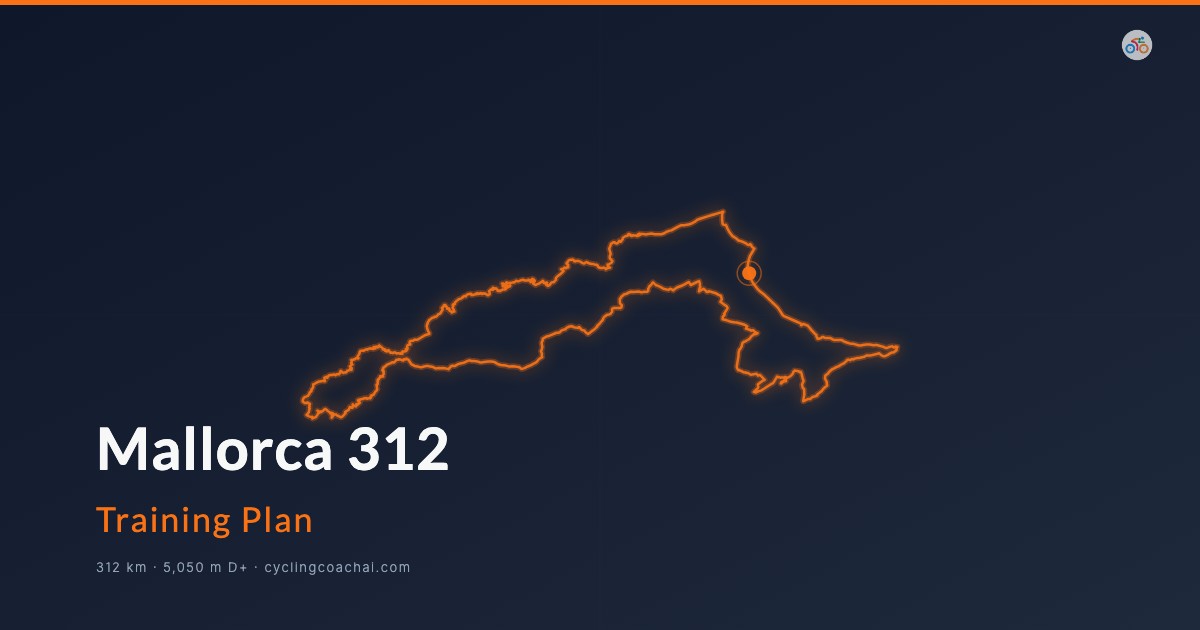
Mallorca 312 Race Overview
| Race detail | |
|---|---|
| 📍 Location | Spain, Mallorca (Playa de Muro, north coast) |
| 📅 Next edition | Saturday 24 April 2027 |
| 🌐 Official website | mallorca312.com |
| 📏 Distances | 312km / 226km / 167km (choice on race day) |
| ⛰️ Elevation gain | 5,050m (312km) / 2,475m (167km) |
| 🏔️ Highest point | Puig Major, 899m via Monnaber Tunnel |
| 🛣️ Surface | 100% tarmac |
| ⏱️ Cut-off time | 14h 20min (312km) |
| 👥 Participants | ~8,500 across all routes |
| 🎟️ Entry method | Open registration, opens 6 October 2026 — sells out on opening day |
| 📁 GPX route | 312km · 167km |
Where the 5,050 Metres Actually Are
The single most useful thing to know about the Mallorca 312 is that it is not one event, it is two stuck together, and almost nobody trains for the second one.
Every climb of the day sits inside the Serra de Tramuntana, and they are done with by kilometre 124. The table below is measured from the official GPX the organisers publish, which is useful for a reason beyond precision: that file carries waypoints marking the start (Inici) and the summit of each climb, so where a climb begins is the organisers' definition rather than anyone's estimate.
| # | Climb | Starts at km | Summit at km | Length | Ascent | Average | Summit |
|---|---|---|---|---|---|---|---|
| 1 | Coll de Femenia | 25.3 | 33.0 | 7.7 km | 419 m | 5.4% | 534 m |
| 2 | Puig Major, with Gorg Blau inside it at km 49.5 | 47.2 | 55.5 | 8.3 km | 342 m | 4.1% | 899 m |
| 3 | Coll d'en Bleda | 70.8 | 75.0 | 4.1 km | 199 m | 4.8% | 221 m |
| 4 | Coll de sa Pedrissa | 81.6 | 87.9 | 6.3 km | 287 m | 4.6% | 421 m |
| 5 | Coll d'en Claret | 91.7 | 93.9 | 2.2 km | 108 m | 4.9% | 496 m |
| 6 | Coll des Pi | 112.2 | 113.4 | 1.2 km | 74 m | 6.2% | 237 m |
| 7 | Coll de sa Gramola | 119.7 | 123.6 | 3.8 km | 168 m | 4.4% | 349 m |
Two things the table settles
Gorg Blau is not a separate climb. The organisers' file puts its waypoint between the start of Puig Major and its summit, so it is a pass you go over on the way up, at 618 metres with another 250 still to climb.
Sóller is not a climb at all, despite appearing on the profile. It is the lowest point of that half of the route, 22 metres above sea level at kilometre 70.8, reached by descending the far side of Puig Major. The Coll d'en Bleda starts there. If you have been told the 312 climbs through Sóller, what actually happens is that you drop to the sea and start again.
The consequence of all this is the whole race. Every metre of climbing is done by kilometre 124, and what is left is roughly 188 kilometres of flat, exposed island road. That is where the day is won or lost.
Why that changes how you train
The mountains are not the hard part. A rider with decent climbing legs gets over sa Gramola feeling fine. The problem starts at kilometre 140 with five hours still to ride, no gradient to break up the effort and a headwind that does not stop. Training only on climbs prepares you for the half of the event that will not eliminate you.
The flat section is a fuelling problem before it is a fitness problem. Five hours of steady tempo with no descents means no free minutes, no pauses in the effort and no natural moments to eat. That is why the nutrition section below is not an afterthought, and why the plans build towards rides where you practise eating on the move at race intensity.
Your group matters more than your watts. On an exposed flat road, riding alone costs around 30% more power than sitting in a group at the same speed. Arriving at the flat section with enough left to hold a wheel is worth more than any amount of climbing strength, which is the real argument for pacing the Tramuntana conservatively.
The organisers publish the route profile and the elevation total, but not length or gradient figures for each individual col, so we do not list them here. The GPX linked in the table above is the reliable source if you want to study a specific climb.
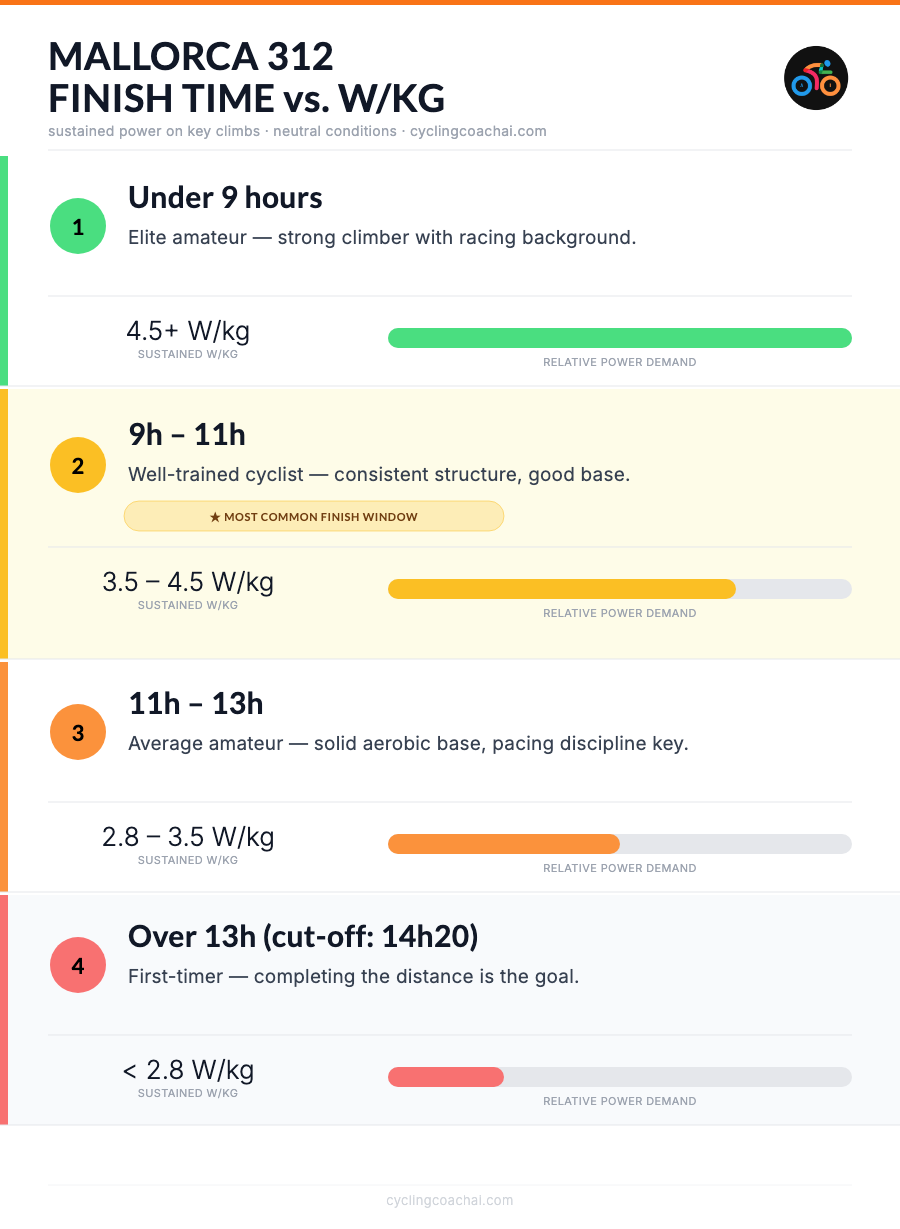
Your Mallorca 312 Finish Target
Before planning your preparation, identify your target finish time and the approximate sustained power you need on the climbs.
What Makes Mallorca 312 Unique
Most European gran fondos are defined by one or two showcase climbs separated by flat transitions. Mallorca 312 is structurally different: difficulty here comes from accumulation, not spectacle. For the showcase-climb version of that formula, four alpine cols in one day, see our guide to La Marmotte's four cols.
The route strings together the Sierra de Tramuntana's rollers from the very first kilometres, never giving you a flat neutralisation sector to recover. The ascent to Puig Major through the Monnaber Tunnel starts at kilometre 47 and tops out at kilometre 55, 899m above sea level. Measured on the organisers' own GPX it is 8.3km averaging 4.1%, which sounds modest until you notice it begins from a plateau you reached over Coll de Femenia: the 14km climb at 5 to 6% that most guides quote is the Soller side, which the 312 descends rather than climbs. Riders who treat this climb as a race effort invariably suffer badly on the repeated ascents in the second and third portions of the route, when the legs are already carrying three or four hours of effort.
The second defining feature is wind. Mallorca in late April sits between spring and early summer, and the wind across the island's central plain transforms what look like flat sectors into significant energy drains. A headwind section that should take 90 minutes on a calm day can stretch to two hours, destroying any pacing plan built around speed targets rather than power output.
The third factor is duration. Even strong amateurs spend 9-11 hours on the bike. At that duration, nutrition execution, fat oxidation efficiency, and mental pacing discipline are as important as peak fitness. The final 100 kilometres of the 312, after the climbing and before the coastal finish, is where the race is really decided.
Physiological Demands of the Mallorca 312
Understanding what the race asks of your body shapes every training decision in the months before April.
Dominant energy system
Aerobic Base
The vast majority of your time on the 312km route is spent below threshold. Your ability to sustain power at 70-80% of FTP for 9-14 hours without significant glycogen depletion determines your finish time more than any other variable.
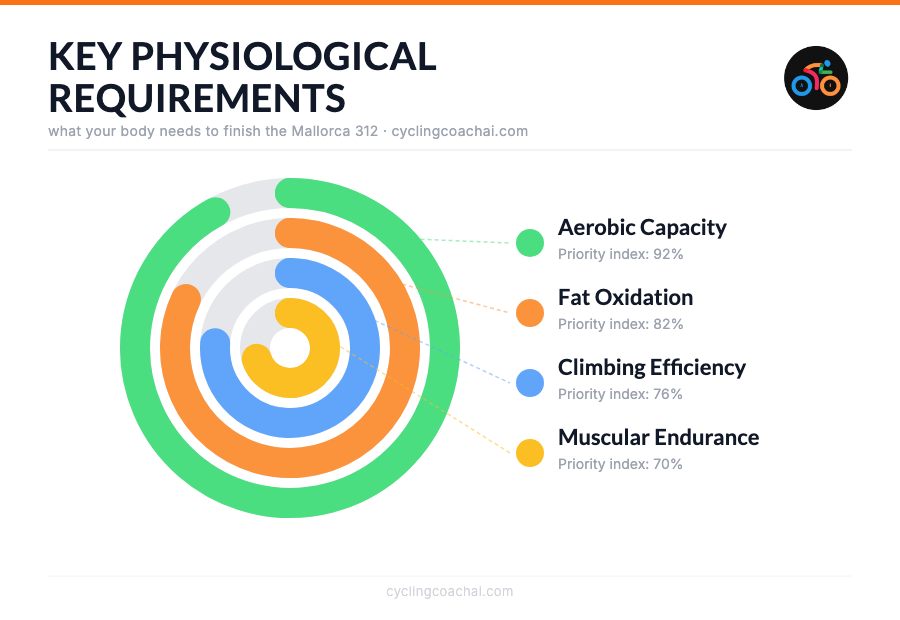
Key physiological requirements in detail:
- High aerobic capacity. You need to sustain high output for 9-14+ hours. This is primarily a function of VO2max and the percentage of it you can maintain without accumulating lactate. Zone 2 training should account for 75-80% of your total training volume throughout the plan.
- Climbing efficiency. At 5,050m of total climbing, your W/kg on extended gradients matters. The Puig Major and the subsequent ascents reward riders who manage effort on sustained 5-8% gradients without spiking heart rate.
- Fat oxidation. At this race duration, even well-fuelled athletes rely on fat metabolism for a significant portion of energy production. Training your body to oxidise fat efficiently delays the glycogen crash that typically hits in the final 100km. This is built through long rides done at true Zone 2 intensity.
- Muscular endurance. The rolling terrain of Mallorca's interior continuously loads and unloads the legs over many hours. Strength training for cyclists, particularly single-leg work and hip hinge patterns, plays a supporting role across the full preparation period.
The relationship between fat oxidation, aerobic capacity, and ultra-endurance performance is documented in: Jeukendrup, A.E. (2011). Nutrition for endurance sports: marathon, triathlon, and road cycling. Journal of Sports Sciences, 29(S1).
Mallorca 312 Training Plan: Full Schedule
Four complete plans based on how much preparation time you have. Select the one that matches your current fitness and available time to race day. Recovery weeks reduce volume by 30-40% while keeping one quality session. The final two weeks in every plan are a taper: volume drops 40-50% while intensity is preserved.
| Day | Session | Duration |
|---|
Key Workouts for Mallorca 312
Three sessions that directly address what the course demands:
1. The Puig Major Simulation
Session: 3×14-20 minute efforts at 88-95% of FTP, with 5-8 minutes of easy spinning between efforts.
Why it works: The Puig Major, from the side the 312 climbs it, is 8.3km at a sustained 4.1%. This session teaches your legs to sustain threshold-adjacent power on long climbs without accumulating lactate too quickly. Do it on the longest sustained climb available to you, or simulate it on a smart trainer with gradient simulation. As fitness builds, extend the efforts toward 20-25 minutes. The discipline of starting conservatively and building into each effort is as important as the physiological stimulus.
When to use it: Build and Race Preparation phases, once or twice per week as the primary quality session.
2. Back-to-Back Long Ride Block
Session: Saturday: 5-6 hours at moderate intensity (Zone 2 to low Zone 3) with 1,500-2,500m of climbing. Sunday: 3-4 hours at easy pace (Zone 1-2), no intensity work.
Why it works: Mallorca 312 is decided in the final 100km, when you already have 200km in your legs. Back-to-back long rides teach your body to perform on pre-fatigued legs: the exact physiological state you will be in past the halfway point. The Sunday ride is not a bonus: it is the session.
When to use it: Every 3 weeks during Build and Race Preparation phases.
3. Pacing Discipline Ride
Session: 3-4 hour ride where you strictly hold 65-75% of FTP throughout, regardless of terrain. On climbs, let speed drop but hold power. On descents, soft-pedal.
Why it works: Pacing errors in the first half of Mallorca 312 are the primary reason riders miss cut-offs or collapse in the final 80km. This session trains the discipline to resist surging on climbs and maintain a sustainable effort across varied terrain. Most riders find they drift 10-15% above their target power before they notice. Use a power meter and treat any drift as a mistake worth correcting.
When to use it: Once every 2-3 weeks throughout the plan.
Nutrition Strategy for Mallorca 312
No training plan survives contact with poor race-day nutrition at this distance. Gut training is as important as leg training for Mallorca 312, and it needs to start in Week 1 of preparation, not the week before the race.
Target carbohydrate intake on race day: 60-90g per hour. Riders who undereat in the first half consistently hit the wall in the final 100km. The body cannot absorb more than this range without prior gut training, and even conditioned athletes need to work up to the higher end gradually. Practise consuming your target fuel intake on every long ride from Week 1 onwards.
Use race-day products in training. The Mallorca 312 expo has every product you could want, and many riders buy their race nutrition there the day before. This is a mistake. Discovering a tolerance issue with a particular gel brand at kilometre 150 is not recoverable. Use identical products in training and on race day.
Race Week Logistics
The 312 is one of the easiest big events to travel to, which is part of why it sells out in a day. Everything below comes from the organisers' rider information.
- Getting there. Palma airport is 40 minutes by car from Playa de Muro, where the event starts and finishes. There is no complicated transfer and no mountain drive at the end of it.
- Number collection. Bibs are handed out at the EXPO on Avenida s'Albufera 33, on the Thursday and Friday before the race, from 9:00 to 21:00. You have to collect yours in person; someone else can only do it with written authorisation. There is no race-morning collection, so a Friday-night arrival is cutting it fine.
- Start time. The first box goes at 6:30 and the last rider is expected through the start by 7:00. That means a 4:30 alarm and eating breakfast at an hour your stomach will not enjoy, which is worth rehearsing on a couple of long training rides.
- Where to stay. The official hotels are the VIVA group properties at Playa de Muro, within riding distance of the start. Booking at the same time as entering is normal practice here: the entry sells out the day it opens and the nearby beds go soon after.
- Choosing your distance. You pick between the 312, the 226 and the 167 on the road, on the day, at the point where the routes split. That is unusual and it is useful: if the weather turns or your legs are gone by the Tramuntana, stepping down is a decision you make with information rather than one you commit to in October.
Common Mistakes When Preparing for Mallorca 312
Underestimating the wind
Training built around climbing volume often ignores flat-ground demands. Add big-gear, low-cadence sessions: 30-45 minutes at 60-70rpm in a harder gear simulates the muscular load of riding against a sustained headwind.
Racing the long training rides
Long rides should be conversational for at least 70-80% of the duration. If you cannot speak in short sentences, you are going too hard and accumulating fatigue that will compromise next week's quality sessions.
Ignoring gut training
At 9-14 hours of effort, your digestive system becomes a limiting factor. Practise consuming 60-90 grams of carbohydrate per hour from your earliest long rides.
Arriving tired
Two weeks before the race, reduce training volume by 40-50% while preserving a little intensity. Many amateur riders arrive fatigued from a final hard training week, a mistake that is impossible to correct once you are on the island.
Skipping strength work
The muscular endurance demands of 5,050m of climbing over 14 hours are severe. Two sessions of cycling-specific strength training per week (single-leg squats, Romanian deadlifts, hip thrusts) from the start of the plan significantly reduces late-race leg failure.
Adaptive Training for Mallorca 312
A standard training plan treats every athlete the same. Your life does not work that way, and neither does the 312km.
Cycling Coach AI builds your Mallorca 312 preparation around your actual FTP, available weekly hours, and goal finish time. Unlike a fixed plan, it adjusts dynamically as your fitness evolves: if you miss a week, it recalculates; if you improve faster than expected, it advances your loading. Every session has a purpose tied to your specific target, not a generic template.
Beyond cycling sessions, it integrates cycling-specific strength work into your weekly schedule, and pairs your training load with a personalised daily nutrition plan, so your fuelling matches your actual energy demands each day of the week. The result is a preparation that fits your real life, not the other way around.
If you are ready to stop guessing and start preparing with a plan built around your actual fitness, create your personalised Mallorca 312 training plan and arrive at Playa de Muro knowing you did everything right.