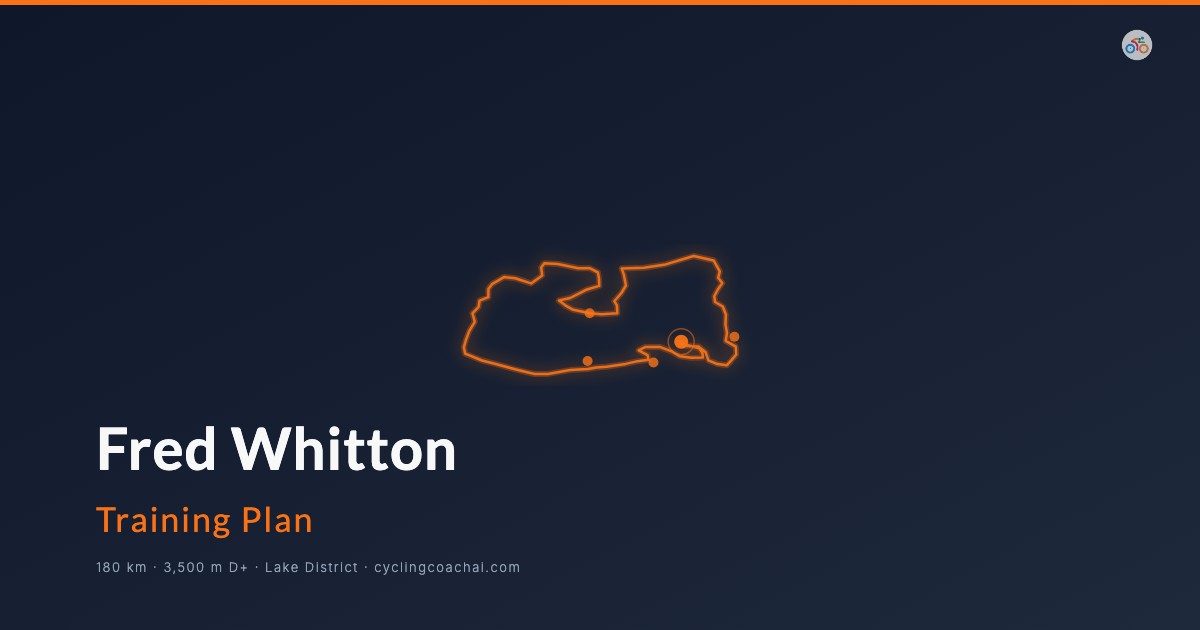
You have signed up for 112 miles through the Lake District, 3,500 metres of climbing, and a route that ends with Hardknott Pass at mile 98. That is what the Fred Whitton Challenge asks of you.
This is not a gran fondo where the hardest climb comes first and the rest is recovery. The Fred saves its worst for last: Hardknott Pass, the steepest road in England at 33% maximum gradient, arrives when your legs have already absorbed 158 kilometres, seven other major climbs, and the particular punishment of Lake District weather in May. Wrynose follows immediately after. Then Blea Tarn. The event is explicitly billed as a challenge, not a race, and that description is earned.
This guide gives you a complete Fred Whitton training plan: race overview, physiological demands, how to train for the Fred Whitton from any fitness base, and full week-by-week plans for 12, 16, 20, and 24 weeks. Follow it and you will arrive at Grasmere with the threshold power, the muscular strength, and the pacing discipline to ride Hardknott rather than walk it.
Fred Whitton Challenge Race Overview
If you want a place in 2027, the ballot is the next thing in your calendar, not your training. Pre-ballot entries open on 2 November 2026 and the general ballot runs from 1 to 10 December 2026. Around 5,000 people apply for roughly 2,500 places, so entry is the first thing that can end your season before it starts. The organisers have not yet published the 2027 race date or the race-week logistics.
| Race detail | |
|---|---|
| 📍 Location | Lake District, Cumbria, England (Grasmere start/finish) |
| 📅 Next edition | 2027 date not yet announced by the organisers. The 2026 edition was 10 May |
| 🌐 Official website | fredwhittonchallenge.co.uk |
| 📏 Distance | 112 miles (~180 km) |
| ⛰️ Elevation gain | 3,500 m (official figure; GPS traces typically return 3,100–3,300 m) |
| 🏔️ Highest point | Kirkstone Pass summit, 454 m |
| 🛣️ Surface | Tarmac (open roads; quality variable on mountain passes) |
| ⏱️ Cut-off checkpoints | Braithwaite by 11:30 am (~60 mi) · Calder Bridge by 2:30 pm (~85 mi) |
| 👥 Participants | ~2,500 (over 5,000 apply annually) |
| 🎟️ Entry method | Ballot. Pre-ballot entries open 2 November 2026; the ballot runs 1 to 10 December 2026 |
| 📁 GPX route | Download GPX |
The Ten Climbs, in Route Order
The Fred is not one hard climb with filler between. It is ten, and the two that decide your day arrive after 95 miles. The figures below come from the organisers' own climbs guide, written by Simon Warren, including his difficulty rating out of ten for each one.
| # | Climb | Length | Ascent | Average | Max | Rating |
|---|---|---|---|---|---|---|
| 1 | Kirkstone Pass (from Troutbeck) | 4,900 m | 273 m | 5.5% | 16% | 6/10 |
| 2 | Park Brow (Ullswater) | 1,900 m | 135 m | 7.7% | 11% | 3/10 |
| 3 | Honister Pass (Seatoller) | 2,375 m | 246 m | 9.9% | 25% | 8/10 |
| 4 | Newlands Pass (Buttermere) | 1,905 m | 205 m | 10.7% | 25% | 8/10 |
| 5 | Whinlatter Pass (Braithwaite) | 3,320 m | 231 m | 6.4% | 15% | 6/10 |
| 6 | Cold Fell (Ennerdale Bridge) | 3,750 m | 167 m | 4.8% | 21% | 6/10 |
| 7 | Bowerhouse Bank (Santon Bridge) | 1,040 m | 86 m | 8.6% | 12% | 2/10 |
| 8 | Hardknott Pass (Eskdale Green) | 2,250 m | 298 m | 13.3% | 33% | 10/10 |
| 9 | Wrynose Pass (Cockley Beck) | 1,750 m | 142 m | 8.0% | 25% | 8/10 |
| 10 | Blea Tarn (Little Langdale) | 1,725 m | 98 m | 7.2% | 25% | 7/10 |
What the table tells you about your training
Three things worth taking from those numbers.
Nothing here is long. The biggest climb is Kirkstone at 4.9 km, and six of the ten are under two kilometres. This is not an Alpine event and training for it with hour-long tempo climbs misses the point. What the Fred asks for is repeatable efforts of five to fifteen minutes, done eight times with fatigue accumulating between them.
The gradients are the problem, not the distance. Four climbs touch 25% and Hardknott touches 33%. At those pitches your cadence collapses and the effort becomes muscular rather than aerobic, which is why the plans below include strength work and low-cadence intervals. It is also why gearing matters more here than at any other UK event: a compact chainset with an 11-28 cassette is not enough.
The order is the cruelty. Warren rates Hardknott 10 out of 10 and it is climb number eight, arriving at mile 98 with seven climbs already in your legs. Then Wrynose at 8, then Blea Tarn at 7. The last three climbs of the day carry a combined rating of 25 out of 30. Any pacing plan that spends freely before mile 90 is a plan to walk.
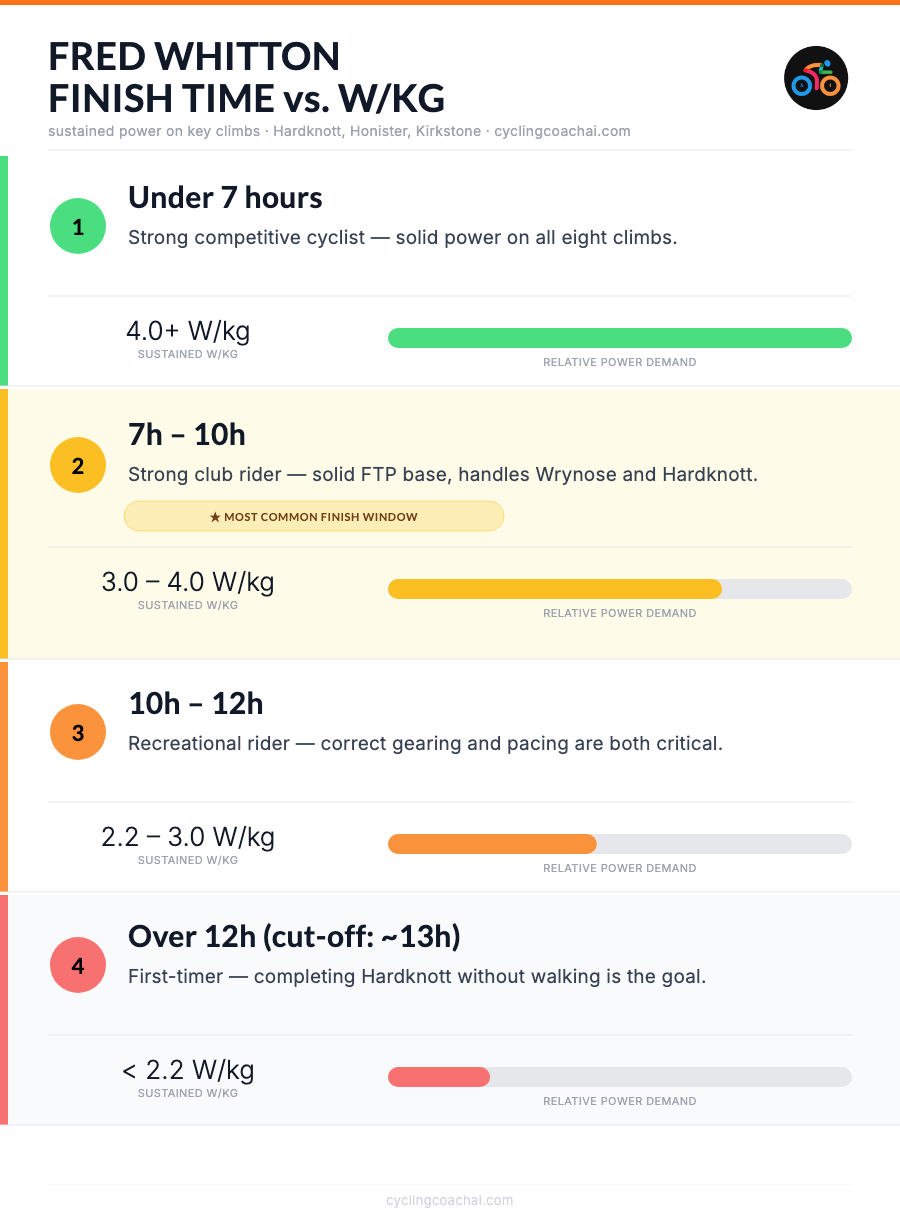
Your Fred Whitton Finish Target
Before planning your preparation, identify your target finish time and the approximate sustained power you need on the climbs.
What Makes the Fred Whitton Unique
Every UK sportive has difficult climbs. The Fred Whitton has eight of them in sequence, with no flat valley to recover in between, and the hardest two at the end of an already brutal day.
The climbs come in the wrong order
Kirkstone Pass (454 m, the highest road pass in the Lake District) arrives at mile 10. Riders who treat this as a warm-up climb and push hard are already compromised before Honister, Newlands, and Whinlatter in the middle miles. Hardknott (33% maximum gradient) arrives at mile 98, when cumulative fatigue has already destroyed glycogen reserves and leg freshness. The climb that would be hard in isolation becomes genuinely extreme after 158 kilometres.
Hardknott is categorically different to anything else in British cycling
The max gradient of 33% is not a brief ramp. It appears on three distinct hairpin sections, each requiring either an extremely low gear, significant muscular force, or both. The road surface is corrugated, potholed, and cambered. Even riders who can sustain 4.0 W/kg on a smooth climb lose traction and momentum on the corrugations. A 34T chainring with a 32T or 34T cassette sprocket is not optional, it is mandatory for most riders.
There is no shelter
Cold Fell at mile 70 is exposed moorland at 293 metres. The Lake District creates its own weather, and May mornings regularly see low cloud, rain, and crosswinds at pass summits regardless of valley conditions. Riders in summer kit who underestimate descent wind chill on Hardknott have become hypothermic within minutes of the summit.
Physiological Demands of the Fred Whitton
Dominant energy system
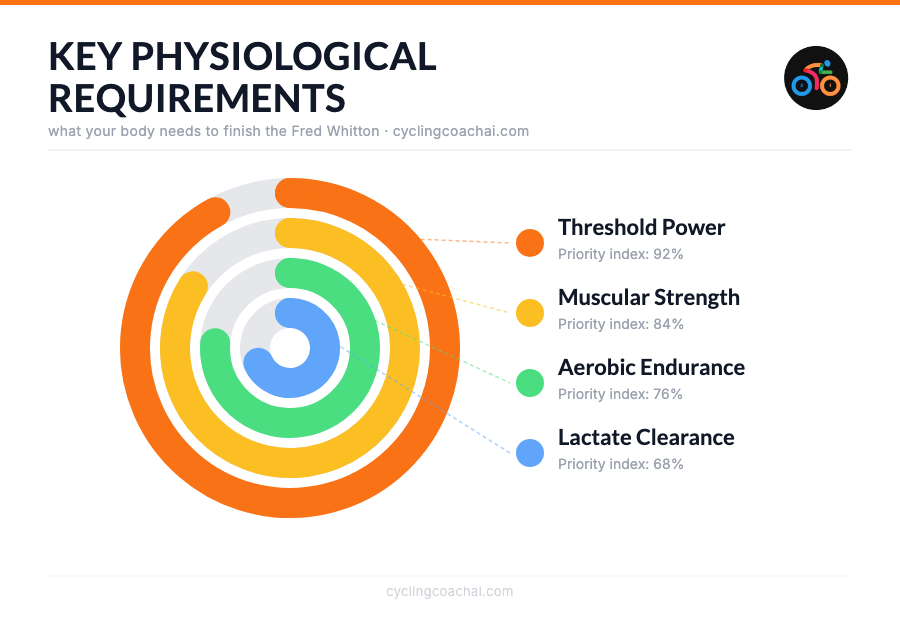
Threshold Power
Unlike ultra-distance events dominated by fat oxidation at Zone 2, the Fred Whitton is built around repeated 15 to 35-minute efforts at or near your functional threshold power. Kirkstone, Honister, and Newlands each demand sustained output at 90 to 100% of FTP. Training that raises your FTP and extends your ability to repeat near-maximal efforts with partial recovery is the single highest-return investment for this event.
Threshold Power. The major climbs last between 15 and 35 minutes at gradients that force you into the threshold zone regardless of intent. There is no option to drop to Zone 2 on a 22% gradient. Your ability to sustain power at 90 to 100% of FTP for these durations, repeatedly, across 180 kilometres, is the primary determinant of your finish time.
Muscular Strength. Hardknott and Wrynose impose forces on the pedals that cardiovascular fitness alone cannot deliver. At 30%+ gradient, even with a 34T chainring and a 34T sprocket, the torque required per pedal stroke is extreme. Riders with a high VO2max but poor leg strength history routinely find themselves unable to generate enough force to maintain momentum on the steepest hairpins. Cycling-specific strength training from week one of your plan is non-negotiable.
Aerobic Endurance. At 180 kilometres with 3,500 m of climbing, the Fred is also a very long day. Your aerobic base determines how well you maintain threshold power on climb seven and eight versus climb one and two. A strong aerobic base, built through consistent Zone 2 riding, is the substrate on which threshold work sits. Without it, intensity-focused training produces diminishing returns.
Lactate Clearance. Between the major climbs, short descents and flat sections offer partial, not full, recovery. Your ability to clear lactate during these windows determines how much power you have available on the next ascent. VO2max intervals and over-under threshold sessions specifically target this adaptation.
Fred Whitton Training Plan: Full Schedule
Select your plan based on your available weekly training time and current fitness level.
| Day | Session | Duration |
|---|
Key Workouts for the Fred Whitton
Kirkstone Threshold Blocks. 3 to 4 repeats of 15 to 20 minutes at 95 to 100% of FTP, with 5 minutes easy between each. If you have access to a climb of 8 to 15 minutes, do these outdoors on the ascent. On a trainer, target 90 to 95 RPM to build sustainable threshold mechanics. This is the single most important workout in the plan, replicated weekly from week five onwards.
Hardknott Simulations. 5 to 6 repeats of 4 to 6 minutes at 108 to 115% of FTP at very low cadence (50 to 60 RPM), with 4 minutes easy between. This replicates the neuromuscular demand of Hardknott's hairpins: high torque, low speed, significant force per pedal stroke. Do these on a steep indoor gradient (10%+ on a smart trainer) or on the steepest local climb you can find. The goal is not aerobic stress, it is neuromuscular recruitment at high resistance.
Pre-Fatigued Threshold Climbs. A 3 to 4 hour ride at Zone 2 followed immediately by 2 to 3 repeats of 12 minutes at FTP. This replicates the specific challenge of climbing at threshold power after your glycogen is already partially depleted, which is exactly the condition you will face on Hardknott at mile 98. This workout appears in the Build phase and becomes progressively harder as the plan advances.
Nutrition Strategy for the Fred Whitton
The two official feed stations are approximately 75 km and 130 km into the route. The gap between them, 55 kilometres that includes Cold Fell, Irton Pike, and the approach to Hardknott, is where most nutrition errors happen. By this point in the ride, appetite suppression from sustained effort makes eating feel unnecessary. It is not. Arriving at Hardknott with any glycogen deficit is the single most common reason strong riders walk.
Target 80 to 90 grams of carbohydrate per hour from the start, not from when you feel depleted. In cool Lake District conditions, the gut tolerates high carbohydrate intake better than in Mediterranean heat, so taking advantage of this is straightforward. Carry at least 3 gels or equivalent between each feed station as backup. The event is on open roads with no neutral support in the mountains.
Caffeine strategy: save it for the final 40 kilometres. 200 mg of caffeine consumed around mile 85 (before Cold Fell) provides peak stimulant effect precisely when Hardknott arrives. Using caffeine earlier in the ride blunts this effect when you need it most.
Hydration varies dramatically by conditions. A cold May day with rain at altitude requires less fluid than a warm sunny one, but cold air is dehydrating. Aim for 500 to 750 ml per hour as a baseline and adjust by feel. Electrolyte replacement matters more in longer efforts, particularly sodium, as hyponatraemia (over-drinking plain water) has been reported in athletes at events of this duration.
Race Week Logistics
- Start. From Grasmere Sports Ground, any time between 06:00 and 08:00. It is a rolling start, not a mass start, so you choose your own time inside that window.
- Registration. At the Grasmere Showground, with a deliberately quick process on the day.
- Parking. Plenty of free parking at Ride HQ, but most of it is on grass. If it has rained, getting cars on and off the field is slow, which is an argument for arriving earlier than you planned.
The start window is a pacing decision, not a convenience
This is the detail most first-timers miss. The checkpoint cut-offs are times of day, not times from your start: Braithwaite closes at 11:30 and Calder Bridge at 14:30 regardless of when you rolled out.
Do the arithmetic. Leave at 06:00 and you have five and a half hours to cover the 60 miles to Braithwaite. Leave at 08:00 and you have three and a half for the same 60 miles, over Kirkstone, Honister, Newlands and Whinlatter. That is the difference between a comfortable morning and chasing a cut-off with Hardknott still ahead of you.
Unless you are confident of a sub-eight-hour ride, start early. The extra hour in bed is the most expensive hour of the day.
Common Mistakes When Preparing for the Fred Whitton
Going too hard on Kirkstone
Kirkstone Pass is at mile 10, before the legs are warm and before the glycogen budget is understood. It is also by far the longest sustained climb on the route. Riders who chase the descent into Patterdale having over-cooked Kirkstone arrive at Honister, the next major climb just 30 miles later, with already-compromised legs. Start Kirkstone 10% easier than feels necessary.
Wrong gearing
A standard 50/34 chainring with an 11-28 cassette is insufficient for Hardknott. The math on a 33% gradient with any reasonable gear combination results in a cadence so low that traction fails before muscular failure. The minimum widely recommended by riders who have completed the event is a 34T inner chainring with a 32T cassette sprocket. A 34T or 36T cassette sprocket is better. This is not optional equipment for most riders at this event. To see the cadence your own chainring and cassette leave you on Hardknott, put them into our gear ratio calculator, which has Hardknott and the other climbs of the route that touch 25% as presets.
Undertrained for short hard efforts
Riders who have built their base through exclusively long Zone 2 riding are often shocked by how hard the Fred Whitton is. The event requires power at threshold for 20 to 35 minutes repeatedly. No amount of long aerobic riding substitutes for specific threshold training. Conversely, riders who do only intervals without an aerobic base blow up after mile 70 when the cumulative fatigue sets in.
Ignoring strength training
The force required per pedal stroke on Hardknott's 30%+ sections exceeds what the cardiovascular system limits. It is a muscular strength problem. Riders who have included single-leg squats, Romanian deadlifts, and step-ups in their preparation find the climb far more manageable than equivalently fit riders who trained exclusively on the bike.
Under-dressing
The Lake District in May is not reliably warm. Temperatures at Kirkstone summit (454 m) can be 4 to 8 degrees lower than in Grasmere. After Hardknott, the descent to Cockley Beck is exposed and can be extremely cold if wet. A lightweight windproof and a pair of arm warmers in a jersey pocket are minimum precautions. Riders who leave without them because the start was warm regularly report hypothermia symptoms on the final descents.
Treating it as a race
The Fred Whitton is a challenge. Riders who start chasing groups in the first 30 miles consistently finish slower, and suffer more, than those who ride conservatively to their own power targets. The event rewards patience in a way that few other sportives do.
If you are ready to stop guessing and start preparing with a plan built around your actual fitness, create your personalised Fred Whitton training plan and arrive in Grasmere knowing you have done everything right.