This plan assumes
Are you ready for this plan?
- Can ride continuously for 20-30 minutes without stopping
- Have access to a road bike that fits you properly
- Can commit to 5 rides per week for 12 weeks
- No injuries or medical conditions that prevent moderate exercise
- Have consulted a doctor if you have more than 20kg to lose or any cardiovascular concerns
Plan overview
Adaptation
Weeks 1-4Four weeks to establish the habit of riding five days per week. Every ride is easy and conversational. This extended adaptation phase lets your body, your schedule, and your mindset fully adjust to regular cycling before any progression begins.
3-4 hours/weekBuild
Weeks 5-9Gradually increase ride duration and introduce light tempo efforts. The long ride grows steadily, and weekday rides extend. Tempo blocks remain short and manageable, keeping the emphasis on easy riding for fat oxidation.
4.5-6 hours/weekConsolidation
Weeks 10-11Maintain the volume and habits you have built. These two weeks prove that your new activity level is sustainable and not just a temporary spike. Your body continues to adapt even without additional progression.
5.5-6 hours/weekActive Recovery
Weeks 12Reduce volume to let your body fully absorb 11 weeks of consistent training. Use this week to reflect on your progress, plan your next phase, and appreciate how far you have come.
4-4.5 hours/weekWeekly structure
Quick answer: what a cycling for weight loss plan does
A cycling for weight loss plan is a structured 8 to 20-week program that combines low-intensity Zone 2 rides (the effort you can repeat week after week), short HIIT sessions to boost metabolism for 12-24 hours after exercise, and a modest 300-500 kcal/day caloric deficit. Done consistently, this cycling weight loss training approach produces sustainable fat loss of 0.5-1 kg per week while preserving lean muscle.
Why cycling works for weight loss
Cycling is one of the most effective ways to combine aerobic exercise with sustainable fat loss because it pairs a high calorie burn with very low joint impact. That combination is what lets you ride longer and more often than you could run, walk uphill or do high-impact circuit training.
Sustainable calorie burn without breakdown
A 75 kg cyclist burns approximately 400-600 calories per hour at moderate intensity, and up to 750-900 cal/hour during high-intensity intervals. If your bike shows watts you can work out what your ride actually burned instead of using an average. Because impact stress is minimal, most riders can sustain 3-5 sessions per week without the recurring soft-tissue injuries that derail high-impact programs.
A deficit that does not wreck your week
Combined with modest dietary adjustments, cycling weight loss training creates a manageable caloric deficit of 300-500 kcal/day, the safe range for losing 0.5-1 kg per week without sacrificing muscle, mood or training quality.
«Maximal fat oxidation occurs at approximately 64% of VO2max in trained individuals, corresponding to a comfortable Zone 2 pace where conversation is still possible.»
Achten & Jeukendrup (2003). Maximal fat oxidation during exercise in trained men. International Journal of Sports Medicine, 24(8), 603-608.
On a stationary bike, an exercise bike or a turbo trainer
Most of the searches that land here are not about a road bike. They are about the exercise bike at the gym, the spin bike in the spare room or a turbo trainer in the garage. The answer is the same for all three, and the reason is worth knowing: this plan is written in perceived effort, not in watts. If your bike has no power meter and no heart rate strap, nothing is missing.
Why the machine matters less than the schedule
A stationary bike removes the things that break consistency: traffic, weather, daylight, punctures and the twenty minutes of getting ready. That is not a small advantage when the whole plan depends on turning up five times a week. It also removes coasting, so a 45-minute indoor ride is usually more work than 45 minutes outdoors.
What it does not remove is the need for easy riding. The single biggest mistake on an exercise bike is treating every session as a class: all-out, sweating, forty minutes, three times a week, until week three when it stops happening.
What the first week actually looks like
This is week 1 of the 12-week plan, exactly as it is scheduled. Every session works on any indoor bike.
| Day | Session | Effort | Time |
|---|---|---|---|
| Monday | Rest | — | — |
| Tuesday | Easy ride | RPE 3-4 | 25 min |
| Wednesday | Easy ride | RPE 3-4 | 25 min |
| Thursday | Rest | — | — |
| Friday | Easy ride | RPE 3-4 | 25 min |
| Saturday | Long easy ride | RPE 3-4 | 45 min |
| Sunday | Recovery spin | RPE 2 | 20 min |
Five sessions, two hours twenty in total, and not one of them hard. RPE 3-4 is a pace you could hold a conversation at; RPE 2 is easier than that.
And week 8, so you can see what changes
Same five days. The volume roughly doubles and exactly one interval block appears.
| Day | Session | Effort | Time |
|---|---|---|---|
| Tuesday | Easy ride | RPE 3-4 | 45 min |
| Wednesday | Easy ride plus 2 x 5 min | RPE 5-6 in the blocks | 50 min |
| Friday | Easy ride | RPE 3-4 | 45 min |
| Saturday | Long easy ride | RPE 3-4 | 105 min |
| Sunday | Recovery spin | RPE 2 | 30 min |
Four and a half hours, and the hardest thing in the week is ten minutes at RPE 5-6. If you were expecting a fat-burning HIIT programme, this is the honest version instead.
What we see in the people who stay
Riders who join us with a weight goal stick with the training at roughly the same rate as riders chasing performance, and they stay whether or not the scale moves that month. What keeps them is having a session to do and knowing it was the right one, which is the part a stationary bike makes easy. So this page sells you the structure and the consistency, not a number of kilos.
Zone 2 and HIIT: how training intensity drives fat loss
The two intensity tools that drive fat loss work through completely different mechanisms, and using them together produces consistently better outcomes than either approach alone.
Zone 2: the engine
Riding at 60-70% of your max heart rate (Zone 2) is where your body uses fat as its dominant fuel source. Sessions can be sustained for 60-90 minutes multiple times per week without creating recovery debt, accumulating real fat oxidation over the week.
HIIT: the metabolic afterburn
Adding 1-2 short HIIT sessions per week triggers the EPOC effect (excess post-exercise oxygen consumption), elevating your metabolic rate for 12-24 hours after the workout. The session itself burns calories; the afterburn keeps burning them while you recover.
«Excess post-exercise oxygen consumption (EPOC) elevates metabolic rate for 12-24 hours after high-intensity sessions, adding measurable caloric expenditure beyond the workout itself.»
LaForgia, Withers & Gore (2006). Effects of exercise intensity and duration on the excess post-exercise oxygen consumption. Journal of Sports Sciences, 24(12), 1247-1264.
The structured plan below distributes both correctly: most of the weekly volume sits in Zone 2 (the base), with 1-2 HIIT sessions placed where recovery allows them to land effectively.
How much weight can I lose with cycling?
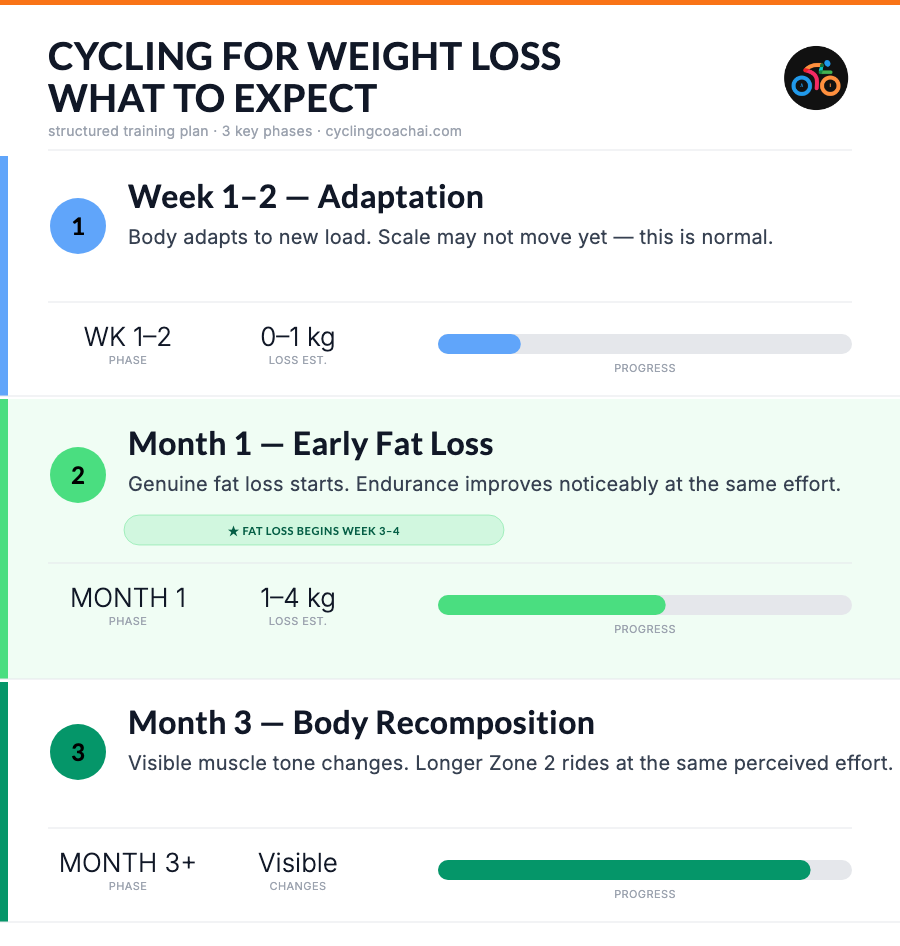
Realistic expectations keep you on track when progress feels slow.
Week 1-2: adaptation phase
Do not expect big numbers on the scale yet. Your body is adapting to new physical stress. Increased appetite and slight water retention are normal.
Month 1: early fat loss (1-4 kg)
With 3-4 rides per week and a modest caloric deficit, most cyclists lose 1-4 kg in the first month. Endurance improves noticeably.
Month 3: visible body composition changes
Cyclists on a structured plan typically show visible changes in muscle tone by the 12-week mark. Total fat loss usually lands in the 4-8 kg range over 12 weeks for riders who follow the plan consistently and pair it with a modest 300-500 kcal/day deficit. That works out to roughly 0.3-0.7 kg per week, the sustainable range that preserves lean muscle and training quality.
Faster rates (1+ kg/week) are achievable in the first 2-3 weeks (much of it water and glycogen) but rarely sustainable through a full plan without performance drops or rebound. Slower rates (under 0.3 kg/week) usually point to undertraining, an inaccurate caloric estimate, or insufficient protein.
Important: fat loss and weight loss are not the same thing. Track fitness metrics alongside the scale for a complete picture.
Nutrition for sustainable weight loss
Training creates the caloric burn; nutrition determines whether that burn translates into actual fat loss.
Start with the caloric deficit
A deficit of 300-500 kcal per day is the sweet spot. Avoid dropping below 1,600 kcal/day for an active adult, regardless of body size.
Hit your protein target
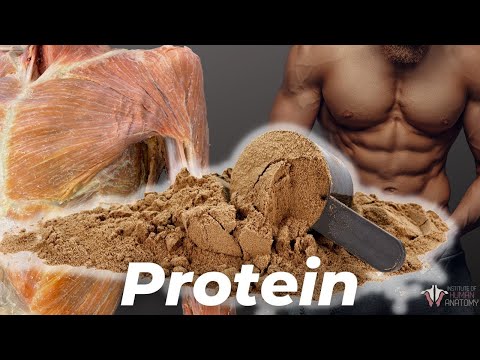
Aim for 1.6-2 g of protein per kg of body weight per day. Protein preserves lean muscle mass during deficit, keeps you full, and supports recovery between sessions.
«Protein intakes of 1.6-2.4 g/kg/day during energy restriction preserve lean body mass and maximise the proportion of weight loss that comes from fat rather than muscle.»
Phillips, Chevalier & Leidy (2016). Protein "requirements" beyond the RDA: implications for optimizing health. Applied Physiology, Nutrition, and Metabolism, 41(5), 565-572.
Match fueling to intensity
For Zone 2 rides under 75 minutes, water is all you need; carbs during the ride blunt fat oxidation. For longer rides and HIIT sessions, intra-ride carbs (30-60 g/hour) are appropriate because they sustain quality without compromising the deficit math.
Watch: cycling nutrition
Should I worry about under-fuelling? (RED-S risk)
Cycling weight loss training works only when the caloric deficit is modest. Drop too low for too long, usually below 1,600 kcal/day for an active adult or sustained deficits over 750 kcal/day, and you risk Relative Energy Deficiency in Sport (RED-S): impaired recovery, hormonal disruption, bone density loss, and counter-productively, stalled fat loss as your body downregulates its metabolic rate.
Practical guardrails: track for 2-3 weeks. If scale weight, sleep quality, training performance or mood drop noticeably, the deficit is too aggressive. Add 200-300 kcal/day back in and re-evaluate after 7-10 days.
«Low energy availability impairs the physiological systems essential to athlete health and performance, including metabolic rate, menstrual function, bone health, immunity, protein synthesis and cardiovascular health, and disproportionately offsets the very fat loss athletes are pursuing.»
Mountjoy et al. (2018). IOC consensus statement on relative energy deficiency in sport (RED-S): 2018 update. British Journal of Sports Medicine, 52(11), 687-697.
Training zones
This plan uses RPE (Rate of Perceived Exertion) and the talk test to guide effort. No devices required, though a heart rate monitor can help confirm you are training in the right zone.
| Zone | RPE | Feel | Talk test |
|---|---|---|---|
| Z1 Active Recovery | 2-3 out of 10 | Very easy, almost no effort. You could hold a full conversation without thinking about your breathing. | Full conversation, no effort |
| Z2 Endurance | 3-4 out of 10 | Comfortable effort. You can speak in full sentences but you are aware that you are working. | Full sentences, slightly aware of breathing |
| Z3 Tempo | 5-6 out of 10 | Moderately hard. Conversation is limited to short phrases. You can sustain this but it requires focus. | Short phrases only, breathing is noticeable |
| Z4 Threshold | 7-8 out of 10 | Hard. Speaking is difficult. You could sustain this for 20 to 40 minutes maximum. | A few words at most, heavy breathing |
12-Week Weight Loss Cycling Plan
5 rides per week building gradually from 2h 20min in week 1 to a peak of 5h 30min before tapering. All efforts guided by RPE with a strong emphasis on easy, fat-burning riding. The longer timeline allows more gradual adaptation.
| Day | Session | Duration |
|---|---|---|
| Week 1 Adaptation | ||
| Mon | Rest | - |
| Tue | Easy ride @ RPE 3-4 | 25 min |
| Wed | Easy ride @ RPE 3-4 | 25 min |
| Thu | Rest | - |
| Fri | Easy ride @ RPE 3-4 | 25 min |
| Sat | Long easy ride @ RPE 3-4 | 45 min |
| Sun | Recovery spin @ RPE 2 | 20 min |
| Week 2 Adaptation | ||
| Mon | Rest | - |
| Tue | Easy ride @ RPE 3-4 | 30 min |
| Wed | Easy ride @ RPE 3-4 | 30 min |
| Thu | Rest | - |
| Fri | Easy ride @ RPE 3-4 | 30 min |
| Sat | Long easy ride @ RPE 3-4 | 50 min |
| Sun | Recovery spin @ RPE 2 | 20 min |
| Week 3 Adaptation | ||
| Mon | Rest | - |
| Tue | Easy ride @ RPE 3-4 | 30 min |
| Wed | Easy ride @ RPE 3-4 | 30 min |
| Thu | Rest | - |
| Fri | Easy ride @ RPE 3-4 | 30 min |
| Sat | Long easy ride @ RPE 3-4 | 55 min |
| Sun | Recovery spin @ RPE 2 | 20 min |
| Week 4 Adaptation | ||
| Mon | Rest | - |
| Tue | Easy ride @ RPE 3-4 | 35 min |
| Wed | Easy ride @ RPE 3-4 | 35 min |
| Thu | Rest | - |
| Fri | Easy ride @ RPE 3-4 | 35 min |
| Sat | Long easy ride @ RPE 3-4 | 60 min |
| Sun | Recovery spin @ RPE 2 | 25 min |
| Week 5 Build | ||
| Mon | Rest | - |
| Tue | Easy ride @ RPE 3-4 | 35 min |
| Wed | Easy ride @ RPE 3-4 | 35 min |
| Thu | Rest | - |
| Fri | Easy ride @ RPE 3-4 | 40 min |
| Sat | Long easy ride @ RPE 3-4 | 70 min |
| Sun | Recovery spin @ RPE 2 | 25 min |
| Week 6 Build | ||
| Mon | Rest | - |
| Tue | Easy ride @ RPE 3-4 | 40 min |
| Wed | Easy ride @ RPE 3-4 | 40 min |
| Thu | Rest | - |
| Fri | Easy ride + 2x5min @ RPE 5-6 | 45 min |
| Sat | Long easy ride @ RPE 3-4 | 80 min |
| Sun | Recovery spin @ RPE 2 | 25 min |
| Week 7 Build | ||
| Mon | Rest | - |
| Tue | Easy ride @ RPE 3-4 | 45 min |
| Wed | Easy ride + 2x5min @ RPE 5-6 | 45 min |
| Thu | Rest | - |
| Fri | Easy ride @ RPE 3-4 | 45 min |
| Sat | Long easy ride @ RPE 3-4 | 90 min |
| Sun | Recovery spin @ RPE 2 | 25 min |
| Week 8 Build | ||
| Mon | Rest | - |
| Tue | Easy ride @ RPE 3-4 | 45 min |
| Wed | Easy ride + 2x5min @ RPE 5-6 | 50 min |
| Thu | Rest | - |
| Fri | Easy ride @ RPE 3-4 | 45 min |
| Sat | Long easy ride @ RPE 3-4 | 105 min |
| Sun | Recovery spin @ RPE 2 | 30 min |
| Week 9 Build | ||
| Mon | Rest | - |
| Tue | Easy ride @ RPE 3-4 | 50 min |
| Wed | Easy ride + 2x5min @ RPE 5-6 | 50 min |
| Thu | Rest | - |
| Fri | Easy ride @ RPE 3-4 | 50 min |
| Sat | Long easy ride @ RPE 3-4 | 2h |
| Sun | Recovery spin @ RPE 2 | 30 min |
| Week 10 Consolidation | ||
| Mon | Rest | - |
| Tue | Easy ride @ RPE 3-4 | 50 min |
| Wed | Easy ride + 2x5min @ RPE 5-6 | 50 min |
| Thu | Rest | - |
| Fri | Easy ride @ RPE 3-4 | 50 min |
| Sat | Long easy ride @ RPE 3-4 | 2h |
| Sun | Recovery spin @ RPE 2 | 30 min |
| Week 11 Consolidation | ||
| Mon | Rest | - |
| Tue | Easy ride @ RPE 3-4 | 50 min |
| Wed | Easy ride + 2x5min @ RPE 5-6 | 50 min |
| Thu | Rest | - |
| Fri | Easy ride @ RPE 3-4 | 50 min |
| Sat | Long easy ride @ RPE 3-4 | 2h |
| Sun | Recovery spin @ RPE 2 | 30 min |
| Week 12 Active Recovery | ||
| Mon | Rest | - |
| Tue | Easy ride @ RPE 3-4 | 40 min |
| Wed | Easy ride @ RPE 3-4 | 35 min |
| Thu | Rest | - |
| Fri | Easy ride @ RPE 3-4 | 40 min |
| Sat | Long easy ride @ RPE 3-4 | 75 min |
| Sun | Recovery spin @ RPE 2 | 25 min |
Weight loss week-by-week breakdown
The First Step
Focus: Ride five times at purely easy effort. Sessions are short. The only goal is showing up consistently.
Key session: Saturday long ride: 45 minutes at RPE 3-4. A gentle introduction to weekend riding.
What to feel: Every ride should feel almost too easy. You are building a foundation, not chasing calorie burn.
Avoid: Going too hard because short, easy rides feel pointless. Trust the process. Consistency at easy effort creates lasting change.
Finding Your Rhythm
Focus: Add 5 minutes to each ride. Keep everything at easy effort. Focus on making the routine feel natural.
Key session: Saturday long ride: 50 minutes at RPE 3-4. Slightly longer, same comfortable effort.
What to feel: The five-ride-per-week routine should start to feel like part of your normal schedule.
Avoid: Weighing yourself constantly. The scale will fluctuate day to day. Weigh yourself once per week at the same time for an accurate trend.
Settling In
Focus: Maintain 30-minute weekday rides and grow the long ride to 55 minutes. All easy effort.
Key session: Saturday long ride: 55 minutes at RPE 3-4. Nearly an hour of comfortable cycling.
What to feel: Rides that felt new in week 1 should now feel routine. That shift is the habit forming.
Avoid: Cutting calories drastically because you are impatient for results. Moderate deficits produce sustainable results. Crash diets produce rebounds.
Habit Locked In
Focus: Weekday rides extend to 35 minutes. Long ride reaches one hour. Adaptation phase complete.
Key session: Saturday long ride: 60 minutes at RPE 3-4. One hour of easy cycling is a great milestone.
What to feel: Confident that five rides per week is doable. If you have made it this far, you can make it to week 12.
Avoid: Skipping meals before rides to increase fat burn. Eat a light snack before riding. Your ride quality and recovery will be much better.
Starting to Build
Focus: Weekday rides reach 35-40 minutes. Long ride grows to 70 minutes. All rides remain at easy effort.
Key session: Saturday long ride: 70 minutes at RPE 3-4. Bring water for any ride approaching or exceeding one hour.
What to feel: Fitness is visibly improving. Hills that were hard in week 1 feel manageable. Your body is adapting.
Avoid: Increasing intensity because easy rides feel too comfortable. Comfortable is correct. Easy riding burns a higher percentage of fat.
First Light Tempo
Focus: The Friday ride introduces 2x5 minutes at RPE 5-6. Long ride reaches 80 minutes. Weekday rides are 40 minutes.
Key session: Friday: 2x5 minutes at RPE 5-6 with 3 minutes easy between. This is moderate effort, not hard.
What to feel: The tempo blocks are a noticeable step up from easy riding but should feel controlled and sustainable.
Avoid: Treating tempo as all-out effort. RPE 5-6 means you can speak in short phrases. If you are gasping, back off.
Growing Volume
Focus: A second tempo session appears on Wednesday. Long ride reaches 90 minutes. Weekday rides are 45 minutes.
Key session: Saturday long ride: 90 minutes at RPE 3-4. Bring a snack for any ride over one hour.
What to feel: You are now riding more than you ever have. The long ride is a real commitment, but it should still feel enjoyable.
Avoid: Adding extra sessions on rest days to speed up weight loss. Rest days are non-negotiable for recovery and adaptation.
Duration Push
Focus: Long ride reaches 1h 45min. Weekday rides hold at 45-50 minutes with one tempo session.
Key session: Saturday long ride: 1h 45min at RPE 3-4. Practice your nutrition strategy for longer rides.
What to feel: The long ride is getting serious. You should feel tired afterward but recovered by Monday.
Avoid: Restricting calories on high-volume days. Your body needs fuel to sustain longer rides. Eat balanced meals.
Peak Build
Focus: Long ride hits 2 hours. Weekday rides are 50 minutes. This is the highest volume week of the plan.
Key session: Saturday long ride: 2 hours at RPE 3-4. A milestone ride. Two hours of easy cycling is excellent for fat oxidation.
What to feel: Tired but not exhausted. If you can complete this week, you have the fitness to sustain this level of activity.
Avoid: Panicking if the scale stalls during a high-volume week. Increased riding causes temporary water retention in muscles. The weight will drop during the consolidation phase.
Holding Steady
Focus: Maintain the same volume as week 9. Prove to yourself that this activity level is sustainable.
Key session: Saturday long ride: 2 hours at RPE 3-4. Same as last week. Enjoy the ride, do not chase performance.
What to feel: This week should feel slightly easier than week 9 because your body has adapted. That is real progress.
Avoid: Increasing volume because you feel good. Consolidation means maintaining, not building. Trust the process.
Sustainable Fitness
Focus: Second week at full volume. Your new fitness level and riding habits are becoming your normal.
Key session: Saturday long ride: 2 hours at RPE 3-4. By now this ride should feel routine, not heroic.
What to feel: Confident and consistent. You have maintained peak volume for three weeks. This is your new baseline.
Avoid: Thinking you need to keep increasing volume forever. Maintenance at a sustainable level produces excellent long-term results.
Recovery and Next Steps
Focus: Reduce volume by 30%. Ride easy and reflect on 12 weeks of progress.
Key session: Saturday long ride: 75 minutes at RPE 3-4. A comfortable ride to close out the plan.
What to feel: Fresh and proud. Use this week to plan your next training cycle. Momentum is everything.
Avoid: Stopping entirely after the plan ends. Transition into a maintenance routine or your next training block to preserve your progress.
Weight loss fueling: caloric deficit strategy
Weight loss nutrition for cycling is about finding a moderate, sustainable caloric deficit while keeping your energy high enough to ride well. The goal is not to starve yourself thin but to eat well, move consistently, and let the results come over time.
Daily nutrition
Focus on whole, minimally processed foods. Build each meal around vegetables, lean protein, and complex carbohydrates like sweet potatoes, brown rice, or whole grain bread. Avoid skipping meals, especially breakfast and post-ride meals. Eating three balanced meals and one or two small snacks per day keeps your energy stable and prevents the binge eating that follows restriction.
On the bike
For rides under one hour, water is all you need. For rides over one hour, bring a light snack like a banana, a small energy bar, or a handful of dates. You do not need aggressive fueling for easy rides, but riding completely fasted for long sessions leaves you drained and more likely to overeat afterward. Sip water regularly throughout every ride.
Recovery meals
After every ride, eat a balanced meal within 60 minutes. Include protein for muscle repair and carbohydrates to replenish energy. Good options include eggs on whole grain toast, a smoothie with fruit and protein, chicken with rice and vegetables, or yogurt with berries. Do not skip post-ride meals in an effort to extend your caloric deficit. This only slows recovery and increases cravings later.
Hydration
Drink water consistently throughout the day, not just during rides. Aim for at least 2 liters daily, more on riding days. Dehydration mimics hunger, so staying hydrated reduces unnecessary snacking. During rides, drink 500ml per hour as a baseline. In hot weather, add an electrolyte tablet to your water.
Sustainable habits
Weight loss that lasts comes from small, consistent changes, not dramatic overhauls. Cook more meals at home. Reduce liquid calories from sugary drinks and alcohol. Eat slowly and pay attention to portion sizes without obsessing over calorie counts. If you eat something off-plan, move on without guilt. One meal does not undo weeks of progress. The best diet is the one you can maintain for months.
Weight Loss Gear Checklist
Essential
Properly fitted road bike
A bike that fits prevents knee pain, back pain, and numbness on longer rides. Visit a local shop for a basic fit if you have not already.
Padded cycling shorts
The single most important comfort upgrade for longer rides. Saddle soreness is the number one reason beginners quit mid-ride.
Two water bottles and cages
You need at least 500ml per hour. Two bottles give you enough capacity between refill stops on longer rides.
Spare inner tube, tire levers, and mini pump
A flat tire 20 miles from home with no spare ends your ride. Learn to change a tube before your first long ride.
Helmet
Non-negotiable for every ride, every time.
Nice to have
Cycling gloves
Reduces hand numbness and vibration on longer rides, and protects your palms if you fall.
Cycling computer or phone mount
Shows elapsed time, distance, and heart rate while riding so you can pace yourself without stopping.
Cycling jersey with rear pockets
Rear pockets hold gels, bars, phone, and keys without a backpack. Reduces back sweat and discomfort on longer rides.
6 mistakes that derail weight loss cycling plans
Crash dieting while training
Severely restricting calories while riding five days per week leads to fatigue, muscle loss, poor recovery, and eventual burnout. Your body cannot adapt to training without adequate fuel.
Fix: Aim for a moderate deficit of 300-500 calories per day. You should have enough energy to complete every ride feeling good, not depleted.
Skipping meals before rides
Riding on an empty stomach to burn more fat sounds logical but backfires in practice. You ride slower, feel worse, and overeat after the ride, often consuming more than you would have eaten beforehand.
Fix: Eat a light meal or snack 1-2 hours before every ride. A banana and toast is enough. Your ride quality and consistency will improve.
Weighing yourself every day
Daily weight fluctuates by 1-2 kg due to water retention, food in your digestive system, and hormonal cycles. These fluctuations create anxiety and lead to reactive decisions that hurt your progress.
Fix: Weigh yourself once per week, same day, same time, same conditions. Track the weekly trend over months, not the daily number.
Overtraining to burn more calories
Adding extra rides, running on rest days, or turning easy sessions into hard efforts because you want faster results. This leads to overtraining, injury, and ultimately quitting the plan entirely.
Fix: Follow the plan as written. Rest days are part of the program. Your body loses weight during recovery, not during the ride itself.
Expecting linear weight loss
Weight loss does not follow a straight line. You will have weeks where you lose nothing, weeks where you gain slightly, and weeks where you drop more than expected. This is completely normal physiology.
Fix: Track a 4-week rolling average instead of weekly numbers. If the trend is downward over a month, you are on track regardless of individual week results.
Compensating for your ride at the dinner table
The classic exercise compensation trap: you finish a 60-minute ride that burned 400 kcal and reward yourself with a 600 kcal recovery snack. The ride feels productive but the day's caloric balance ends in surplus, not deficit. Research consistently shows most cyclists unconsciously over-eat after training, erasing the deficit they just created.
Fix: Plan post-ride meals BEFORE you ride, not based on hunger after. A balanced 300-400 kcal meal with protein + carbs covers recovery without wiping the deficit. Avoid liquid calories (juice, sports drinks, beer) on training days, they add up fast and barely register as food.
6 tips to maximize your cycling weight loss results
Ride fasted (when possible)
For easy RPE 2-3 sessions under 75 minutes, try riding before breakfast. Keep intensity moderate, sip water, and eat a balanced meal within an hour of finishing. This nudges your body toward fat as the primary fuel during the session. Do not use this approach for HIIT or rides over 90 minutes.
Add one HIIT session per week
A single short HIIT session per week triggers the EPOC effect (excess post-exercise oxygen consumption), elevating your metabolic rate for 12-24 hours after the workout. Two HIIT sessions per week are the upper limit for most beginners — more crowds out the Zone 2 base where fat oxidation actually happens.
Include strength training off the bike
Two 30-40 minute strength sessions per week (compound movements: squats, deadlifts, rows, push-ups) increase your resting metabolic rate and preserve lean muscle mass during the caloric deficit. Without strength work, a portion of every kilo you lose comes from muscle, not fat.
Prioritize sleep
Poor sleep elevates cortisol and ghrelin, increases hunger, and directly impairs fat oxidation. Sleep-deprived athletes lose significantly less fat than rested ones, even with identical caloric deficits. Aim for 7-9 hours per night with consistent timing. Sleep is training.
Move more outside the bike (NEAT)
Non-Exercise Activity Thermogenesis (NEAT) accounts for 15-30% of total daily caloric expenditure. Walking, taking stairs, standing, fidgeting — all of it adds up. A daily 7,000-10,000 step target compounds with your cycling sessions and is the single most underrated weight-loss lever.
Consider a second easy ride on heavy days
On heavy training days, a short 20-30 minute low-intensity recovery spin in the evening increases total caloric expenditure and accelerates recovery without adding fatigue. The session must stay easy (RPE 2) — if it feels like training, it is not recovery.
Why a personalized plan outperforms this one
This plan provides a solid starting point, but weight loss is deeply individual. A plan built for your specific metabolism, schedule, and lifestyle adapts to you rather than asking you to adapt to it.
Start Free · Pay Nothing Today · Cancel Anytime