This plan assumes
Are you ready for this plan?
- Can ride continuously for 4 hours at a comfortable pace
- Have a power meter and heart rate monitor
- Have completed at least one 100-mile ride
- Can commit to 5-6 rides per week for 20 weeks
Plan overview
Build
Weeks 7-15Extensive build with sweet spot, threshold, and ultra-specific long rides.
9-14 hours/weekPeak
Weeks 16-18Race simulations, back-to-back days, and nutrition strategy finalization.
10-13 hours/weekWeekly structure
What 200 miles really demands
A 200-mile bike event, often called a double century, is a different animal from a 100-mile ride. The metabolic, mental and logistical demands are not 2× a century, they are closer to 3-4× because the second half is ridden in deep fatigue territory most cyclists never train for.
Expect 10 to 14 hours in the saddle depending on terrain and pace. Sustained energy expenditure typically reaches 6,000-9,000 kJ. Every system that works fine for a century, nutrition, hydration, saddle comfort, mental focus, gets stress-tested past its breaking point. This plan builds the engine, the fueling protocol and the fatigue tolerance to finish strong.
How long does it take to train for a 200-mile ride
The realistic minimum is 16 weeks for an intermediate rider with a strong aerobic base. 20 weeks is the sweet spot for most riders, allowing a true 8-week build phase plus targeted peak training. Beginners or riders coming from low base fitness need 24 weeks or more, and ideally a 100-mile event in the first half of the year as a stepping stone.
The defining feature of any 200-mile plan is the back-to-back long-ride block: a long Saturday (5-7 hours) followed by a moderate Sunday (2-3 hours) starting from mile 80+. These weekends teach your body to produce power on tired legs, the exact skill the event demands.
Pacing strategy for a double century
The pacing rule for 200 miles is simple: ride 5% below the effort that feels right for the first 100 miles. If your century pace is 72% FTP, ride 65-68% for the first half. If your century heart rate target is Zone 2 upper, stay in Zone 2 lower.
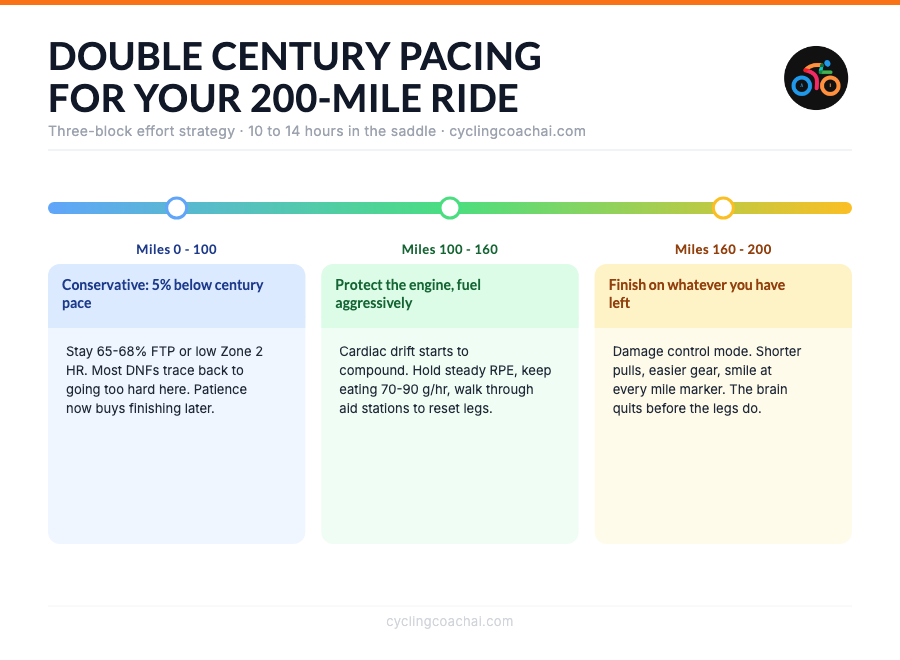
The reason: cardiac drift and muscular fatigue compound non-linearly past mile 100. A perceived "easy" pace at mile 30 becomes survival pace at mile 150 if you started too hard. Conservative pacing in hours 1-5 is what makes hours 8-12 possible.
Event-day nutrition and self-sufficiency for your 200-mile ride
This section covers what to eat and drink on the day of your 200-mile ride. For day-to-day fueling around training rides, see the Fueling your training section further down.
200-mile events often have aid stations 30-60 miles apart. You need to carry, consume and absorb 70-90 g of carbohydrate per hour for 10+ hours without GI failure. That is the hardest part of double-century preparation.
Carbohydrates
70-90 g per hour from mile 20 onward. Mix solid food (rice cakes, bananas, bars) with liquid carbs (drinks, gels) to prevent flavor fatigue. After hour 4 your stomach often rejects gels, so pre-test rice cakes, peanut butter sandwiches or dates during long training rides.
Hydration
750-1,000 ml per hour. Add an electrolyte cap or tab per bottle in heat. Track bottle count by aid station so you do not finish a remote section dry.
Carrying capacity
A frame bag or top-tube bag is essential. Jersey pockets alone cannot hold 10 hours of food, and digging for a gel at mile 140 with cold fingers is harder than it sounds.
Practice nutrition on the bike
Rehearse your exact race-day nutrition on every ride over 4 hours during the build and peak phases. Gut tolerance is trainable, but only if you actually train it.
Mental preparation and fatigue management
The physical demands of 200 miles are massive, but most DNFs are mental. After hour 7 the brain starts negotiating with itself: "just stop at the next town", "this hurts more than expected", "I'll try again next year."
The plan addresses this by including at least three rides over 6 hours in the final 8 weeks. These rides simulate the mental territory of late-event fatigue. They teach you that the discomfort of hour 7 is not a sign to stop, it is the normal state of long-distance cycling, and it passes.
Race-day mental tools: break the ride into four 50-mile segments mentally, eat before you feel hungry, drink before you feel thirsty, smile at aid stations, and refuse to let the second half hurt before mile 130. You are stronger than your fatigued brain claims.
Watch: mental toughness in ultra-endurance cycling

Training zones
This plan uses power zones (% of FTP) and heart rate zones (% of max HR) to guide effort. A power meter and heart rate monitor are required.
Power zones
| Zone | % FTP | RPE | Feel |
|---|---|---|---|
| Z1 Recovery | 0-55% FTP | 1-2 out of 10 | Extremely easy. No sensation of effort. Used only for recovery rides. |
| Z2 Endurance | 56-75% FTP | 3-4 out of 10 | Comfortable, sustainable effort. You are working but could maintain this for hours. |
| Z3 Tempo | 76-90% FTP | 5-6 out of 10 | Moderately hard. Sustainable for 30-60 minutes but requires concentration. |
| Z4 Threshold | 91-105% FTP | 7-8 out of 10 | Hard. You can sustain this for 20-40 minutes with focus. Speaking is difficult. |
| Z5 VO2max | 106-120% FTP | 8-9 out of 10 | Very hard. Maximum sustainable effort for 3-8 minutes. Legs and lungs burn. |
| Z6 Anaerobic Capacity | 121-150% FTP | 9-10 out of 10 | Maximum effort for 30 seconds to 2 minutes. Not sustainable. |
| Z7 Neuromuscular Power | 150%+ FTP | 10 out of 10 | All-out sprint for under 30 seconds. Pure explosive effort. |
Heart rate zones
| Zone | % Max HR | Feel |
|---|---|---|
| Z1 Recovery | 0-59% max HR | Extremely easy. No sensation of effort. Used only for recovery rides. |
| Z2 Endurance | 60-70% max HR | Comfortable, sustainable effort. You are working but could maintain this for hours. |
| Z3 Tempo | 71-80% max HR | Moderately hard. Sustainable for 30-60 minutes but requires concentration. |
| Z4 Threshold | 81-90% max HR | Hard. You can sustain this for 20-40 minutes with focus. Speaking is difficult. |
| Z5 VO2max | 91-100% max HR | Very hard. Maximum sustainable effort for 3-8 minutes. Legs and lungs burn. |
20-Week 200-Mile Bike Training Plan
5-6 rides per week building to a peak of 12h+ before tapering for your 200-mile ride. All sessions use power zones (% FTP) with heart rate as secondary reference.
| Day | Session | Duration |
|---|---|---|
| Week 1 Base | ||
| Mon | Rest | - |
| Tue | Endurance + 3x8min tempo @ 76-90% FTP / 71-80% HR | 75 min |
| Wed | Easy endurance @ 56-75% FTP / 60-70% HR | 60 min |
| Thu | Endurance + 2x10min tempo @ 76-90% FTP / 71-80% HR | 75 min |
| Fri | Rest | - |
| Sat | Long endurance @ 56-75% FTP / 60-70% HR | 2h 30min |
| Sun | Recovery @ 0-55% FTP / 0-59% HR | 50 min |
| Week 2 Base | ||
| Mon | Rest | - |
| Tue | Endurance + 3x8min tempo @ 76-90% FTP / 71-80% HR | 75 min |
| Wed | Easy endurance @ 56-75% FTP / 60-70% HR | 60 min |
| Thu | Endurance + 2x10min tempo @ 76-90% FTP / 71-80% HR | 75 min |
| Fri | Rest | - |
| Sat | Long endurance @ 56-75% FTP / 60-70% HR | 2h 30min |
| Sun | Recovery @ 0-55% FTP / 0-59% HR | 50 min |
| Week 3 Base | ||
| Mon | Rest | - |
| Tue | Endurance + 3x8min tempo @ 76-90% FTP / 71-80% HR | 75 min |
| Wed | Easy endurance @ 56-75% FTP / 60-70% HR | 60 min |
| Thu | Endurance + 2x10min tempo @ 76-90% FTP / 71-80% HR | 75 min |
| Fri | Rest | - |
| Sat | Long endurance @ 56-75% FTP / 60-70% HR | 3h 30min |
| Sun | Recovery @ 0-55% FTP / 0-59% HR | 50 min |
| Week 4 Base | ||
| Mon | Rest | - |
| Tue | Endurance + 3x8min tempo @ 76-90% FTP / 71-80% HR | 75 min |
| Wed | Easy endurance @ 56-75% FTP / 60-70% HR | 60 min |
| Thu | Endurance + 2x10min tempo @ 76-90% FTP / 71-80% HR | 75 min |
| Fri | Rest | - |
| Sat | Long endurance @ 56-75% FTP / 60-70% HR | 4h 30min |
| Sun | Recovery @ 0-55% FTP / 0-59% HR | 50 min |
| Week 5 Base | ||
| Mon | Rest | - |
| Tue | Endurance + 3x8min tempo @ 76-90% FTP / 71-80% HR | 75 min |
| Wed | Easy endurance @ 56-75% FTP / 60-70% HR | 60 min |
| Thu | Endurance + 2x10min tempo @ 76-90% FTP / 71-80% HR | 75 min |
| Fri | Rest | - |
| Sat | Long endurance @ 56-75% FTP / 60-70% HR | 4h 30min |
| Sun | Recovery @ 0-55% FTP / 0-59% HR | 50 min |
| Week 6 Build | ||
| Mon | Rest | - |
| Tue | Endurance + 3x14min sweet spot @ 88-93% FTP / 71-80% HR | 85 min |
| Wed | Easy endurance @ 56-75% FTP / 60-70% HR | 60 min |
| Thu | Endurance + 2x17min threshold @ 91-105% FTP / 81-90% HR | 85 min |
| Fri | Easy endurance @ 56-75% FTP / 60-70% HR | 55 min |
| Sat | Long endurance @ 56-75% FTP / 60-70% HR | 4.2h |
| Sun | Recovery @ 0-55% FTP / 0-59% HR | 55 min |
| Week 7 Build | ||
| Mon | Rest | - |
| Tue | Endurance + 3x15min sweet spot @ 88-93% FTP / 71-80% HR | 85 min |
| Wed | Easy endurance @ 56-75% FTP / 60-70% HR | 60 min |
| Thu | Endurance + 2x18min threshold @ 91-105% FTP / 81-90% HR | 85 min |
| Fri | Easy endurance @ 56-75% FTP / 60-70% HR | 55 min |
| Sat | Long endurance @ 56-75% FTP / 60-70% HR | 4.4h |
| Sun | Recovery @ 0-55% FTP / 0-59% HR | 55 min |
| Week 8 Build | ||
| Mon | Rest | - |
| Tue | Endurance + 3x15min sweet spot @ 88-93% FTP / 71-80% HR | 85 min |
| Wed | Easy endurance @ 56-75% FTP / 60-70% HR | 60 min |
| Thu | Endurance + 2x18min threshold @ 91-105% FTP / 81-90% HR | 85 min |
| Fri | Easy endurance @ 56-75% FTP / 60-70% HR | 55 min |
| Sat | Long endurance @ 56-75% FTP / 60-70% HR | 4.5h |
| Sun | Recovery @ 0-55% FTP / 0-59% HR | 55 min |
| Week 9 Build | ||
| Mon | Rest | - |
| Tue | Endurance + 3x16min sweet spot @ 88-93% FTP / 71-80% HR | 85 min |
| Wed | Easy endurance @ 56-75% FTP / 60-70% HR | 60 min |
| Thu | Endurance + 2x19min threshold @ 91-105% FTP / 81-90% HR | 85 min |
| Fri | Easy endurance @ 56-75% FTP / 60-70% HR | 55 min |
| Sat | Long endurance @ 56-75% FTP / 60-70% HR | 4.7h |
| Sun | Recovery @ 0-55% FTP / 0-59% HR | 55 min |
| Week 10 Build | ||
| Mon | Rest | - |
| Tue | Endurance + 3x16min sweet spot @ 88-93% FTP / 71-80% HR | 85 min |
| Wed | Easy endurance @ 56-75% FTP / 60-70% HR | 60 min |
| Thu | Endurance + 2x19min threshold @ 91-105% FTP / 81-90% HR | 85 min |
| Fri | Easy endurance @ 56-75% FTP / 60-70% HR | 55 min |
| Sat | Long endurance @ 56-75% FTP / 60-70% HR | 4.8h |
| Sun | Recovery @ 0-55% FTP / 0-59% HR | 55 min |
| Week 11 Build | ||
| Mon | Rest | - |
| Tue | Endurance + 3x17min sweet spot @ 88-93% FTP / 71-80% HR | 85 min |
| Wed | Easy endurance @ 56-75% FTP / 60-70% HR | 60 min |
| Thu | Endurance + 2x20min threshold @ 91-105% FTP / 81-90% HR | 85 min |
| Fri | Easy endurance @ 56-75% FTP / 60-70% HR | 55 min |
| Sat | Long endurance @ 56-75% FTP / 60-70% HR | 5.0h |
| Sun | Recovery @ 0-55% FTP / 0-59% HR | 55 min |
| Week 12 Build | ||
| Mon | Rest | - |
| Tue | Endurance + 3x17min sweet spot @ 88-93% FTP / 71-80% HR | 85 min |
| Wed | Easy endurance @ 56-75% FTP / 60-70% HR | 60 min |
| Thu | Endurance + 2x20min threshold @ 91-105% FTP / 81-90% HR | 85 min |
| Fri | Easy endurance @ 56-75% FTP / 60-70% HR | 55 min |
| Sat | Long endurance @ 56-75% FTP / 60-70% HR | 5.2h |
| Sun | Recovery @ 0-55% FTP / 0-59% HR | 55 min |
| Week 13 Build | ||
| Mon | Rest | - |
| Tue | Easy endurance @ 56-75% FTP / 60-70% HR | 60 min |
| Wed | Rest | - |
| Thu | Endurance + 2x8min tempo @ 76-90% FTP / 71-80% HR | 65 min |
| Fri | Rest | - |
| Sat | Long endurance @ 56-75% FTP / 60-70% HR | 3h |
| Sun | Recovery @ 0-55% FTP / 0-59% HR | 40 min |
| Week 14 Build | ||
| Mon | Rest | - |
| Tue | Endurance + 3x18min sweet spot @ 88-93% FTP / 71-80% HR | 85 min |
| Wed | Easy endurance @ 56-75% FTP / 60-70% HR | 60 min |
| Thu | Endurance + 2x21min threshold @ 91-105% FTP / 81-90% HR | 85 min |
| Fri | Easy endurance @ 56-75% FTP / 60-70% HR | 55 min |
| Sat | Long endurance @ 56-75% FTP / 60-70% HR | 5.5h |
| Sun | Recovery @ 0-55% FTP / 0-59% HR | 55 min |
| Week 15 Build | ||
| Mon | Rest | - |
| Tue | Endurance + 3x19min sweet spot @ 88-93% FTP / 71-80% HR | 85 min |
| Wed | Easy endurance @ 56-75% FTP / 60-70% HR | 60 min |
| Thu | Endurance + 2x22min threshold @ 91-105% FTP / 81-90% HR | 85 min |
| Fri | Easy endurance @ 56-75% FTP / 60-70% HR | 55 min |
| Sat | Long endurance @ 56-75% FTP / 60-70% HR | 5.6h |
| Sun | Recovery @ 0-55% FTP / 0-59% HR | 55 min |
| Week 16 Build | ||
| Mon | Rest | - |
| Tue | Endurance + 3x19min sweet spot @ 88-93% FTP / 71-80% HR | 85 min |
| Wed | Easy endurance @ 56-75% FTP / 60-70% HR | 60 min |
| Thu | Endurance + 2x22min threshold @ 91-105% FTP / 81-90% HR | 85 min |
| Fri | Easy endurance @ 56-75% FTP / 60-70% HR | 55 min |
| Sat | Long endurance @ 56-75% FTP / 60-70% HR | 5.8h |
| Sun | Recovery @ 0-55% FTP / 0-59% HR | 55 min |
| Week 17 Peak | ||
| Mon | Rest | - |
| Tue | Endurance + 3x15min sweet spot @ 88-93% FTP / 71-80% HR | 90 min |
| Wed | Easy endurance @ 56-75% FTP / 60-70% HR | 60 min |
| Thu | Endurance + 2x20min threshold @ 91-105% FTP / 81-90% HR | 90 min |
| Fri | Easy endurance @ 56-75% FTP / 60-70% HR | 55 min |
| Sat | Long endurance + century pace sections @ 76-85% FTP / 71-80% HR | 6h |
| Sun | Recovery @ 0-55% FTP / 0-59% HR | 55 min |
| Week 18 Peak | ||
| Mon | Rest | - |
| Tue | Endurance + 3x15min sweet spot @ 88-93% FTP / 71-80% HR | 90 min |
| Wed | Easy endurance @ 56-75% FTP / 60-70% HR | 60 min |
| Thu | Endurance + 2x20min threshold @ 91-105% FTP / 81-90% HR | 90 min |
| Fri | Easy endurance @ 56-75% FTP / 60-70% HR | 55 min |
| Sat | Long endurance + century pace sections @ 76-85% FTP / 71-80% HR | 6h |
| Sun | Recovery @ 0-55% FTP / 0-59% HR | 55 min |
| Week 19 Peak | ||
| Mon | Rest | - |
| Tue | Endurance + 2x15min threshold @ 91-105% FTP / 81-90% HR | 80 min |
| Wed | Easy endurance @ 56-75% FTP / 60-70% HR | 50 min |
| Thu | Endurance + 2x12min sweet spot @ 88-93% FTP / 71-80% HR | 75 min |
| Fri | Rest | - |
| Sat | Long endurance + pace sections @ 76-85% FTP / 71-80% HR | 4h |
| Sun | Recovery @ 0-55% FTP / 0-59% HR | 45 min |
| Week 20 Peak | ||
| Mon | Rest | - |
| Tue | Easy endurance @ 56-75% FTP / 60-70% HR | 55 min |
| Wed | Rest | - |
| Thu | Activation: 2x5min @ 91-105% FTP / 81-90% HR | 45 min |
| Fri | Rest | - |
| Sat | 200-Mile Ride Day | 10-14h |
| Sun | Rest | - |
Week-by-week breakdown
Week 1
Focus: Build endurance base.
Key session: Saturday long ride: the primary endurance builder for this week.
What to feel: Controlled effort. Finish each session feeling like you could do 15 more minutes.
Avoid: Going too hard on easy days.
Week 2
Focus: Build endurance base.
Key session: Saturday long ride: the primary endurance builder for this week.
What to feel: Controlled effort. Finish each session feeling like you could do 15 more minutes.
Avoid: Going too hard on easy days.
Week 3
Focus: Build endurance base.
Key session: Saturday long ride: the primary endurance builder for this week.
What to feel: Controlled effort. Finish each session feeling like you could do 15 more minutes.
Avoid: Going too hard on easy days.
Week 4
Focus: Build endurance base.
Key session: Saturday long ride: the primary endurance builder for this week.
What to feel: Controlled effort. Finish each session feeling like you could do 15 more minutes.
Avoid: Going too hard on easy days.
Week 5
Focus: Build endurance base.
Key session: Saturday long ride: the primary endurance builder for this week.
What to feel: Controlled effort. Finish each session feeling like you could do 15 more minutes.
Avoid: Going too hard on easy days.
Week 6
Focus: Progressive overload.
Key session: Saturday long ride: the primary endurance builder for this week.
What to feel: Challenging but manageable. The intervals should be hard but completeable.
Avoid: Not fueling properly for long rides.
Week 7
Focus: Progressive overload.
Key session: Saturday long ride: the primary endurance builder for this week.
What to feel: Challenging but manageable. The intervals should be hard but completeable.
Avoid: Not fueling properly for long rides.
Week 8
Focus: Progressive overload.
Key session: Saturday long ride: the primary endurance builder for this week.
What to feel: Challenging but manageable. The intervals should be hard but completeable.
Avoid: Not fueling properly for long rides.
Week 9
Focus: Progressive overload.
Key session: Saturday long ride: the primary endurance builder for this week.
What to feel: Challenging but manageable. The intervals should be hard but completeable.
Avoid: Not fueling properly for long rides.
Week 10
Focus: Progressive overload.
Key session: Saturday long ride: the primary endurance builder for this week.
What to feel: Challenging but manageable. The intervals should be hard but completeable.
Avoid: Not fueling properly for long rides.
Week 11
Focus: Progressive overload.
Key session: Saturday long ride: the primary endurance builder for this week.
What to feel: Challenging but manageable. The intervals should be hard but completeable.
Avoid: Not fueling properly for long rides.
Week 12
Focus: Progressive overload.
Key session: Saturday long ride: the primary endurance builder for this week.
What to feel: Challenging but manageable. The intervals should be hard but completeable.
Avoid: Not fueling properly for long rides.
Week 13
Focus: Recovery and absorption.
Key session: Saturday long ride: the primary endurance builder for this week.
What to feel: Fresh and restless. Trust the process.
Avoid: Skipping the recovery week.
Week 14
Focus: Progressive overload.
Key session: Saturday long ride: the primary endurance builder for this week.
What to feel: Challenging but manageable. The intervals should be hard but completeable.
Avoid: Not fueling properly for long rides.
Week 15
Focus: Progressive overload.
Key session: Saturday long ride: the primary endurance builder for this week.
What to feel: Challenging but manageable. The intervals should be hard but completeable.
Avoid: Not fueling properly for long rides.
Week 16
Focus: Progressive overload.
Key session: Saturday long ride: the primary endurance builder for this week.
What to feel: Challenging but manageable. The intervals should be hard but completeable.
Avoid: Not fueling properly for long rides.
Week 17
Focus: Race preparation.
Key session: Saturday long ride: the primary endurance builder for this week.
What to feel: Sharp and efficient. Rides feel easier at the same power.
Avoid: Not fueling properly for long rides.
Week 18
Focus: Race preparation.
Key session: Saturday long ride: the primary endurance builder for this week.
What to feel: Sharp and efficient. Rides feel easier at the same power.
Avoid: Not fueling properly for long rides.
Week 19
Focus: Race preparation.
Key session: Saturday long ride: the primary endurance builder for this week.
What to feel: Sharp and efficient. Rides feel easier at the same power.
Avoid: Not fueling properly for long rides.
Week 20
Focus: Race preparation.
Key session: Saturday long ride: the primary endurance builder for this week.
What to feel: Sharp and efficient. Rides feel easier at the same power.
Avoid: Not fueling properly for long rides.
Fueling your training
200-mile nutrition is a discipline in itself. At this distance, caloric deficit is inevitable and the goal is to minimize it.
Before rides
Eat a carb-rich meal 3 hours before. Aim for 150-200g carbohydrates for ultra-distance rides.
During rides
60-90g carbs per hour from the first 20 minutes. Mix gels, bars, and real food. Practice your exact race nutrition on every long ride over 4 hours.
After rides
Recovery nutrition within 30 minutes. 1.2g carbs per kg bodyweight plus 20-30g protein.
Hydration
500-750ml per hour with electrolytes. For rides over 5 hours, include sodium tabs to prevent hyponatremia.
Race day
Pre-ride meal 3-4 hours before start. Carry enough for 10-14 hours of riding. Know every aid station location.
Gear checklist
Essential
Power meter
Essential for pacing a century. Without power data, you are guessing your effort and risk blowing up after 60 miles.
Heart rate monitor (chest strap)
Secondary effort reference and cardiac drift detection on long rides. Chest straps are more accurate than wrist sensors during high-intensity intervals.
Properly fitted road bike
A professional bike fit is critical for 5-7 hours in the saddle. Poor fit causes knee, back, and neck issues that compound with distance.
Padded cycling bib shorts
Bib shorts eliminate waistband pressure on long rides. Invest in quality chamois padding for century distances.
Two water bottles and cages (or hydration system)
You need 500-750ml per hour for 5-7 hours. Two large bottles with a plan for refills at aid stations.
Nice to have
Cycling computer with mapping
Displays real-time power, heart rate, distance, and route navigation. Critical for pacing and knowing what is ahead.
Saddle bag with spare tube, CO2, and multi-tool
A mechanical issue 50 miles from the finish with no support vehicle ends your day. Be self-sufficient.
Aero helmet or aero socks
Small aerodynamic gains add up over 100 miles. An aero helmet saves 30-60 seconds per hour at century pace.
5 mistakes that derail 200 mile training plans
Not doing enough back-to-back long days
A single long ride does not simulate ultra fatigue. Back-to-back weekend rides teach your body to perform on tired legs.
Fix: Include at least 4 back-to-back weekends in the build phase.
Underestimating nutrition needs
At 200 miles, you need 60-90g carbs per hour for 10-14 hours. That is 600-1200g of carbs total. Most riders eat half of what they need.
Fix: Calculate your total caloric need and plan your food supply before the ride.
Going too hard in the first 50 miles
200 miles requires extreme pacing discipline. If you ride the first quarter above 80% FTP, you will bonk before mile 120.
Fix: Cap power at 70-75% FTP for the first 50 miles.
Not training in similar conditions
If your event is hilly, hot, or at altitude, train for those conditions. A flat training plan will not prepare you for 15,000 feet of climbing.
Fix: Simulate event conditions in your long rides.
Ignoring mental preparation
200 miles takes 10-14 hours. Physical fitness alone is not enough. Mental resilience determines whether you finish.
Fix: Practice mental strategies during long rides: chunking the distance, positive self-talk, and distraction techniques.
Ride day tips
Break the ride into segments
Do not think about 200 miles. Think about the next aid station, the next town, the next climb. Mental fatigue is the biggest enemy on an ultra ride.
Start slower than you think
Your first 50 miles should feel embarrassingly easy. 70-75% FTP maximum. Save everything for the second half.
Have a crew or support plan
200 miles of self-supported riding is possible but much harder. A support vehicle or crew at key points makes a significant difference.
Train your non-cycling systems
Neck, shoulders, hands, and saddle contact points all need conditioning for 10-14 hours. Practice your exact position and kit on every long ride.
Why a personalized plan outperforms this one
This plan provides a solid framework for century preparation. But a plan built from your actual power data, recovery metrics, and weekly schedule adapts to you instead of asking you to adapt to it.
Start Free · Pay Nothing Today · Cancel Anytime