You have signed up for 235 kilometres through the Victorian Alps, 4,500 metres of climbing, and the defining challenge of Australian amateur cycling: riding Falls Creek not once but twice. The second ascent, arriving after 185 kilometres with Hotham and Tawonga Gap already in your legs, is where the Peaks Challenge is truly decided.
Unlike most gran fondos where one big climb defines the day, the Peaks Challenge Falls Creek imposes a structural demand that is unique in the endurance cycling calendar. You cannot conserve energy on the first ascent and then attack the second one. You cannot treat the Ovens Valley descent as recovery. You arrive at the base of Falls Creek for the second time with whatever fitness your preparation left you, and you climb. Everything before that moment is preamble.
This guide gives you a complete Peaks Challenge training plan: race overview, the physiological demands of riding the Victorian Alps in summer heat, how to build the sustained climbing power and heat tolerance to complete both Falls Creek ascents, and full week-by-week plans for 12, 16, 20, and 24 weeks.

Peaks Challenge Falls Creek Race Overview
| Race detail | |
|---|---|
| 📍 Location | Falls Creek, Victoria, Australia |
| 📅 Next edition | TBC — typically March (held annually since 1982) |
| 🌐 Official website | bicyclenetwork.com.au |
| 📏 Distance | 235 km |
| ⛰️ Elevation gain | 4,500 m D+ |
| 🏔️ Key summits | Falls Creek (1,780 m) × 2, Mt Hotham (1,750 m), Tawonga Gap (1,120 m) |
| 🛣️ Surface | 100% sealed road |
| ⏱️ Cut-off time | 18 hours |
| 👥 Participants | ~1,200 starters |
| 🎟️ Entry method | Open registration (fills quickly) |
| 📁 GPX route | Download GPX file |
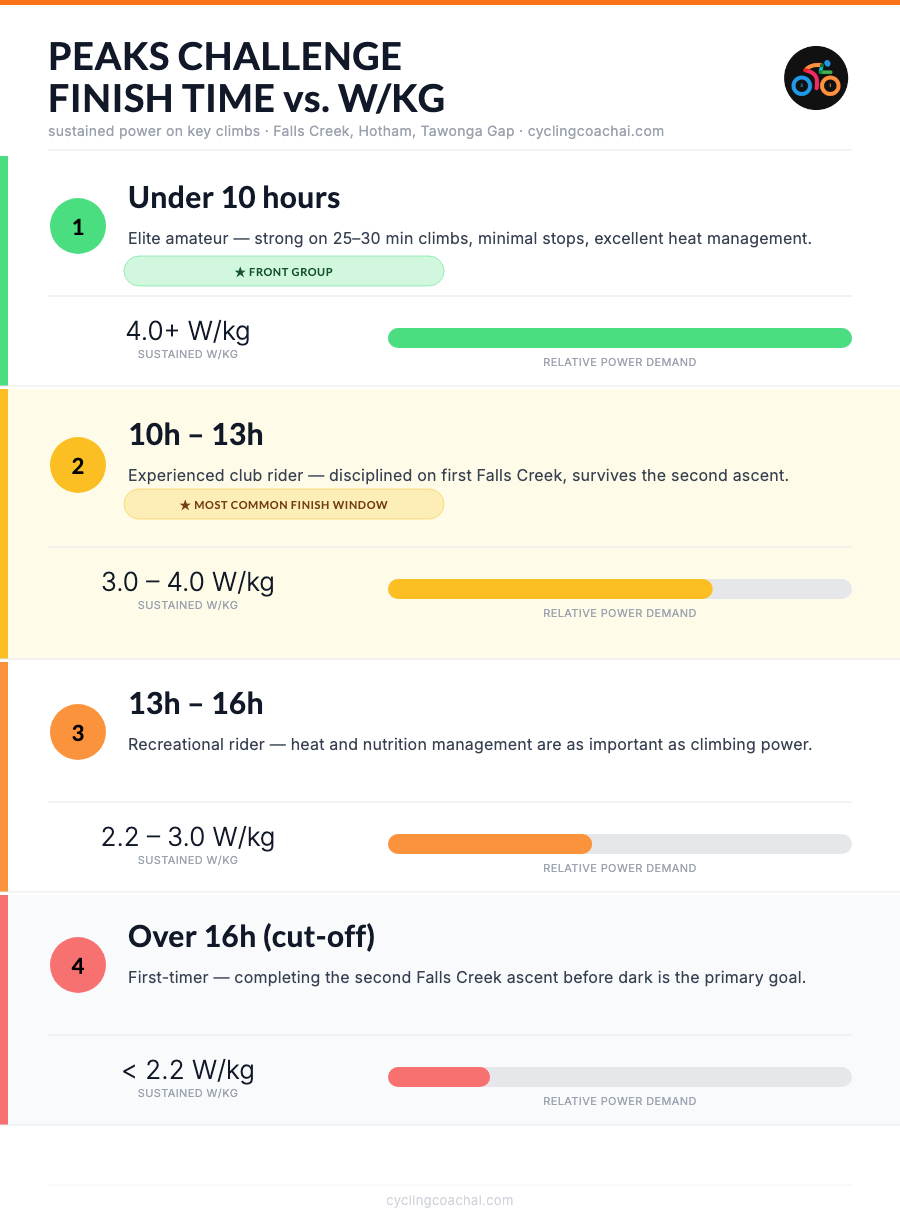
Estimated Finish Times
| Estimated finish time | Approximate sustained W/kg |
|---|---|
| Under 10 hours | 4.0+ W/kg |
| 10h – 13h | 3.0 – 4.0 W/kg |
| 13h – 16h | 2.2 – 3.0 W/kg |
| Over 16h (approaching cut-off) | < 2.2 W/kg |
Based on sustained power on key climbs in neutral conditions. Heat, wind, and pacing errors on the first Falls Creek ascent significantly affect these projections.
Your Peaks Challenge Finish Target
The W/kg values above reflect sustained climbing power across all four major ascents, not a single effort peak. A rider whose watts per kilo reach 3.5 on a fresh 20-minute test may sustain only 2.8-3.0 W/kg on the second Falls Creek ascent after 185 kilometres. The gap between tested fitness and late-race reality at the Peaks Challenge is larger than at almost any other gran fondo in the world precisely because of the double Falls Creek structure.
What Makes the Peaks Challenge Unique
The Peaks Challenge covers four major climbs: Falls Creek outbound, Tawonga Gap, Mount Hotham, and Falls Creek again on the return. Each is a sustained effort of 45-90 minutes at tempo-to-threshold intensity depending on your fitness. The course does not offer recovery between climbs — the descents are fast but not long enough to meaningfully restore glycogen or reduce accumulated fatigue. By the time you are on Hotham, you have already ridden 100 kilometres with 2,000 metres of climbing in your legs.
The second Falls Creek ascent is the defining challenge of the event. Beginning at Tawonga South after approximately 185 kilometres, it is a 31-kilometre climb averaging 5.5% with ramps above 8% near the summit. The temperature differential between the Ovens Valley floor (which can reach 35°C in March) and the Falls Creek summit (typically 12-15°C) creates an environmental whiplash that amplifies dehydration and makes pace judgment difficult. Riders who went too hard early in the day discover this ascent; those who managed their energy across the first four-fifths of the course find it hard but manageable.
Falls Creek is also one of Australia's most exposed cycling venues. From around kilometre 210, there is no shelter from wind off the plateau. After eight or more hours in the saddle in summer heat, arriving at the final exposed section with insufficient fuelling and pacing discipline is a common cause of withdrawal from the Peaks Challenge. The event's 18-hour cut-off is real and turns away riders every year.
Physiological Demands of the Peaks Challenge
Dominant energy system
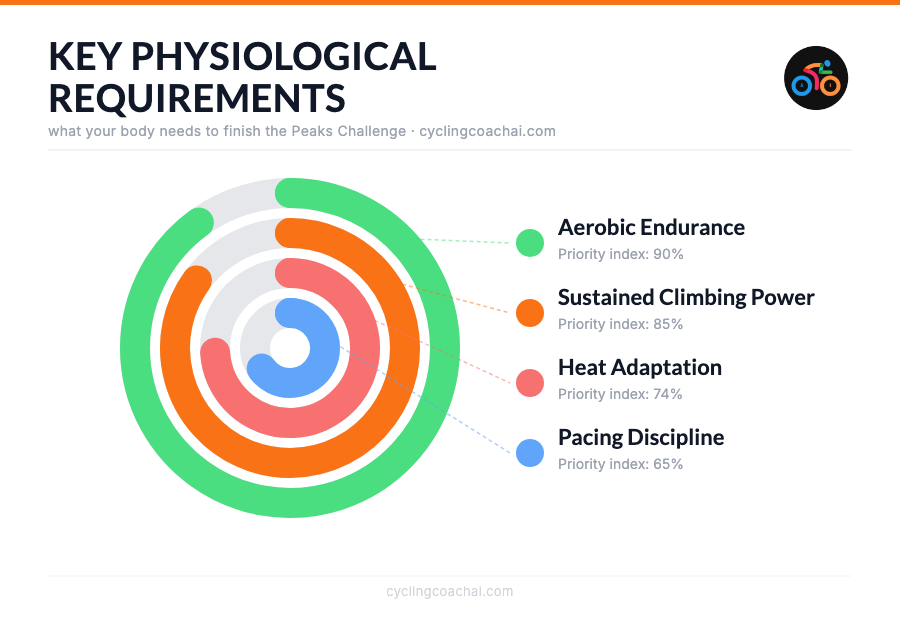
Aerobic Endurance
The Peaks Challenge demands 5,000-8,000 kJ of sustained output across 10-16 hours, with four prolonged climbing efforts that repeatedly stress the aerobic-to-threshold boundary. Training your aerobic engine and raising your sustainable climbing wattage is the foundation of all effective Peaks Challenge preparation.
Sustained climbing power is the differentiator between a comfortable finish and a survival finish at the Peaks Challenge. The event does not require the peak power of a criterium or the VO2max efforts of a short mountain stage. It requires the ability to sustain 85-93% of your FTP on prolonged climbs, repeatedly, for an entire day. This is a specific adaptation that only develops through long climbing sessions and accumulated hill training volume, not through interval work alone.
Heat adaptation is the physiological demand that most riders underestimate before their first Peaks Challenge. The Ovens Valley in March regularly reaches 35-38°C during the middle of the day. Riders who have trained through an Australian winter and arrive without heat conditioning experience significant cardiovascular drift on the valley sections: heart rate climbs 10-15 beats per minute higher than expected for the same power output, glycogen burns faster, and sweat rate increases. Heat adaptation training in the final 6-8 weeks meaningfully reduces this penalty on race day.
Pacing discipline earns its place as a distinct physiological and psychological demand because the Peaks Challenge punishes over-ambition on the first Falls Creek ascent more severely than almost any other event. The excitement of the start, the cool morning air on the opening climb, and the enthusiasm of riding with faster athletes all conspire to push first-timers above their sustainable pace. Riders who train to a specific power target on every climb and hold that target even when it feels too easy consistently perform better on the second ascent than those who ride by feel.
Peaks Challenge Training Plan: Full Schedule
Four complete plans based on your available preparation time and current fitness. Every plan includes a dedicated heat adaptation block in the final build phase, back-to-back long rides to simulate the second Falls Creek ascent on fatigued legs, and a taper that preserves intensity while reducing volume in the final two weeks.
| Day | Session | Duration |
|---|
Key Workouts for the Peaks Challenge
1. The Hotham Simulation
Session: 2×25 minutes at 88-92% of FTP with 10 minutes of easy spinning between efforts. Progress to 3×20 minutes in the final build phase.
Why it works: Mount Hotham is a 25-kilometre climb averaging 5.4% gradient, and it arrives when you already have Tawonga Gap and significant valley kilometres in your legs. This session replicates the sustained threshold-adjacent demand of prolonged Alpine climbing. The critical instruction is to do the second interval in a fatigued state: the easy spinning between efforts is 10 minutes, not full recovery. If you only ever practice this effort from fresh, you will be unprepared for the reality of Hotham after 100 kilometres. On a turbo trainer, set the gradient to 5-6% and hold the target power for the full duration without standing.
When to use it: Every 10 days from early build phase through race prep.
2. The Falls Creek Double
Session: Saturday: 5-6 hours with at least 2,000 metres of climbing at Zone 2 to Zone 3. Sunday: 3-4 hours with 1,000-1,500 metres of climbing, beginning the ride with the first significant climb of the day rather than easing in.
Why it works: The second Falls Creek ascent begins after 185 kilometres. No single long ride can replicate this, but back-to-back long rides with climbing on both days create the specific fatigue profile that makes the second ascent manageable. The Sunday ride starts immediately with climbing to simulate the neurological and muscular state of arriving at Falls Creek base after a full day in the saddle. Riders who only do single long rides, no matter how long, consistently find the second Falls Creek ascent disproportionately harder than their fitness should predict.
When to use it: Every week in the build phase and the first three weeks of race prep.
3. The Heat Adaptation Block
Session: 4-5 hour ride completed entirely in the hottest part of the day (11am to 3pm in summer). Dress warmly enough to maintain elevated core temperature. Target Zone 2 output and focus on hydration discipline: 750ml per hour minimum, with sodium supplementation.
Why it works: After 6-10 sessions of heat exposure, the body adapts by increasing plasma volume, lowering the core temperature at which sweating begins, and reducing the heart rate elevation per degree of core temperature rise. The net effect on race day is a 3-5 beat per minute reduction in heart rate at the same power output in warm conditions, which translates directly to lower glycogen expenditure and a stronger second Falls Creek ascent. This block replaces one long ride per two weeks in the final 8 weeks of preparation.
When to use it: Every two weeks from the mid-build phase through race prep.
Common Mistakes When Preparing for the Peaks Challenge
Going too hard on the first Falls Creek ascent
The Peaks Challenge begins with Falls Creek. The morning is cool, legs are fresh, and the climb is beautiful in the early light. Riders who ride Falls Creek outbound at threshold or above because it feels manageable pay for this decision at the base of Falls Creek inbound. The correct pacing for the first ascent is 80-88% of FTP. It should feel slightly too easy. The day is long enough that any deficit created in the first 35 kilometres cannot be recovered.
Insufficient long-climb volume in training
The Peaks Challenge requires four sustained climbing efforts of 45-90 minutes each. Riders who train on flat terrain without access to prolonged climbs and do not compensate with turbo trainer simulations frequently lack the specific muscular endurance for seated climbing at threshold over 45+ minutes. Every Hotham simulation session must be done on a genuine climb or at 5-7% gradient on an indoor trainer.
Arriving without heat conditioning
Training in cool conditions and then racing in 35°C Ovens Valley heat creates a performance gap that no amount of aerobic fitness can bridge. The heat block in this plan is not optional for riders preparing through winter months or in cool climates. If sauna protocols are more accessible than outdoor heat training, post-ride sauna sessions of 20-30 minutes at 80-90°C achieve similar plasma volume adaptations.
Under-fuelling during the valley sections
The flat-to-rolling Ovens Valley sections between climbs feel like recovery. Many riders reduce their calorie intake during these sections and arrive at the base of the next climb under-fuelled. The Peaks Challenge has four major climbs separated by valley transitions, each requiring full glycogen stores to climb at target pace. Eat on the descents and during valley transitions, not just at the top of climbs.
Ignoring the temperature differential
The 15-20°C swing between the valley floor and the Falls Creek summit creates a challenge unique to this event. Riders who descend Hotham without stopping to add a layer arrive at Harrietville cold, then must perform a hard transition directly back into the climbing effort toward Falls Creek. Practice your temperature management strategy on every back-to-back training weekend.
Comparing it to other gran fondos
The Peaks Challenge is harder than events of similar distance and elevation on paper because of the structural double ascent. Riders who have done similar European gran fondos like the Mallorca 312, Fred Whitton, or La Marmotte should expect the Peaks Challenge to feel disproportionately harder in the final 50 kilometres. The preparation principles are similar, but the back-to-back climbing demand requires specific adaptation that those events do not.
Adaptive Training for the Peaks Challenge
A static training plan treats every rider the same. The Peaks Challenge does not.
Cycling Coach AI builds your Peaks Challenge preparation around your actual FTP, available weekly hours, and target finish time. Unlike a fixed plan, it adjusts week by week as your fitness evolves: if you miss a block due to heat, illness, or work, it recalculates without leaving you behind; if your Hotham simulation times improve ahead of schedule, it advances your loading to match. Every session has a specific purpose tied to your individual targets, not a generic template written for a hypothetical average rider.
Because the Peaks Challenge is as much a nutritional and physiological challenge as a fitness one, the plan integrates structured strength work into your weekly schedule from the first week. Hip flexor strength, lower back endurance, and single-leg stability directly reduce the muscular fatigue that accumulates over 235 kilometres of climbing. Riders who include consistent strength sessions in the 12 weeks before the event consistently report better form on the second Falls Creek ascent than those who focus on cycling volume alone.
Your daily nutrition plan adjusts to your training load automatically. On a 6-hour heat adaptation day, your carbohydrate targets, electrolyte needs, and calorie intake are calculated differently than on a Zone 2 recovery morning. The plan does not give you a generic macros spreadsheet. It tells you what to eat on Tuesday before a 90-minute Hotham simulation, what to take on the long ride Saturday, and how to fuel the recovery between your back-to-back sessions so Sunday's climbing feels like progression, not survival.
If you are ready to stop guessing and start preparing with a plan built around your actual fitness, create your personalised Peaks Challenge training plan and arrive at Falls Creek knowing you have done everything right on both ascents.