Spending hours in the saddle is fantastic for your endurance, but it often leaves you feeling tight and stiff.
If you've ever finished a ride with an aching back or tight hips, you know exactly what we mean.
I promise this guide will give you a simple, effective stretching routine to combat that stiffness and improve your performance.
You'll learn the key stretches that keep you flexible and powerful.
We'll walk through eight essential stretches for cyclists.
You'll get step-by-step instructions for each, helping you stay pain-free and ride stronger.
Benefits of Stretching for Cyclists
Stretching is a valuable practice for you as a cyclist, offering numerous benefits that can boost your performance and well-being.
It helps you improve flexibility, which is essential for efficient pedaling and maintaining an optimal riding posture.
With an increased range of motion, you can achieve more effective power transfer and reduce your risk of injury by ensuring your muscles are ready for the demands of cycling.
Additionally, stretching aids your muscle recovery by promoting blood circulation, which can reduce soreness and improve recovery time after long rides.
It also helps you maintain overall muscle balance, preventing tightness and imbalances that might lead to discomfort or injury.
Optimal Stretching Times for Cyclists
Stretching is an essential part of your cycling routine, helping you improve flexibility and prevent injuries. Scientific studies suggest several optimal times for stretching, each offering unique benefits:
-
Pre-Ride Stretching: Engage in dynamic stretches before cycling to enhance your performance by warming up your muscles and increasing blood flow. These stretches involve active movements that mimic cycling motions, preparing your body for the physical demands ahead.
-
Post-Ride Stretching: After cycling, it's recommended to do static stretching. This involves holding a position for a period, which can help reduce muscle stiffness and soreness. It also aids your recovery process by promoting flexibility and relaxation.
-
Off-Day Stretching: Incorporating stretching on your rest days can maintain and improve overall flexibility. It allows you to focus on stretching without the immediate strain of a ride, supporting your long-term flexibility goals and recovery.
Each of these stretching times serves a distinct purpose, contributing to your overall performance and well-being.
Best Stretching Exercises for Cyclists
1. Hip Flexor and Quad Stretch (90/90 Position)
This stretch directly targets tight hip flexors, one of the most common issues for cyclists.
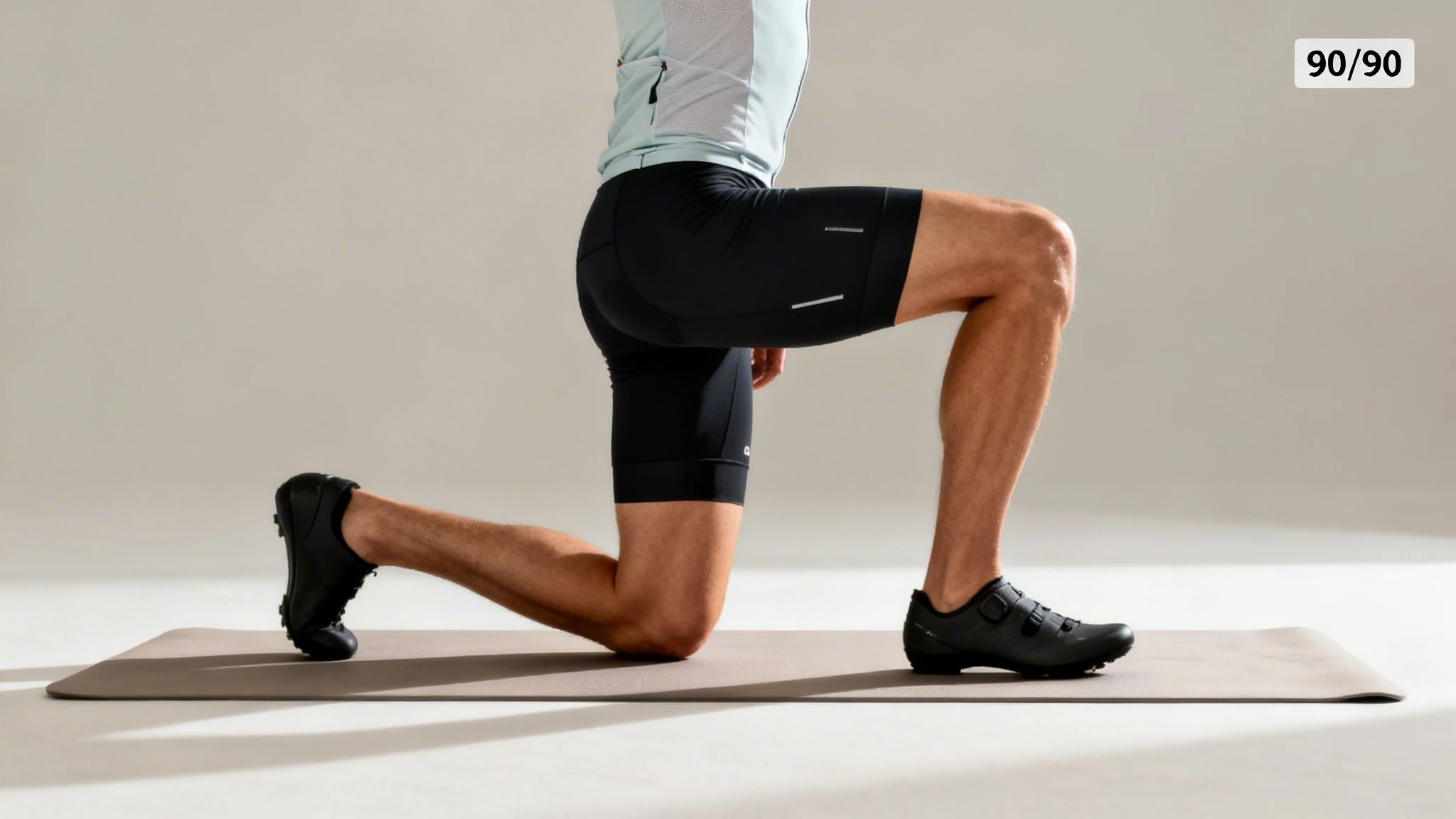
The 90/90 stretch hits your hip flexors and quads. It creates a deep pull through the front of your hip and thigh.
Benefits
-
Enhanced pedaling power through improved hip extension
-
Reduced lumbar strain by opening the front hip
-
Balanced muscle length to prevent overuse injuries
How to Perform
-
Kneel on one knee on a soft mat.
-
Place your opposite foot flat with the knee bent at 90 degrees.
-
Keep your torso upright and core engaged.
-
Lean forward gently until you feel a deep stretch.
Pro Tips
-
Perform this as part of your post-ride mobility routine.
-
Hold for 60 seconds per side.
-
Repeat 2–3 times weekly.
-
Integrate it with your Cycling Coach AI recovery days.
Learn more about structured routines in our training schedule for beginners guide.
2. Hamstring and Glute Stretch (Forward Fold or Seated Reach)
The forward fold is a key stretch for your posterior chain. This includes your hamstrings, glutes, and lower back.
These muscles can get tight from cycling. This tightness limits your mobility and can cause back pain.
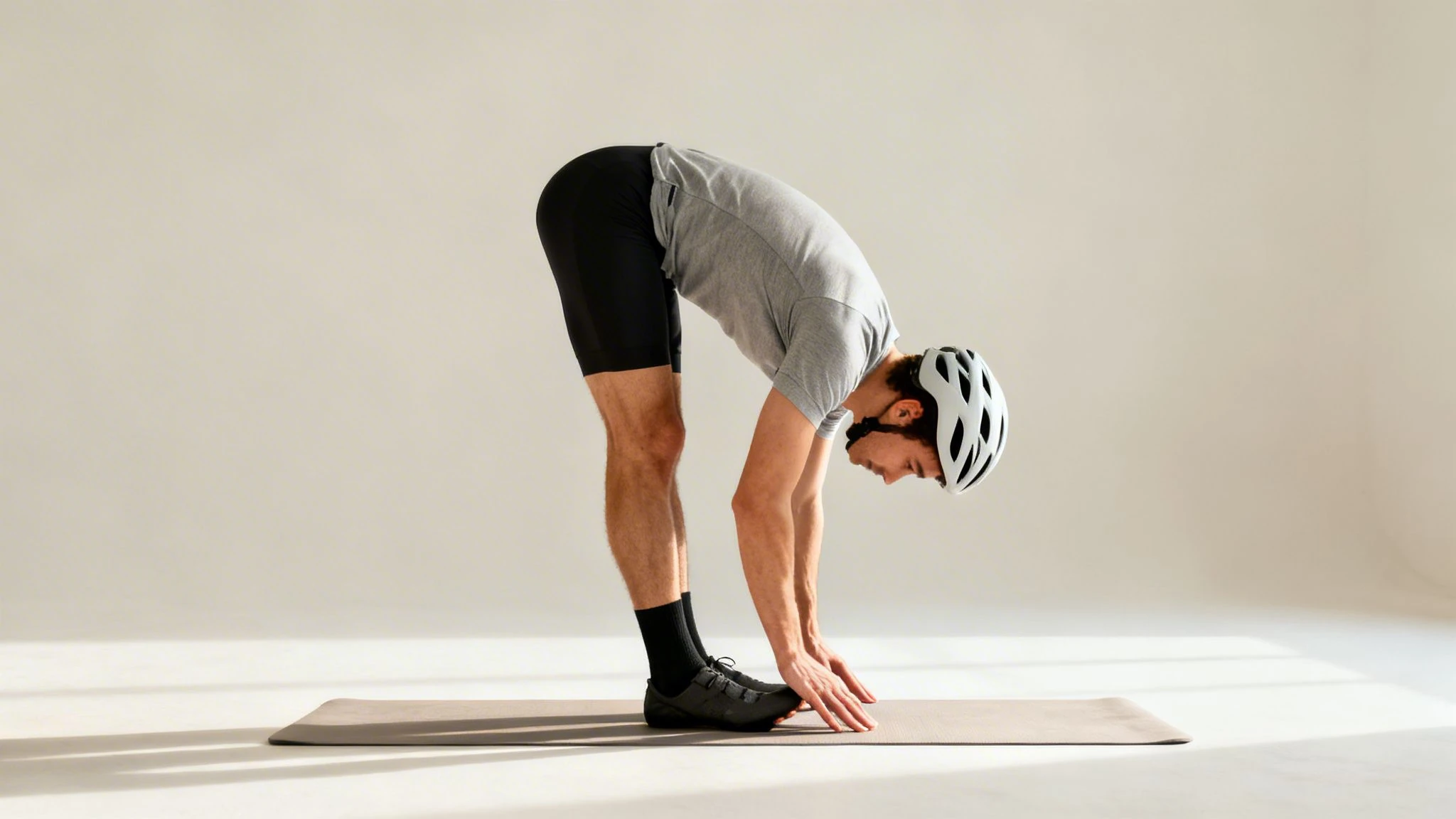
You perform this stretch by hinging forward from your hips. Keep your legs mostly straight. It’s a core exercise in cycling cooldowns.
Benefits
-
Improved hip mobility for a more fluid pedal stroke
-
Reduced lower back strain by releasing hamstring tension
-
Alleviated sciatica symptoms from tight glutes
How to Perform
-
Stand with your feet hip-width apart or sit with legs extended.
-
Hinge forward from your hips, not your waist.
-
Keep your back straight and reach toward your toes.
-
Stop when you feel a comfortable stretch.
Pro Tips
-
Hold this static position for 60-90 seconds; do not bounce.
-
Use a strap or towel if you need assistance.
-
Perform only after a ride when your muscles are warm.
This stretch is a core part of an effective recovery. Learn more in our guide on what is a cycling cool down.
3. IT Band and Piriformis Stretch (Figure-4 or Cow Face Pose Modified)
The repetitive pedaling motion can tighten your IT band and piriformis. This can cause knee and hip pain.
This targeted stretch is crucial for your mobility routine.
The Figure-4 stretch isolates deep hip rotator muscles. This includes the piriformis, which can compress the sciatic nerve when tight. It's a key tool for preventing IT Band Syndrome (ITBS).
Benefits
-
Reduces sciatic nerve compression by releasing the piriformis
-
Prevents lateral knee pain associated with ITBS
-
Improves hip rotation for a smoother pedal stroke
How to Perform
-
Lie on your back with both knees bent and feet flat.
-
Cross your right ankle over your left thigh.
-
Reach through and grasp the back of your left thigh.
-
Gently pull your left knee toward your chest.
Pro Tips
-
Hold for up to 90 seconds per side for a deep release.
-
Perform 4–5 times weekly, especially after long rides.
-
Combine with foam rolling the IT band for a full approach.
-
Use on recovery days.
4. Chest and Shoulder Stretch (Doorway Pec Stretch or Cross-Body Shoulder)
Your forward-leaning posture on the bike often tightens chest muscles. This can lead to rounded shoulders.
This imbalance can affect your breathing and comfort.
The doorway pec stretch helps counteract this. It uses a frame to open your chest. This is crucial for correcting your posture.
Benefits
-
Improved posture by counteracting the forward-leaning position
-
Enhanced breathing capacity by opening the chest
-
Reduced neck and shoulder strain from imbalances
How to Perform (Doorway Stretch)
-
Stand in a doorway and place one forearm against the frame.
-
Your elbow should be bent at a 90-degree angle.
-
Step forward gently with the same-side leg.
-
Feel the stretch across your chest and hold.
Pro Tips
-
Hold for 60–90 seconds per side for a deep release.
-
Keep your shoulders relaxed and down.
-
Combine with thoracic spine exercises for better mobility.
-
Schedule it into your recovery days.
This stretch complements a dynamic routine. Discover more in our guide on what is a cycling warm up.
5. Lower Back and Spinal Rotation Stretch (Supine Twist)
Your static, forward-leaning posture on the bike often causes lower back stiffness.
A supine spinal twist is a restorative stretch that helps.
It gently rotates your spine and releases tension.
This stretch targets the muscles that stabilize you during rides. Lying on your back and drawing one knee across your body helps decompress the lower spine.
Benefits
-
Reduces lower back stiffness by decompressing spinal joints
-
Improves rotational mobility for better on-bike handling
-
Releases tension in core and back muscles
How to Perform
-
Lie flat on your back with knees bent and feet flat.
-
Extend your arms out to the sides in a "T" position.
-
Gently let both knees fall to one side.
-
Keep your shoulders on the floor and hold the stretch.
Pro Tips
-
Hold for 60–90 seconds per side.
-
Perform 2–3 times per week to prevent stiffness.
-
Keep both shoulder blades on the floor to maximize the twist.
-
Use before bed on rest days to reduce morning tightness.
Effective recovery is essential for progress. Discover more in our guide on recovery after cycling.
6. Calf and Soleus Stretch (Downward Dog or Wall Calf Stretch)
Your calf muscles work hard with every pedal stroke. They are often overlooked in stretching routines.
Neglecting them can restrict ankle mobility and lead to injury.
This stretch targets both major calf muscles. You can do it by leaning against a wall or holding a downward dog yoga pose. Both create a deep stretch in your lower leg.
Benefits
-
Improved ankle mobility for a more efficient pedal stroke
-
Reduced risk of injury to the Achilles tendon
-
Alleviated lower leg tightness and cramping
How to Perform (Wall Stretch)
-
Stand facing a wall, about arm's length away.
-
Place your hands on the wall and step one foot back.
-
Keep your back leg straight and heel planted on the floor.
-
Lean forward until you feel the stretch in your calf.
Pro Tips
-
Perform this stretch daily, even on non-riding days.
-
Hold for 60 seconds per variation, with 2 sets per leg.
-
To target the soleus, perform the stretch with a slightly bent knee.
-
Use downward dog in a morning mobility routine.
7. Thoracic Spine Extension and Mobility (Foam Roller or Cat-Cow)
Cycling's forward posture often leads to a rounded upper back. Thoracic spine mobility is essential for reversing this.
A stiff mid-back can cause issues from your neck to your lower back.
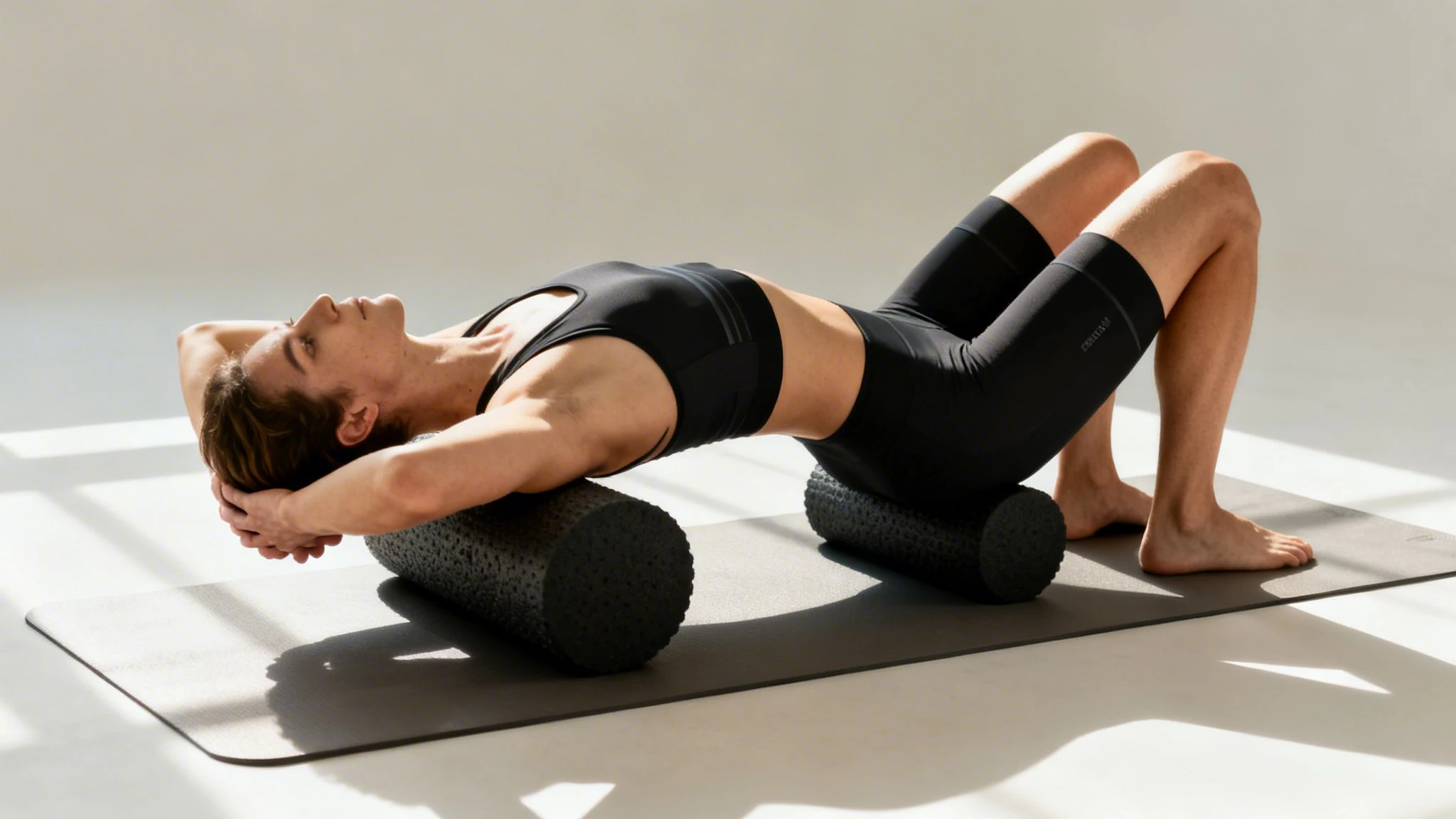
This practice uses a foam roller to extend your thoracic spine. You can also perform dynamic Cat-Cow movements. Both methods counteract the hunched position of riding.
Benefits
-
Improved breathing efficiency by opening your chest
-
Reduced neck and shoulder strain from better posture
-
Decreased lower back pain by preventing compensation
How to Perform (Foam Roller)
-
Sit on the floor with a foam roller behind you.
-
Lie back with the roller at your mid-back.
-
Support your head with your hands to avoid neck strain.
-
Gently extend your upper back over the roller.
Pro Tips
-
Perform dynamic Cat-Cow movements daily.
-
Combine with pec stretches for balanced mobility.
-
Use the foam roller before long rides to improve breathing.
-
Avoid rolling on your lower back or neck.
Targeted strength work is also key. Explore more in our guide to cross-training for cyclists.
8. Ankle Mobility and Plantarflexion Stretch (Toe Point or Quad Wrap Stretch)
Your ankle is the first point of contact in your pedal stroke. Its mobility is crucial for efficient power transfer.
Don't make the common mistake of neglecting it.
This stretch targets the muscles that point and flex your foot. It involves pointing your toes down or pulling them up. This addresses stiffness that can lead to knee pain.
This is especially critical for mountain and gravel cyclists.
Benefits
-
Improved pedal stroke efficiency for a smoother rotation
-
Reduced risk of knee pain by preventing compensation
-
Enhanced stability on uneven surfaces
How to Perform
-
Sit on the floor with your legs extended.
-
Grab the top of one foot with your hand.
-
Gently pull your toes downward to stretch the front of your ankle.
-
Hold, then gently pull your toes upward toward your shin.
Pro Tips
-
Move through all ankle planes: up/down, side-to-side, and circles.
-
Hold each stretch for 30–45 seconds per side.
-
Perform 3–4 times weekly, especially after hard efforts.
-
Integrate into your Cycling Coach AI recovery plan.
See how ankle mobility fits into the bigger picture in our article on how to improve your cycling FTP.
8-Point Cycling Stretch Comparison
| Stretch | Complexity 🔄 | Resources ⚡ | Expected outcomes 📊 | Ideal use cases 💡 | Key advantages ⭐ |
|---|---|---|---|---|---|
| Hip Flexor and Quad Stretch (90/90 Position) | Moderate — requires proper kneeling form to avoid lumbar overextension | Low — mat/knee pad or bench; 30–60s per side | High — improves hip extension, pedaling efficiency, reduces anterior knee/back strain | Post-ride mobility, recovery days, cyclists with tight hip flexors | Directly targets hip flexors & quads; quick to perform |
| Hamstring and Glute Stretch (Forward Fold or Seated Reach) | Low — simple hip-hinge but must avoid spinal rounding | Very low — no equipment; strap optional; 60–90s holds | High — lengthens posterior chain, reduces low-back pain, improves hip extension | Cooldowns, post-interval recovery, general flexibility work | Accessible for all levels; low injury risk when done correctly |
| IT Band and Piriformis Stretch (Figure-4 / Modified Cow Face) | Low–Moderate — technique needed to avoid nerve irritation | Low — mat; foam roller optional | Moderate — eases lateral knee pain and piriformis/sciatic tension with consistency | After long rides, ITBS prevention, riders with lateral hip/knee pain | Targets lateral hip stabilizers and sciatic pathway |
| Chest and Shoulder Stretch (Doorway Pec / Cross-Body) | Low — simple positions but needs consistent practice | Very low — doorway/wall; 60–90s per side | Moderate–High — improves thoracic extension, shoulder mobility, reduces neck tension | Daily posture work, post-desk breaks, post-ride upper-body recovery | Counters rounded-shoulder posture; improves breathing and stability |
| Lower Back and Spinal Rotation (Thread the Needle / Supine Twist) | Low — easy, but maintain shoulders down to maximize rotation | Low — floor space; 60–90s holds | High — reduces lumbar stiffness, aids spinal decompression, prevents compensation | Recovery days, cooldowns, before bed for morning stiffness | Improves rotational mobility and relieves low-back discomfort |
| Calf and Soleus Stretch (Downward Dog / Wall Calf) | Low — simple variations; keep heel planted for effectiveness | Very low — wall/stairs/mat; quick holds (60s) | Moderate — improves ankle dorsiflexion, reduces Achilles/plantar risk | Daily warm-up/cooldown, pre-event prep, climbing-focused sessions | Prevents cramping; improves pedal mechanics and ankle endurance |
| Thoracic Spine Extension and Mobility (Foam Roller / Cat‑Cow) | Low–Moderate — foam roller technique requires care for neck/back | Low — foam roller optional; bodyweight alternatives | High — restores thoracic extension, improves breathing and upper‑body mechanics | Pre-ride breathing prep, daily posture work, rehab protocols | Corrects kyphosis; immediate posture and breathing benefits |
| Ankle Mobility and Plantarflexion (Toe Point / Quad Wrap) | Low — simple multi-planar movements; consistency required | Very low — no equipment; 2–3 minutes per session | Moderate — improves pedal stroke efficiency, reduces foot numbness | MTB/gravel technical riding, preventing foot numbness, recovery | Enhances ankle ROM across planes and proprioception |
Final Thoughts
Becoming a stronger cyclist isn't just about logging miles. Recovery and maintenance play a huge role. These stretches are fundamental tools for unlocking your potential.
By consistently adding these movements, you invest in your long-term performance.
Mastering a stretching routine for cycling is about more than injury prevention. It's about enhancing your power transfer and increasing your comfort. Think of each stretch as a direct deposit into your body’s performance bank.
You are systematically addressing the unique demands of cycling.
Your next steps are clear.
-
Start Small: Pick one 5-minute routine and do it three times this week.
-
Listen to Your Body: Notice which stretches feel best. Customize your routine based on what you feel.
-
Integrate and Automate: Make stretching a non-negotiable part of your ritual.
Consistent stretching builds a deeper awareness of your physical state.
This proactive approach ensures you spend more time pedaling efficiently.
Your bike is a fine-tuned machine. Treat your body with the same meticulous care.