
You have signed up for 200 miles of flint rock gravel, roughly 3,500 metres of rolling elevation, and checkpoint cutoffs that pull unprepared riders off the course before they ever see the finish in Emporia. That is what Unbound Gravel asks of you.
It is the biggest and most demanding gravel race in North America, not because of altitude or a single brutal climb but because of relentless accumulation: 10 to 20 hours of sharp Flint Hills rock that shreds tyres and legs alike, punishing Kansas wind that turns open prairie into a wall, and summer heat that tests hydration strategy as severely as it tests fitness. Every year, roughly 30% of starters in the 200-mile event do not finish.
This guide gives you a complete Unbound Gravel training plan: race overview, physiological demands, how to train for Unbound Gravel from any fitness base, and full week-by-week plans for 12, 16, 20, and 24 weeks. Follow it and you will arrive at the start line in Emporia with the aerobic endurance, the gravel-specific skills, and the heat tolerance to cross the finish line strong.
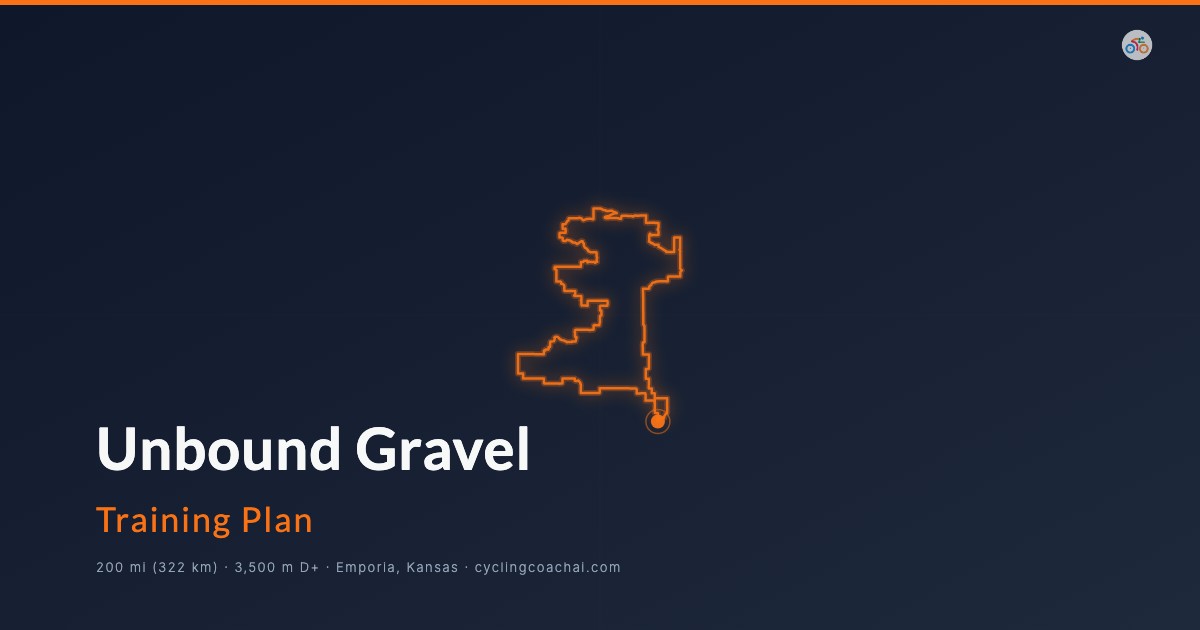
Unbound Gravel Race Overview
| Race detail | |
|---|---|
| 📍 Location | Emporia, Kansas, USA (Flint Hills region) |
| 📅 Next edition | May 28-31, 2026 |
| 🌐 Official website | unboundgravel.com |
| 📏 Distances | 200 mi (322 km) / 100 mi / 50 mi / 25 mi |
| ⛰️ Elevation gain | ~3,500m (11,500 ft) for 200-mile |
| 🏔️ Highest point | ~460m (Flint Hills, no significant altitude) |
| 🛣️ Surface | ~85-90% gravel (flint rock), ~5-10% dirt, ~5% paved |
| ⏱️ Cut-off time | ~20 hours (checkpoint cutoffs at miles 60, 120, 180) |
| 👥 Participants | ~2,500 (200-mile), ~4,500 total across all distances |
| 🎟️ Entry method | Lottery + legacy entries for returning finishers |
| 📁 GPX route | Published 2-4 weeks before race day |
Estimated Finish Times
| Estimated finish time | Approximate W/kg needed |
|---|---|
| Sub 10h (Top 100) | 4.0-4.5 W/kg |
| 10h-13h | 3.0-4.0 W/kg |
| 13h-16h | 2.2-3.0 W/kg |
| Finisher (16h-20h) | < 2.2 W/kg |
Based on sustained power output on flint gravel, neutral wind and temperature conditions. Wind, heat, tyre choice, and mechanical issues significantly affect actual finish time.
Your Unbound Gravel Finish Target
Before planning your preparation, identify your target finish time and the approximate sustained power you need to hold across 200 miles of Kansas gravel.
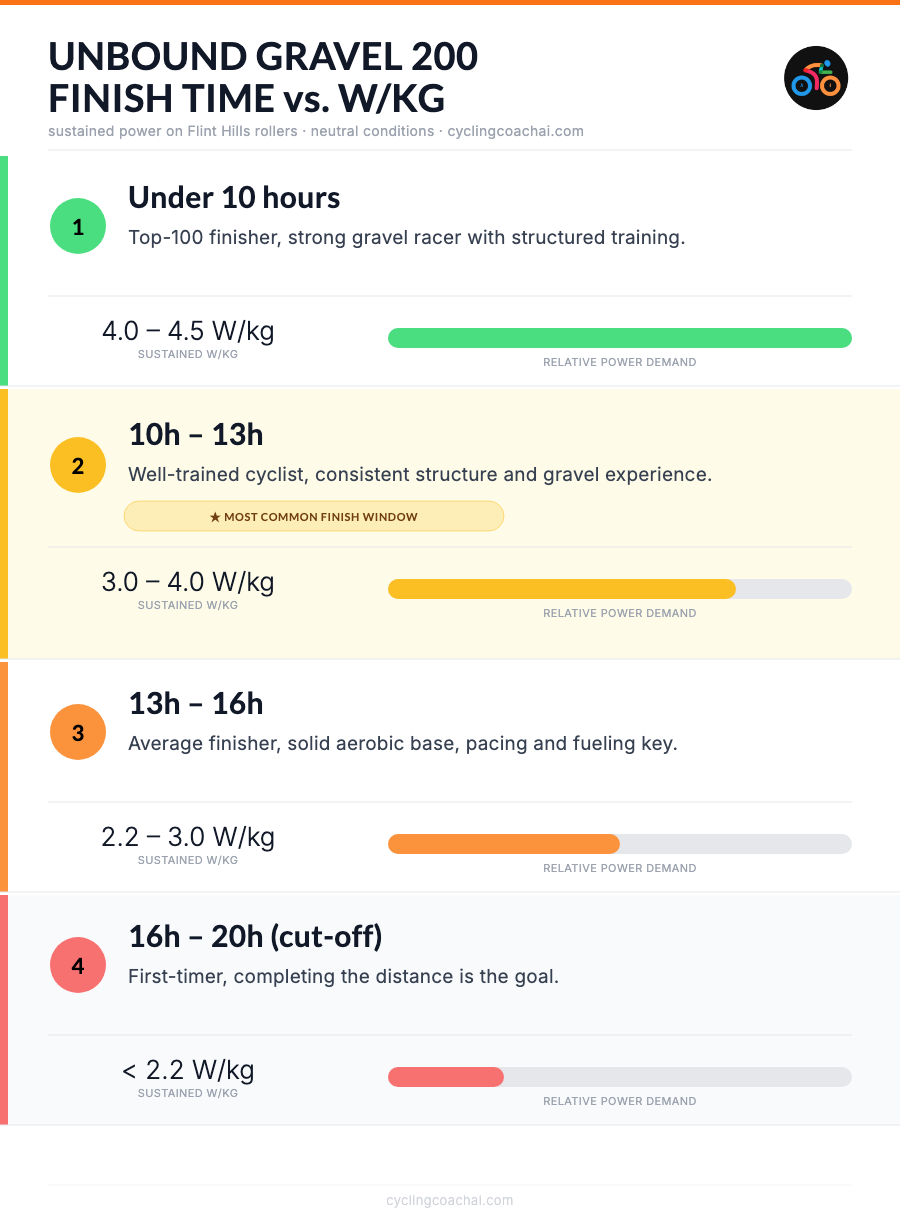
Estimates based on sustained power on flint gravel, neutral conditions. Wind, heat, and mechanical issues significantly affect actual finish time.
What Makes Unbound Gravel Unique
Most gravel events are defined by scenic beauty and a festival atmosphere. Unbound Gravel 200 is structurally different: difficulty here comes from the combination of distance, surface, wind, and heat that makes the Flint Hills one of the most demanding environments in gravel racing.
The Flint Hills surface
The course is built on flint rock gravel, sharper and more abrasive than the packed gravel found in most other events. Tyre choice and pressure become critical performance variables, not just comfort preferences. Too narrow or too high pressure and you risk multiple flats that end your race; too wide or too soft and you sacrifice rolling efficiency across 322 kilometres. The surface also changes dramatically with weather: a dry year produces loose, marble-like rock that demands constant attention, while rain transforms sections into thick, tyre-clogging mud that can stop forward progress entirely.
Kansas wind exposure
The Flint Hills are open, treeless prairie. There is no shelter from wind at any point on the course. A headwind section that should take 60 minutes on a calm day can stretch to 90 minutes, destroying any pacing plan built around speed rather than power output. Wind also increases cooling demands: riders often underestimate fluid loss when a constant breeze makes heat feel manageable while sweat rate stays dangerously high.
Heat and humidity
Late May in Kansas regularly delivers temperatures of 32-38 degrees Celsius (90-100 degrees Fahrenheit) with high humidity. At 10 to 20 hours of effort, heat tolerance becomes as important as fitness. Riders who have not heat-acclimated in the weeks before the race face significantly higher DNF rates, particularly in the exposed afternoon sections between miles 120 and 180.
Self-supported racing
Outside of the designated checkpoints at approximately miles 60, 120, and 180, riders are responsible for their own nutrition, hydration, and mechanical support. There is no neutral service. A flat tyre with no spare tube or a broken derailleur hanger 40 miles from any checkpoint means walking or waiting. Mechanical preparedness and self-sufficiency are not optional skills; they are race requirements.
Physiological Demands of the Unbound Gravel
Understanding what the race asks of your body shapes every training decision in the months before May.
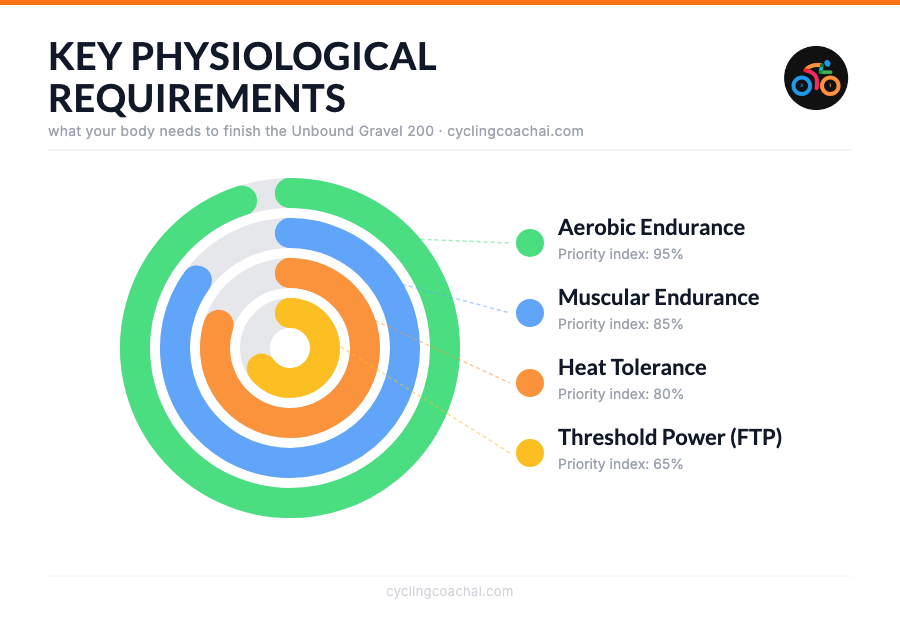
Dominant Energy System: Aerobic Endurance
The vast majority of your 200-mile effort is spent well below threshold. Your ability to sustain power at 60-75% of FTP for 10-20 hours on a rough surface, in heat, without significant glycogen depletion determines your finish time more than any other variable.
Key physiological requirements in detail:
-
Aerobic endurance (95%). At 10-20 hours, Unbound is an ultra-endurance event. Zone 2 training should comprise 75-80% of your total training volume. Your ability to sustain a high percentage of VO2max without accumulating lactate determines whether you ride strongly through the final 60 miles or slowly disintegrate after checkpoint three.
-
Muscular endurance (85%). Flint rock gravel creates constant micro-vibrations and surface irregularities that fatigue stabiliser muscles far faster than smooth tarmac. Strength training for cyclists, particularly core stability and hip hinge patterns, plays a critical supporting role. Training on gravel or rough surfaces is essential, not optional.
-
Heat tolerance (80%). Late May in Kansas is hot. Heat acclimation protocols in the final 10-14 days before the race can reduce core temperature and heart rate at any given power output by measurable amounts. Even riders in temperate climates should include deliberate heat exposure in preparation.
-
Threshold power (65%). While most of the race is sub-threshold, the ability to briefly push above threshold to clear short steep rollers, accelerate out of muddy sections, or respond to group surges is valuable. W/kg still matters, even if you spend less time near threshold than in a road race.
The relationship between aerobic capacity, heat tolerance, and ultra-endurance performance is documented in: Periard, J.D. et al. (2015). Adaptations and mechanisms of human heat acclimation. Sports Medicine, 45(Suppl 1).
Unbound Gravel Training Plan: Full Schedule
Four complete plans based on how much preparation time you have. Select the one that matches your current fitness and available time to race day. Recovery weeks reduce volume by 30-40% while keeping one quality session. The final two weeks in every plan are a taper: volume drops 40-50% while intensity is preserved.
| Day | Session | Duration |
|---|
Key Workouts for Unbound Gravel
Three sessions that directly address what the course demands:
1. Flint Hills Simulation
Session: 3x20 minutes at 85% of FTP on gravel or the roughest surface available. 5-7 minutes of easy spinning between efforts. If no gravel is available, use a mountain bike on trails or increase resistance on a smart trainer.
Why it works: The Flint Hills gravel demands sustained power output on a surface that constantly disrupts your rhythm. This session teaches your legs and core to maintain steady wattage despite vibration, traction loss, and micro-corrections. The 20-minute duration mirrors the sustained effort required between the rolling hills that characterise the course. As fitness builds, extend efforts toward 25-30 minutes or reduce rest intervals.
When to use it: Build and Race Preparation phases, once or twice per week as the primary quality session.
2. Back-to-Back Gravel Weekend
Session: Saturday: 6-7 hours at moderate intensity (Zone 2 to low Zone 3) on gravel or mixed terrain, carrying race-day nutrition and hydration. Sunday: 3-4 hours at easy pace (Zone 1-2) on any surface, no intensity work.
Why it works: Unbound is decided in the final 60 miles, when you already have 140 miles of flint rock in your legs. Back-to-back long rides teach your body to perform on pre-fatigued legs: the exact physiological state you will be in past checkpoint three. The Sunday ride is not recovery; it is the session. Practise eating and drinking at race-day rates on the Saturday ride.
When to use it: Every 3 weeks during Build and Race Preparation phases.
3. Wind Resistance Tempo
Session: 4x15 minutes at 80-85% of FTP into a headwind or on an exposed, flat road. 5 minutes of easy spinning between efforts. Hold power steady regardless of speed; do not chase a speed target.
Why it works: Kansas wind is constant and demoralising. This session builds the pacing discipline to maintain effort by power rather than speed when a 25 km/h headwind cuts your ground speed in half. The mental training is as important as the physical stimulus: learning to accept low speed while maintaining target watts prevents the surge-and-fade pattern that destroys riders in the Flint Hills wind.
When to use it: Once every 2-3 weeks throughout the plan, ideally on the windiest days available.
Nutrition Strategy for Unbound Gravel
No training plan survives contact with poor race-day nutrition at this distance. Gut training is as important as leg training for Unbound Gravel, and it needs to start in Week 1 of preparation, not the week before the race.
Target carbohydrate intake on race day: 60-90g per hour. At 10-20 hours of effort, riders who undereat in the first half consistently hit the wall after checkpoint three. The body cannot absorb more than this range without prior gut training, and even conditioned athletes need to work up to the higher end gradually. Practise consuming your target fuel intake on every long ride from Week 1 onwards.
Plan for self-supported nutrition. Between checkpoints, you carry everything. This means planning caloric density carefully: gels, chews, and concentrated drink mix weigh less and deliver more energy per gram than solid food. However, at this duration, palatability matters. Most finishers use a mix of engineered nutrition (gels, drink mix) and real food (rice cakes, PB&J sandwiches) to prevent flavour fatigue that leads to under-eating in the second half.
Hydration in Kansas heat is non-negotiable. At 32-38 degrees Celsius, sweat rates of 1-1.5 litres per hour are common. Carry capacity between checkpoints must match your sweat rate for the expected duration. Electrolyte supplementation, particularly sodium at 500-1000mg per hour, prevents the cramping and cognitive decline that heat and dehydration produce in the final 60 miles. Practise your full hydration strategy on hot training rides.
Use race-day products in training. Discovering a tolerance issue with a particular gel brand at mile 120, with 40 miles to the next checkpoint, is not recoverable. Use identical products in training and on race day. Pre-load your drop bags with exactly what you will use and nothing you have not tested.
Common Mistakes When Preparing for Unbound Gravel
Wrong tire choice for Flint Hills
The Flint Hills surface is uniquely abrasive. Tyres that work perfectly on packed European gravel get shredded on Kansas flint. Run 40-45mm tyres with puncture-resistant casings and carry at least two spare tubes plus a plug kit. Test your exact race-day tyre setup on the roughest surface you can find during training. Tyre failures are the single largest cause of DNFs at Unbound.
Going out too hard in the opening miles
The excitement of 2,500 riders rolling out of Emporia produces predictable pacing errors. Riders who go 10-15% above target power in the first 30 miles pay for it severely after mile 150. The first hour should feel easy, almost disappointingly so. Use a power meter and commit to staying below 70% of FTP for the first 60 miles regardless of what riders around you are doing.
Underestimating wind and heat exposure
Riders from wooded or mountainous regions are often unprepared for the relentless, unshielded wind and heat of the open Kansas prairie. There is no shade and no wind break for the entire course. If you train in a temperate climate, add deliberate heat acclimation in the final two weeks: ride in the hottest part of the day, add layers on the trainer, or use a sauna protocol.
Falling behind on hydration
The constant breeze makes heat feel more manageable than it is, masking sweat rate. By the time you feel thirsty, you are already significantly dehydrated. Set a timer to drink every 15-20 minutes from the start, not when you feel the need. Carry more water than you think you need between checkpoints.
Mechanical unpreparedness
Between checkpoints, there is no neutral service. A flat tyre with no spare, a broken chain with no quick link, or a seized derailleur hanger 40 miles from help means your race is over. Carry a complete repair kit: spare tubes, tyre plugs, CO2 or a mini-pump, a multi-tool, a quick link, and a spare derailleur hanger. Practise trailside repairs in training so they are routine, not panicked.
Skipping gravel-specific training
Road fitness does not transfer perfectly to gravel. The constant micro-vibrations, traction management, and bike handling demands of rough surfaces fatigue muscles that road riding barely touches. If you do not have access to gravel, substitute mountain bike trails, rough fire roads, or cobblestones. At minimum, 20-30% of your total training volume in the final 8 weeks should be on non-paved surfaces.
Adaptive Training for Unbound Gravel
A static training plan assumes every week goes perfectly. Your life and the Flint Hills do not work that way.
Cycling Coach AI builds your Unbound Gravel preparation around your actual FTP, available weekly hours, and goal finish time. Unlike a fixed plan, it adjusts dynamically as your fitness evolves: if you miss a week, it recalculates; if you improve faster than expected, it advances your loading. Every session has a purpose tied to your specific target, not a generic template.
Beyond cycling sessions, it integrates cycling-specific strength work into your weekly schedule and pairs your training load with a personalised daily nutrition plan, so your fuelling matches your actual energy demands each day. The result is a preparation that fits your real life, not the other way around.
If you are ready to stop guessing and start preparing with a plan built around your actual fitness, create your personalised Unbound Gravel training plan and arrive in Emporia knowing you did everything right.