Feeling like you've hit a plateau with your cycling?
You know that doing harder efforts is the key to getting faster, but the idea of "interval training" can feel complicated and intimidating.I promise there’s a simple, safe way to start.
You don’t need a power meter, a heart rate monitor, or a fancy training plan to begin.
This guide will show you exactly when you’re ready for intervals, how to do them using only your feeling of effort, and two simple workouts to get you started.
When Are You Ready for Intervals? (And When You're Not)
Before you jump into intensity, building a solid foundation is essential.Our cycling training plan for beginners is the perfect starting point to build consistency.
Many beginners jump into hard efforts too soon.
They see it as a shortcut to fitness, but it’s often a shortcut to burnout.
Adding intensity before you’re ready does more harm than good.
Think of it like building a house—you need a solid foundation before putting up the walls.
This isn’t about holding you back. It’s about setting you up to actually benefit from the training.
Your Readiness Checklist
Your first job is to be honest with yourself. If you can’t say "yes" to these points, your focus should be on easy, consistent riding, not intensity.- Can you ride 3 times per week consistently? If not, make that your number one goal. Consistency is the foundation of all fitness.
- Do your easy rides feel genuinely easy? If a conversational-pace ride still feels hard, your body is still adapting. Give it more time.
- Is your recovery solid? Poor sleep, lingering soreness, or constant fatigue means you need more rest, not more stress.
How to Start Intervals Without a Power Meter or Heart Rate Monitor
You don’t need any gadgets to start interval training. The most powerful tool you have is your own sense of effort.We use a simple 1-10 scale called the Rating of Perceived Exertion (RPE). 1 feels like sitting on the couch. 10 is an all-out sprint you can’t hold.
Learning to use this scale is a skill that will serve you your entire cycling career. If you’re new to the concept, understanding what RPE is and how to apply it is a great first step.
Your Beginner Intensity Anchors
Forget complex training zones. For now, you only need to learn two key feelings.- Easy (RPE 2–3): This is a relaxed, conversational pace. Use this for your warm-ups, cool-downs, and recoveries.
- "Work" Effort (RPE 6): This should feel hard but controlled. Your breathing is deep and focused. You can only speak a few words at a time.
Your recovery periods should feel truly easy. Think RPE 1-2. This allows your body to prepare for the next effort.
The golden rule for beginners: finish your session feeling like you could have done one more interval. This builds fitness without digging you into a hole.
If you do have a heart rate monitor, it helps to set clear targets first.
Calculate your cycling heart rate zones using Max HR so your “easy”, “moderate”, and “hard” efforts map to real BPM ranges.
Two Simple Interval Workouts to Get You Started
Here are two short, simple, and repeatable workouts.Your goal is to learn what these efforts feel like, not to set records.
Always warm up properly before starting.
We have a guide on what makes a good cycling warm-up, but 10-15 minutes of easy spinning is a great start.
As you get into your hard efforts, it’s also important to remember to fuel your body before a workout.
Workout 1: Short Repeats
This is the perfect first interval session. The efforts are short and manageable, with generous recovery.- Total Time: 48 Minutes
- Warm-Up: 10 minutes of easy spinning (RPE 1–3).
- Main Set: 8 repetitions of 1 minute "on" (RPE 6) followed by 2 minutes easy (RPE 1-2).
- Cool-Down: 10 minutes of easy spinning (RPE 1–2).
Workout 2: Controlled Blocks
This workout introduces a slightly longer effort to build your ability to sustain a controlled pace.- Total Time: 43 Minutes
- Warm-Up: 10 minutes of easy spinning (RPE 1–3).
- Main Set: 3 repetitions of 3 minutes "on" (RPE 6) followed by 3 minutes easy (RPE 1-2).
- Cool-Down: 10 minutes of easy spinning (RPE 1–2).
Mistakes and Signs to Back Off
Enthusiasm is great, but pushing too hard, too soon is the fastest way to halt your progress.Understanding the common pitfalls will help you train smarter.
Common Beginner Mistakes
- Doing intervals too hard: Turning every session into a race leads to burnout. Stick to "hard but controlled."
- Adding intervals before building a base: Consistency comes first. Don't skip this crucial step.
- Not taking recovery seriously: Rest is when you get stronger. Don't cut your easy periods or easy days short.
- Trying to “make up” missed workouts: Cramming sessions together creates fatigue, not fitness. Stick to the plan.
Warning Signs to Watch For
Your body gives clear signals when you're overdoing it. Learning to listen is a vital skill.- Needing longer recovery between intervals every session.
- Fatigue lasting 48+ hours after a workout.
- Sleep disruption, irritability, or loss of motivation.
- Elevated perceived effort on your easy rides.
- Persistent soreness or new aches and pains.
What Comes After Your First Intervals
You now have a safe and simple on-ramp to interval training.Remember, intervals are just one tool, not the only tool.
Smart, consistent progress is the real goal.
As you get comfortable, you’ll naturally ask, “What’s next?”
This is where a structured plan becomes essential to avoid guesswork and overtraining. If fat loss is your main goal, a dedicated 4-week cycling for weight loss plan combines these interval sessions with Zone 2 base rides into a complete weekly structure.
A tool like Cycling Coach AI can build a personalized plan that adapts as you improve.
It’s easy to get carried away.
The timeline below shows the classic path many riders take from excitement right into fatigue.
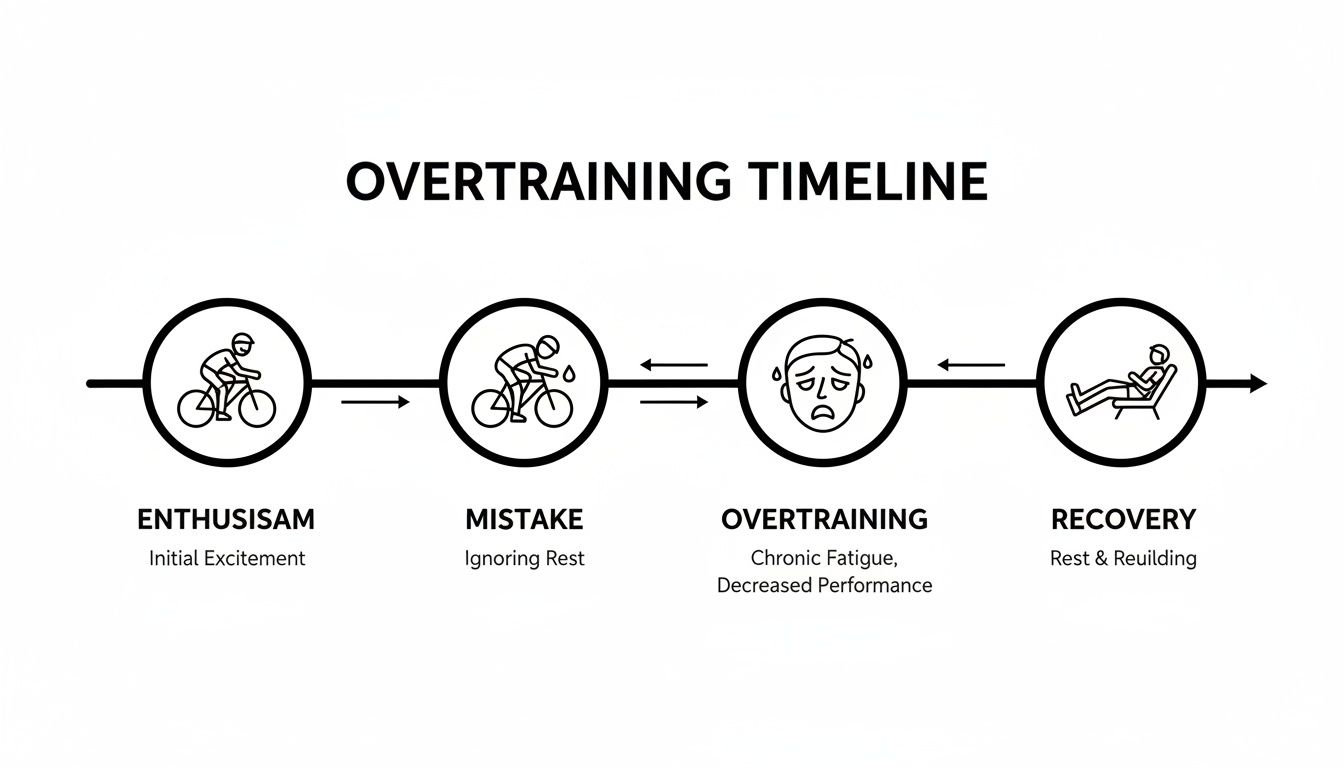
This visual is a reminder of how enthusiasm can slide into overtraining without a proper plan.
As you get fitter, you can look at how to raise your VO2 max.
But for now, focus on the foundation.
Our beginner’s cycling training plan is the perfect place to start.