50-Mile Cycling Plans: From Beginner to Intermediate Riders
Structured training plans for your first or fastest 50-mile ride. Road and gravel plans from beginner to intermediate, 8 to 16 weeks.

What is a 50-mile ride
A 50-mile ride is the first major endurance milestone for most cyclists. It bridges the gap between recreational riding and structured training, requiring 2.5 to 4 hours in the saddle depending on your pace and terrain.
Unlike shorter rides where fitness alone carries you through, 50 miles introduces the need for on-bike nutrition, pacing awareness, and mental stamina. Training specifically for this distance transforms it from a survival test into an achievable goal.
How long does it take to train for 50 miles
Most riders can prepare for 50 miles in 8 to 12 weeks, depending on their current fitness. If you can ride for 30-60 minutes comfortably, 8 weeks of structured training is sufficient. If you are starting from a lower base, 12 weeks gives your body more time to adapt.
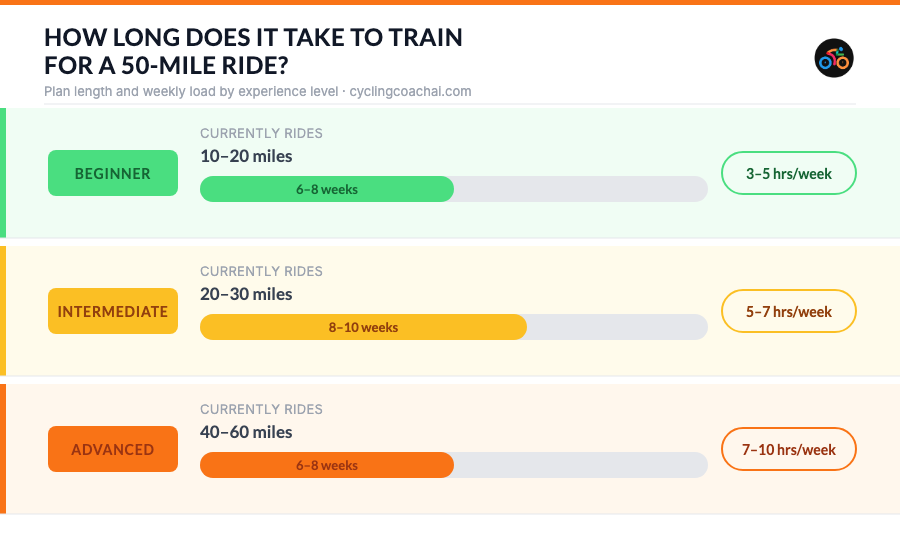
The key difference between 8-week and 12-week plans is the progression rate, not the starting point. Both begin with easy rides and build progressively. The longer plan simply gives you more weeks to adapt between increases.
How many miles per week should you train
Beginners: Start at 20-35 miles per week across 3-4 rides. The long ride starts at 60 minutes and builds to 2.5-3 hours by peak week.
Intermediate riders: Begin at 40-60 miles per week with 4-5 rides. Structured intervals are added to weekday sessions while the long ride builds progressively.
The single most important session each week is the long ride. Every other session supports it. If you can only ride 3 days per week, make one of them a long ride.
Choosing between road and gravel 50-mile plans
Road plans focus on sustained steady-state effort on paved surfaces. Pacing is predictable, drafting is possible, and nutrition is straightforward with regular access to aid stations or shops along the route.
Gravel plans prepare you for mixed-surface riding where terrain changes constantly. They require 15-25% more energy than road equivalents due to rolling resistance, include bike handling on loose surfaces, and emphasize self-supported nutrition since aid stations may be sparse.
If your event is on pavement, choose road. If it includes gravel, dirt, or mixed surfaces, choose gravel.
How to choose the right plan duration
8 weeks. You can already ride 60+ minutes comfortably and want a focused preparation block. Progression is faster week to week.
12 weeks. The most popular option. Full base phase, progressive build, and proper taper without feeling rushed. Enough room for a recovery week without losing momentum.
16 weeks. Available for intermediate riders who want extended preparation or are combining the 50-mile goal with FTP improvement.
50-mile ride pacing strategy
Pacing matters even on a 50-mile ride. The most common mistake is starting too fast because the first 15 miles feel easy. If you ride the first third above your sustainable effort, the final 15 miles will feel significantly harder than they should.
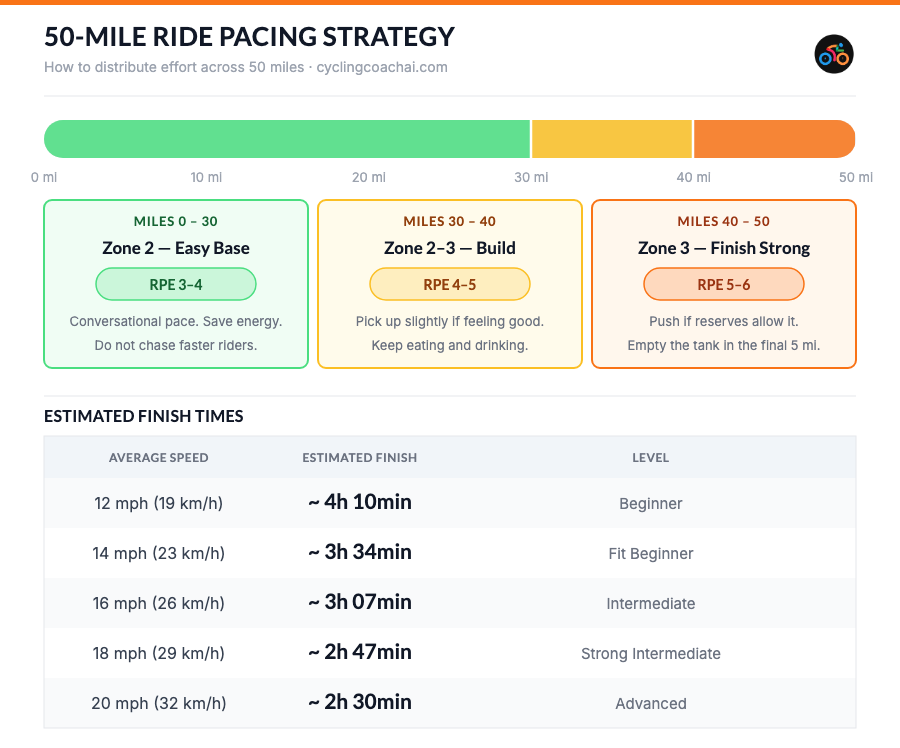
Ride the first 30 miles at a conversational effort (RPE 3-4 or Zone 2). Build slightly through miles 30-40. Only push harder in the final 10 miles if you feel strong. Negative splitting produces both the fastest times and the best experience.
Nutrition and hydration for 50 miles
A 50-mile ride is short enough that nutrition is simpler than a century, but long enough that ignoring it causes problems. Your glycogen stores fuel approximately 90 minutes of moderate cycling. After that, you need external fuel.
Under 90 minutes: Water is sufficient.
90 minutes to 3 hours: Consume 30-60g of carbohydrates per hour. A gel every 30-45 minutes or a bar every hour is enough.
Hydration: Drink 500ml per hour as a baseline. Use electrolyte mix for rides over 90 minutes.
Dehydration of just 2% body mass impairs cycling performance independently of thirst perception, reducing power output and increasing perceived effort even when riders do not feel thirsty.
Source: Wall et al., Medicine and Science in Sports and Exercise, 2019
The week before your 50-mile ride
The taper for a 50-mile ride is lighter than for a century. Reduce volume by 20-30% in the final week but keep 1-2 short sessions with brief efforts at moderate intensity to stay sharp.
3 days before: Last easy ride, 30-45 minutes maximum.
2 days before: Complete rest. Check your bike, tires, and gear.
Day before: Optional 20-minute easy spin. Eat a carb-rich dinner. Prepare your on-bike nutrition and bottles.
Morning of: Pre-ride meal 2-3 hours before start. Nothing new, only foods you have eaten before training rides.
Common 50-mile training mistakes
Never doing a long ride over 2 hours
If your longest training ride is 90 minutes, 50 miles will feel significantly harder than expected. You need at least 3-4 long rides of 2+ hours during the plan to prepare your body and mind for the duration.
Going too fast in the first 15 miles
Event-day adrenaline makes everything feel easy at the start. If you ride the first 15 miles above your target effort, you will struggle after mile 35. Discipline early pays off late.
Not eating at all
Many riders think 50 miles is "short enough" to skip nutrition. It is not. If your ride takes over 2 hours, you need carbohydrates. Start eating at minute 45, not when you bonk at mile 40.
Not testing gear before ride day
New shoes, new saddle, new shorts on ride day means new problems at mile 30. Test everything during training. Ride day should have zero surprises.
All 50 miles plans by discipline
🚴 Road
🪨 Gravel
50 Miles training plan FAQ
Common questions about 50 miles cycling training plans.
8 to 12 weeks for most riders. If you can ride 30-60 minutes comfortably, 8 weeks is sufficient. If starting from a lower base, 12 weeks gives more adaptation time.
Yes. If you can ride 30 minutes without stopping and commit to 3-4 rides per week for 8-12 weeks, a structured plan will get you there. You do not need to be fit to start.
Yes, if your ride takes over 90 minutes. Aim for 30-60g of carbohydrates per hour. Start eating at minute 45, not when you feel hungry. A gel every 30-45 minutes is enough.
Most beginners finish in 3-4 hours, averaging 13-17 mph. Do not target speed. Ride at RPE 3-4 or Zone 2 for the first two thirds and only push harder in the final 10 miles if you feel strong.
Completing 50 miles is an excellent stepping stone to 100. The endurance base, nutrition practice, and pacing awareness transfer directly. Many century plans recommend completing a 50-mile ride before starting.
Yes. All sessions can be completed indoors. Reduce ride durations by 15-20% on the trainer since there is no coasting. Do at least 2-3 long rides outdoors to practice nutrition and pacing in real conditions.