Prepare for Your Epic 200-Mile Cycling Goal
Ultra-distance training plans for 200-mile road and gravel events. Power-based programs for intermediate and advanced riders with progressive long ride builds, back-to-back training, and self-supported nutrition strategy.

What is a 200-mile ride
A 200-mile ride, also known as a double century, is the defining ultra-distance challenge in cycling. At 10-16 hours of riding time, it is a fundamentally different event from a century. Physical fitness is necessary but not sufficient. You need practiced self-supported nutrition, mental resilience strategies, fatigue management across an entire day, and potentially the ability to ride at night.
Events like Unbound 200, The Rift, and various double century rides attract riders who have already conquered 100 miles and want the next challenge. These plans prepare you for that step.
How long does it take to train for 200 miles
Training for 200 miles requires a minimum of 16 weeks for intermediate riders and 20-24 weeks for the most thorough preparation. You must have completed at least one century ride before starting. The training volume and intensity demand a solid existing base.
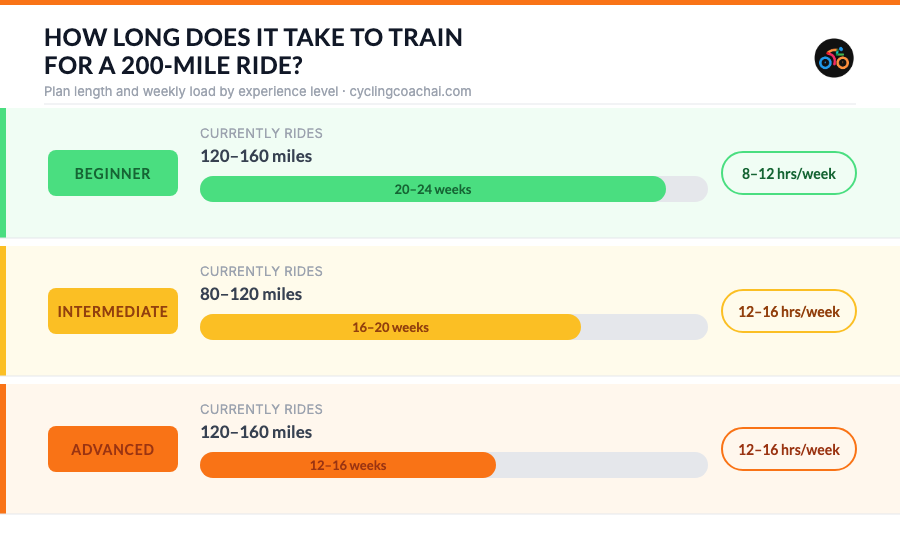
The additional weeks compared to a century plan are not just about more volume. They allow for back-to-back long ride weekends that simulate the accumulated fatigue of ultra-distance riding, multiple FTP retests, and extended nutrition rehearsal.
How many miles per week should you train
Intermediate riders: Start at 80-100 miles per week and build toward peak weeks of 140-180 miles. Back-to-back weekend rides (Saturday long ride + Sunday medium ride) are essential from the build phase onward.
Advanced riders: Begin at 120+ miles per week with structured intensity. Peak weeks may reach 200+ miles with multiple days over 4 hours.
The most important sessions are the long rides and the back-to-back days. Single long rides build endurance. Back-to-back days teach your body to perform on tired legs, which is exactly what miles 120-200 demand.
Ultra-distance nutrition strategy
At 200 miles, caloric deficit is inevitable. The goal is to minimize it. Plan for 60-90g of carbohydrates per hour for 10-14 hours. That is 600-1200g of carbs total. You need a mix of gels, bars, real food (rice cakes, sandwiches, dates), and liquid calories because your gut will reject monotony after 6 hours.
Self-sufficiency is critical. Many ultra events have 30-50 miles between aid stations. Carry everything you need between support points and practice your exact nutrition plan on every training ride over 4 hours.
In a 387-km ultra-cycling race, 39% of cyclists finished with blood sodium concentrations at or below 135 mmol/L, indicating that sodium depletion is a significant and underestimated risk in ultra-distance events. Fluid intake exceeding sweat rate, combined with insufficient sodium replacement, is the primary driver.
Source: Fluid balance of cyclists during a 387-km race, PubMed, 2014
How to choose the right plan duration
16 weeks. The minimum for intermediate riders with a strong existing century base. Compressed timeline with faster progression and fewer recovery cycles.
20 weeks. The standard and most recommended option. Full base building, two build-peak cycles, multiple FTP retests, and thorough nutrition rehearsal.
24 weeks. Maximum preparation for advanced riders targeting competitive finishes or riders building from a moderate base. Includes the deepest periodization and the most back-to-back long ride weekends.
200-mile pacing strategy
Pacing a 200-mile ride is entirely different from pacing a century. The margin for error is near zero. Going out even 5% too hard in the first quarter drains reserves you cannot recover.
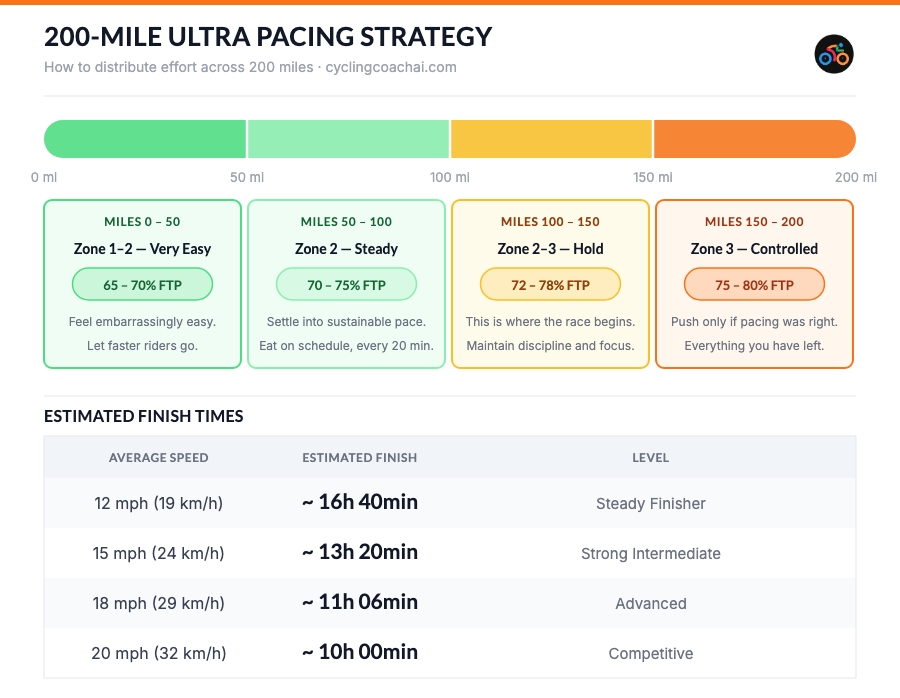
Miles 1-50: 65-70% FTP maximum. This should feel embarrassingly easy. Let faster riders go. You will see many of them again after mile 150.
Miles 50-100: Settle into 70-75% FTP. Steady, controlled, sustainable. Eat on schedule.
Miles 100-150: This is where the race begins. Maintain discipline. Do not increase effort just because you have completed a century distance.
Miles 150-200: If you have paced correctly, you have reserves here. Push to 75-80% FTP for the final quarter only if everything feels right.
Hydration and electrolyte management
At 200 miles, hydration is not just about drinking enough water. Hyponatremia (dangerously low blood sodium) is a real risk in ultra events, caused by drinking too much plain water without adequate sodium replacement.
Hydration rate: 500-750ml per hour, adjusted for temperature and sweat rate.
Sodium: Add electrolyte tabs or salt capsules to your hydration plan. An increased beverage concentration of 30-50 mmol/L sodium is recommended for events over 6 hours.
Monitoring: Weigh yourself before and after long training rides to calibrate your personal sweat rate. If you gain weight during a ride, you are overhydrating.
Mental preparation for 200 miles
Physical fitness gets you to mile 120. Mental resilience gets you to 200. After 8-10 hours, your body wants to stop. Every part of you will look for reasons to quit. Training your mind is as important as training your legs.
Break the ride into segments. Do not think about 200 miles. Think about the next aid station, the next town, the next 10 miles. Mental fatigue is the biggest enemy on an ultra ride.
Practice mental strategies during training. Use long rides (4+ hours) to develop positive self-talk, distraction techniques, and a plan for when motivation drops.
Have a plan B. Something always goes wrong on a 200-mile day: a flat, a mechanical, stomach issues, weather. Prepare contingencies so problems become obstacles, not endings.
Equipment and logistics for 200 miles
Ultra-distance riding demands more equipment planning than any other cycling discipline.
Nutrition storage: Frame bags, top tube bags, and jersey pockets must carry enough food for 30-50 miles between aid stations. Practice your exact setup on long training rides.
Hydration: Two large bottles minimum. Know where refill points are. Consider a hydration bladder for remote sections.
Lighting: If your event could extend past sunset, front and rear lights are mandatory. Test battery life during training.
Spares: Two tubes, tire plugs, CO2 canisters, and a multi-tool. At 200 miles, mechanical self-sufficiency is not optional.
Clothing: Layers for temperature changes across a 12-16 hour day. Arm warmers and a vest that pocket easily.
Common 200-mile training mistakes
Not doing enough back-to-back long days
A single long ride does not simulate ultra fatigue. Back-to-back weekend rides teach your body to perform on tired legs. Include at least 4-6 back-to-back weekends in the build phase.
Pacing the first quarter too hard
Starting at 75% FTP feels fine for the first 2 hours but drains reserves you need for hours 8-14. Pace for mile 150, not mile 50.
Not practicing night riding
If your event could extend past sunset, you need to ride in the dark during training. Navigation, visibility, and mental state change dramatically after dark.
Not testing equipment over 6+ hours
Saddle soreness, hand numbness, and contact point issues that are invisible on a 3-hour ride become debilitating at hour 8. Test everything on your longest training rides.
Underestimating mental fatigue
After 10 hours, your brain is as tired as your legs. If you have not practiced mental strategies during long training rides, you will not have them when you need them most.
All 200 miles plans by discipline
🚴 Road
🪨 Gravel
200 Miles training plan FAQ
Common questions about 200 miles cycling training plans.
Most intermediate riders complete 200 miles in 10-14 hours of riding time. Including rest stops, plan for 12-16 hours total. Terrain, weather, and wind significantly affect finish times.
Yes. These plans assume you have completed at least one 100-mile ride. The century base provides the aerobic foundation, nutrition experience, and mental framework that 200-mile training builds upon.
Plan for 60-90g of carbohydrates per hour over 10-14 hours. That is 600-1200g of carbs total, or roughly 2400-4800 calories from carbohydrate sources. You also need sodium supplementation to prevent hyponatremia.
Structured intervals and endurance sessions transfer well to indoor training. But do at least 4-6 long rides outdoors (4-6 hours) including back-to-back days to prepare for sustained posture, nutrition logistics, and mental demands.
Plans start at 16 weeks for intermediate riders with a strong century base. 20 weeks is recommended for most riders. 24 weeks provides maximum preparation with the deepest periodization.
A support crew or pre-positioned drop bags make a significant difference at 200 miles. Self-supported riding is possible but much harder. At minimum, know where aid stations and shops are along the route.